88
Part 1 - General Safety Information
Part 14 - Maintenance
C. Maintenance Only to be Performed by a Qualied Service
Technician
Removing the Cabinet Cover and Inspecting the Boiler
Before carrying out any work on the boiler, switch o the power supply
at the external power switch and circuit breaker. Close the external
gas shuto.
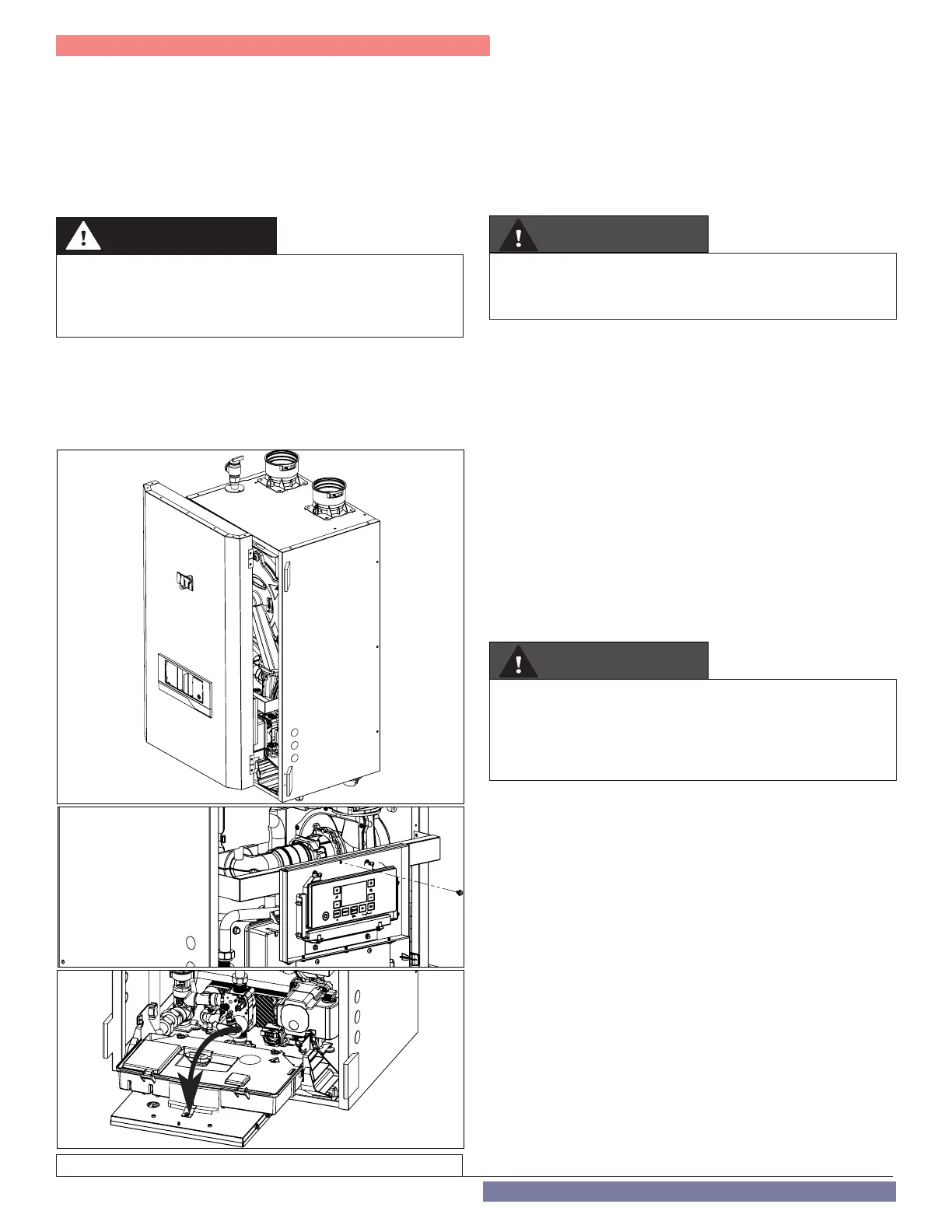
See Figure 81 to access the interior of the boiler:
1. Release the four (4) latches from the front cover (two [2] each
side). Lift and remove the front cover from the cabinet
(a)
.
2. Remove the screw securing the control panel to the cross-member
(b).
3. Push in the tabs and pull the control panel housing forward (c).
Figure 81 - Removing the Cover and Control Panel Housing
Before Starting Maintenance:
1. Ensure the power and gas remain o.
2. Close the valves of heating and hot water circuit.
3. Remove the front panel as shown in Figure 81.
4. If necessary, empty the appliance on the water side.
Draining Procedure
To drain the heating system:
1. Ensure the boiler power and gas remain o.
2. Open the manual purge valve.
3. Open the system drain valve and collect the escaping water in a
container.
4. Drain the water from the lowest points of the system (where
applicable).
If the system is to be inactive in areas where the room temperature
may fall below 0°C during winter, it is recommended that anti-freeze
liquid be added to the heating system in order to avoid the need for
repeated draining. Ensure the antifreeze used is compatible with the
stainless steel boiler heat exchanger.
Check Water and Gas Piping
1. Remove the boiler cover and perform a gas leak inspection following
Operating Instructions on page 2 of this manual. If gas odor or leak
is detected, follow procedures on page 2. Call a qualied service
technician.
2. Visually inspect for leaks around the boiler water connections
and around the heat exchanger. Visually inspect the external
system piping, circulators, and system components and ttings.
Immediately call a qualied service technician to repair any leaks.
It is recommended to use antifreeze which contains PROPYLENE
GLYCOLS as these inhibit corrosion. Use the quantities and formulation
suggested by the antifreeze manufacturer to protect against freezing
in your region and prevent scaling and corrosion.
Regularly check the pH level of the water/anti-freeze mix in the boiler
circuit and replace it when the value measured is lower than the limit
prescribed by the manufacturer.
DO NOT MIX DIFFERENT TYPES OF ANTI-FREEZE.
The manufacturer will not be held liable for any damage caused by
the appliance or the system due to the use of inappropriate antifreeze
substances or additives.
Draining the DHW System and Indirect Water Heater
Every time there is a danger of freezing, the domestic hot water system
must be drained as follows:
1. Shut o the main water inlet valve.
2. Open all the hot and cold water taps.
3. Drain the water from the lowest points of the system.
WARNING
WARNING
Ensure power and gas to the appliance are shut off before
performing the following operations. Failure to do so will
result in substantial property damage, severe personal
injury, or death.
Have leaks xed at once by a qualied service technician.
Failure to comply could result in substantial property
damage, severe personal injury, or death.
NEVER use any toxic chemical, including automotive,
standard glycol antifreeze, or ethylene glycol made for
hydronic (non-potable) systems. These chemicals can
attack gaskets and seals in water systems, are poisonous if
consumed, and can cause personal injury or death.
DANGER
3. If applicable, check the condensate neutralizer and ensure it is full
of condensate neutralizing marble chips.
(b)
(a)
(c)



 To Next Page