54
Part 1 - General Safety Information
Part 8 - Gas Connections
A. Gas Pipe Sizing Tables
1. Gas Pipe Sizing
This information is for reference use only. Refer to gas pipe manufacturer
specications for actual delivery capacity. The DOE standard for Natural
Gas is 1100 BTU/ft
3
. Contact the local gas supplier for actual BTU/ft
3
rating.
2. Natural Gas Pipe Sizing
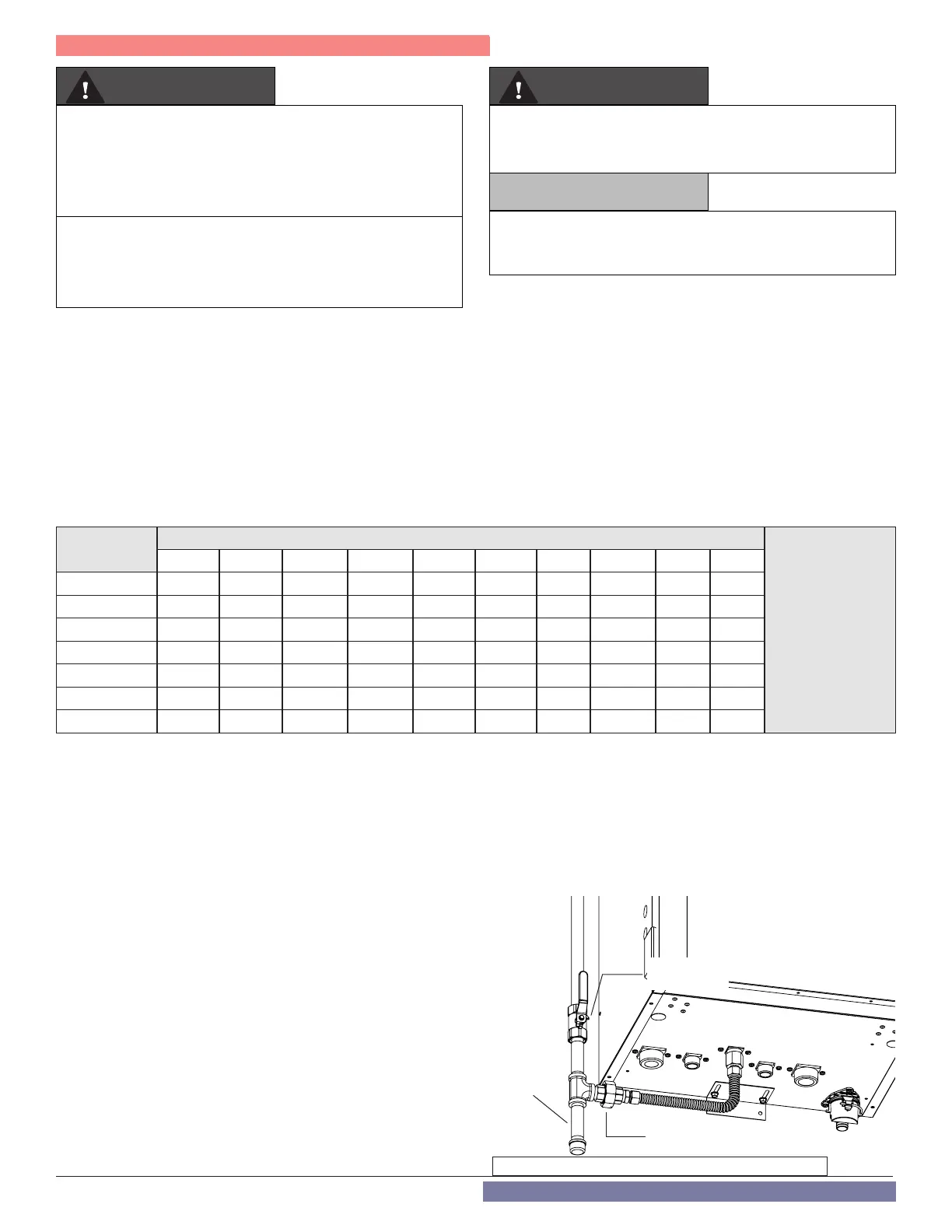
The following tables list maximum capacity of pipe in cubic feet of
gas per hour for gas pressures of 14” or less and a pressure drop of 0.5
inches water column, based on a 0.60 specic gravity for natural gas.
Pipe Size (in.)
Length of Pipe (Feet)
BTU’s Per Hour x
1,000
Schedule 40
Metallic Pipe
(0.60 Specic
Gravity,
0.5 WC Pressure
Drop)
10 20 30 40 50 60 80 100 150 200
3/4 360 247 199 170 151 137 117 104 83 71
1 678 466 374 320 284 257 220 195 157 134
1 1/4 1390 957 768 657 583 528 452 400 322 275
1 1/2 2090 1430 1150 985 873 791 677 600 482 412
2 4020 2760 2220 1900 1680 1520 1300 1160 928 794
3 11300 7780 6250 5350 4740 4290 3670 3260 2610 2240
4 23100 15900 12700 10900 9660 8760 7490 6640 5330 4560
Table 20 - Natural Gas Delivery Capacity - Refer to ANSI Z223.1 - National Fuel Gas Code, Latest Edition
3. LP (Liquid Propane) Gas Pipe Sizing
Contact gas supplier to size pipes, tanks, and 100% lockup gas pressure
regulator. Adjust propane supply regulator provided by the gas
supplier for 14 inches w.c. maximum pressure.
B. Gas Connection Requirements
1. The gas connection tting is ¾” NPT.
NOTE: The gas pipe size must not be less than ¾”.
NOTE: DO NOT USE 1/2” quick ex gas lines! Doing so will result in
improper appliance operation.
2. The supply line must be sized for the maximum input of the boiler
being installed. If there are additional gas appliances on the main
supply line, measure the size of the supply line according to the
COMBINED total maximum BTUH draw for the appliances as if they
were operating at the same time.
3. Measure the length of the gas supply line from the gas meter to the
boiler. The boiler must be installed downstream of the gas meter to
ensure adequate gas supply. Use the tables in this manual or refer
to the gas line manufacturer’s sizing information to determine the
correct supply pipe size.
4. The National Fuel Gas Code (NFPA 54) requires that a sediment trap
(drip leg) be installed in the gas line on boilers not so equipped.
The drip leg must be accessible, a minimum of 3” in length, and not
subject to freezing conditions. See Figure 54.
5. A manual gas shut-o valve should be installed in the gas supply
line close to the boiler. See Figure 54.
6. To facilitate any future maintenance, it is also recommended that an
approved gas union tting be installed in the supply line between
the shut-o valve and the ¾” NPT connection on the boiler.
FIRE AND/OR EXPLOSION HAZARD
To avoid serious injury or death, the gas line
installation and the gas line inlet pressure test
must be done by a licensed professional.
Ensure the gas on which the boiler will operate is the same type specied
on the rating plate (natural gas or LP gas). This boiler must be converted
to propane operation. Follow Gas Conversion Manual instructions
(separate document). Failure to follow these instructions could result in
property damage, personal injury, or death.
Make sure the gas line pressures are within normal limits. Pressures
outside normal limits can result in poor performance and hazardous
operating conditions, property damage, personal injury, or death.
WARNING WARNING
Do not operate the boiler on Natural Gas or LP gas with average sulfur
rates greater than 30 mg/m3. Doing so could result in improper
product operation and failure, and WILL VOID the boiler warranty.
NOTICE
Figure 54 - Gas Line with Shut-O and Sediment Trap Detail
Manual Gas
Shut-o Valve
Sediment
trap
Union



 To Next Page