Chapter 1 5
Introduction
stantially longer than the background analyte-free emission. Improvement in
detectivity (see Appendix B) and selectivity for sulfur and phosphorus is obtained
by using gated integration that rejects the unwanted CH*, C
2
*, and OH* chemilu-
minescence responses. (Refer to Chapter 5 for further discussion of PFPD opera-
tional parameters settings to optimize chemiluminescence responses.)
Since the PFPD is a pulsed detector (generating pulsed chemiluminescence), the
electronics are significantly different from the traditional FPD electronics. For the
PFPD, the most basic pulsed electronics consist of a fast electrometer, an event
(threshold) detection circuit, and a gated integrator. The output from the photomul-
tiplier tube is initially amplified by a fast electrometer. The subsequent output
signal is then digitized and passed through a gated integrator. The integration
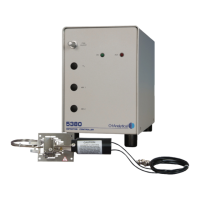
interval is defined by the operator specified gates. The Detector Controller then
converts this electronic signal to an analog signal that is proportional to the inte-
grated signal.
The operator’s ability to optimize the operation of the PFPD is facilitated by the
use of WinPulse, a Windows
®
-based software package developed by OI Analytical.
WinPulse permits the operator to set up and optimize all of the PFPD’s operating
parameters. After these parameters have been uploaded to the Detector Controller,
the software is no longer required for the continued operation of the PFPD. If the
chromatographic conditions change dramatically, the operator can reactivate
WinPulse to reprogram the operational parameters.
Features
• Ability to “tune” selectivity of the PFPD results in fewer false positive identifi-
cations and decreasing the need for additional sample preparation.
• Improved sensitivity compared to many standard FPDs makes it easier to
detect lower quantities of trace-level contaminants and decreases the need for
sample concentration.
• Saves operational gas costs by using only 10% of the gas flow rate of standard FPDs.
• Equimolar sulfur chemiluminescence response that is independent of a
compound’s molecular structure allows calibration for complex samples.
• Real-time dual analog outputs enable acquisition of information for two
elements simultaneously.
• Optimization possible for up to 28 different elements.
• Automated timed events can be set for most detector parameters, which can
extend the performance range of a detector for a given application and often
minimizes the need for complicated chromatographic solutions to difficult
applications.
• No soot formation as a result of “self-cleaning” design.


 To Next Page