ICover
Glass
I
• An
Olympus
objective engraved "16010.17" requires a cover
glass
of
0.17mm
thickness.
If
the
numerical aperture
of
the objective
is
0.7
or
higher (except immersion objectives)
and
no correction collar
is
provided, the resolving power deteriorates greatly,
if
cover
glass
thickness deviates
from
the above listed value.
NOTE:
In some countries a 0.17
mm
thick
cover
glass
corresponds
to
a #1
Y,
cover
glass.
• A cover
glass
(0.4
mm
thick)
for
blood
counting, etc.
can
be
used
with
Olympus
objectives
except 0 Plan
40X.
S Plan
Apo
40X
and S Plan lOOX.
ISpecimen Slide I
• Specimen slides 0.8 mm
to
1.5 mm
thick
are
recommended for
Olympus
objectives.
• Specimen slides 0.8
mm
to
1.2
mm
thick
are
recommended for, the
dark
field condenser
and the
dj
fferential interference contrast
con~
denser.
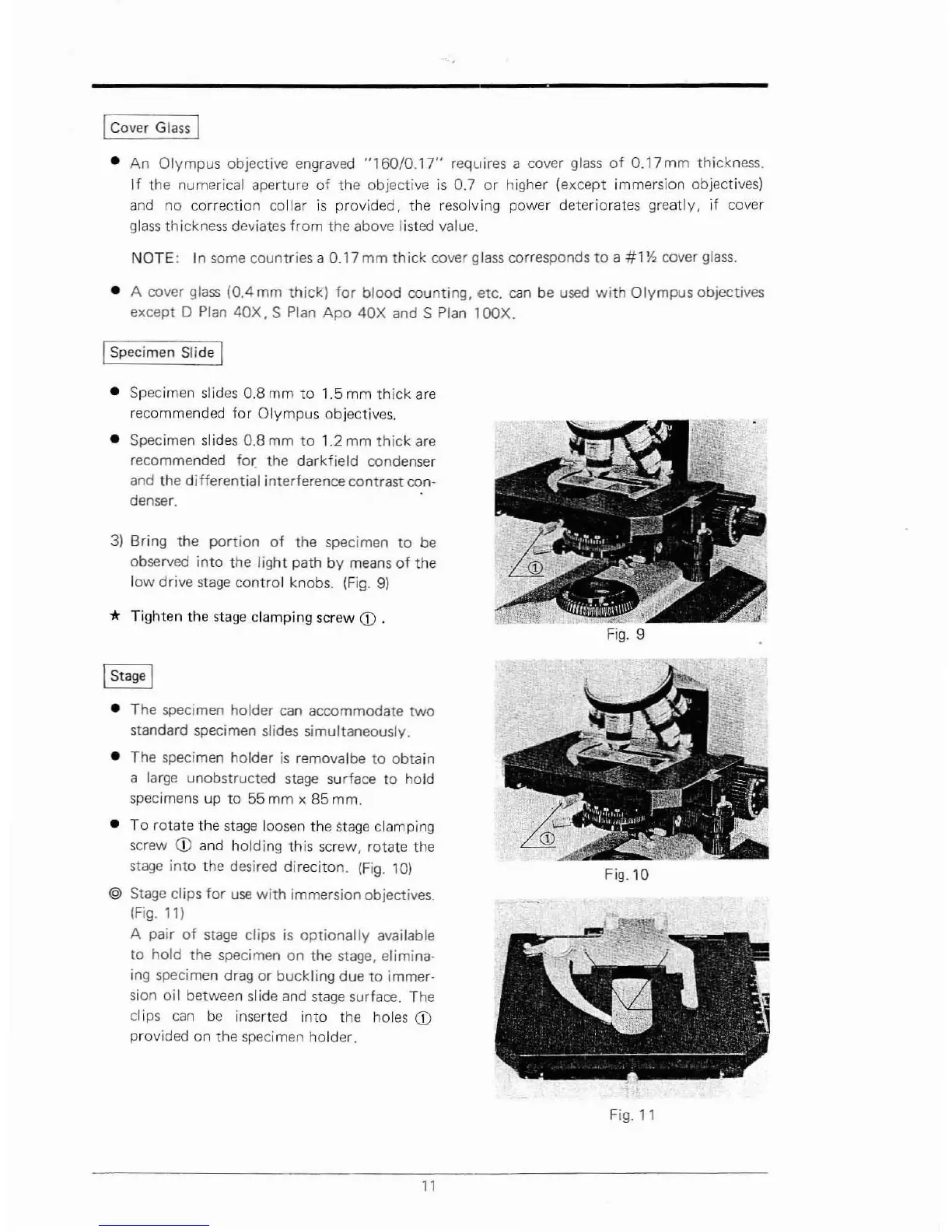
3) Bring the
portion
of
the specimen
to
be
observed
into
the
light path
by
means
of
the
low
drive
stage
control
knobs.
(Fig.
9)
* Tighten the
stage
clamping screw
<D
.
I
Stage
I
•
The
specimen holder
can
accommodate
two
standard specimen slides simultaneously.
• The specimen holder
is
removalbe
to
obtain
a large unobstructed stage surface to hold
specimens up
to
55 mm x
85
mm.
•
To
rotate the
stage
loosen the
$tage
clamping
screw
CD
and holding this screw, rotate the
stage
into
the desired direciton.
(Fig.
10)
@ Stage clips
for
use
with
immersion objectives.
(Fig.
111
A pair
of
stage clips
is
optionally
available
to hold the specimen
on
the stage, elimina-
ing specimen drag
or
buckling
due
to
immer-
sion
oil
between slide and stage surface. The
cI
ips
can
be
inserted
into
the holes
CD
provided on the specimen holder.
11
Fig.10
Fig.
11



 To Next Page