F.
Use
of
Immersion Objectives
1)
Focus the specimen
with
a
low
power
objective.
2)
Put a
drop
of
immersion
oil
on the specimen slide and the
front
lens
of
the immersion
objective.
3)
Rotate the revolving nosepiece
to
bring the immersion objective
into
the light path, and
focus
with
the fine adjustment knobs.
NOTE:
ill
For
immersion condensers such
as
an
achromatic-aplanatic condenser
or
Abbe
condenser, remove the specimen
from
the
mechanical stage and place a
drop
of
immersion
oil
on
the
front
lens
of
the condenser. Then, place
the
specimen
on
the
stage
and slowly raise
the
condenser
until
firm
contact
with
the underside
of
the specimen slide
is
made.
® Care should be taken
to
prevent
oil
bubbles
from
forming
in
the
oil
film
between
condenser and specimen slide.
If
any bubbles appear, re-apply immersion
oil,
for
these bubbles greatly deteriorate
the
lens performance.
®
After
use.
carefully wipe
off
the immersion
oil
deposited
on
the lens surfaces
with
gauze moistened
with
xylene. Never leave oil on the lens surfaces
after
use
as
oil
remnants
will
seriously impair the perforrrance
of
the
lens
system.
,
G. Photomicrography
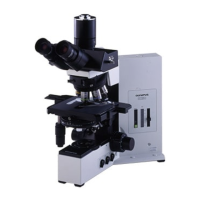
The
Olympus
Photomicrographic Equipment Model
PM-lOAO
is
uniquely
qualified
to
be
used
with
the
BHTU
microscope
for
routine
and advanced
photomicrography.
A separate,
detailed instruction manual
is
available for the
PM-lOAD
camera system.
For
quick
reference, however,
you
may want
to
refer
to
the
following
pointers when using
the
PM-lOAD.
1.
Photographic Eyepiece
Use
NFK
photo
eyepieces
for
photomicro-
graphy.
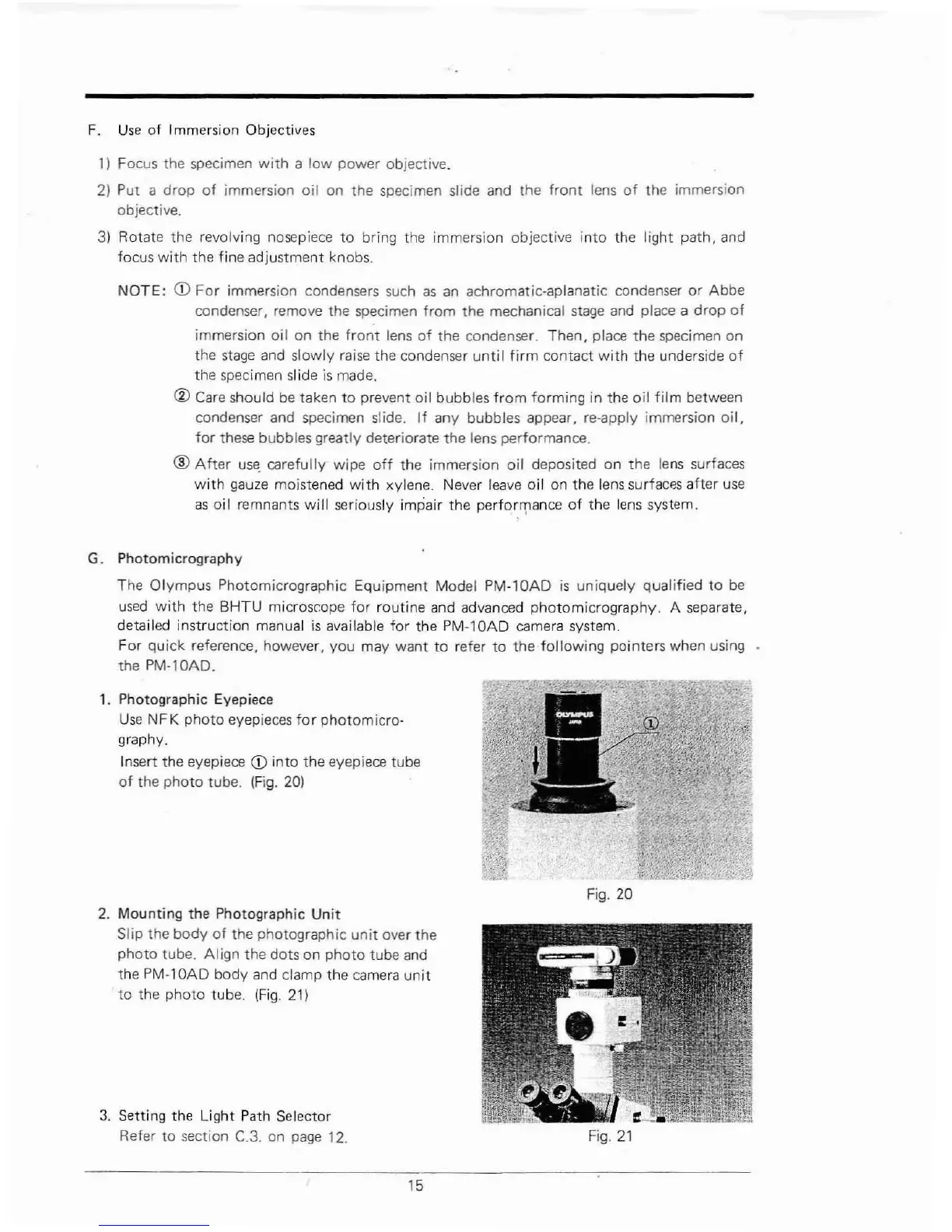
Insert
the
eyepiece
CD
into
the eyepiece tube
of
the
photo
tube.
(Fig.
20)
Fig. 20
2.
Mounting
the Photographic
Unit
Slip the
body
of
the photographic
unit
over the
photo
tube.
Align
the
dots on
photo
tube
and
the PM-
lOAD
body
and clamp the camera
unit
to
the photo tube.
(Fig.
211
3.
Setting the Light Path Selector
Refer
to
section C.3. on
page
12.
15



 To Next Page