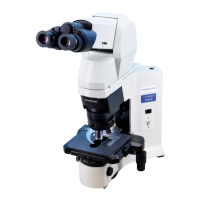
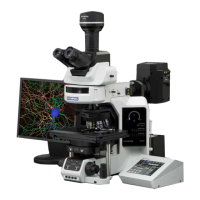
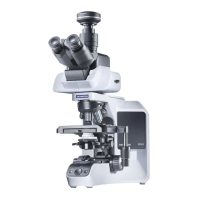
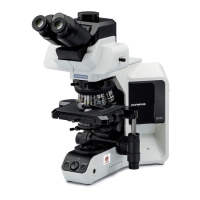
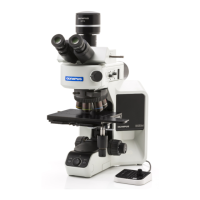
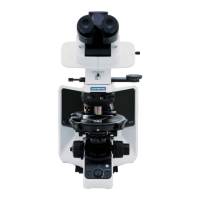
This document serves as the instruction manual for the Olympus BXFM System Microscope, an optical microscope designed for industrial applications. It details the setup, operation, and maintenance of the device, emphasizing safety and optimal performance.
Function Description
The Olympus BXFM System Microscope is engineered for observing magnified images of specimens in industrial settings. Its primary applications include observation, inspection, and measurements of various materials such as semiconductors, electrical components, molded articles, and mechanical parts. The microscope supports a wide array of observation methods, including reflected light brightfield, darkfield, simple polarization, differential interference contrast (DIC), fluorescence, and infrared observation. The system is built around the UIS2 (UIS) optical system, ensuring high-quality imaging when used with compatible components like eyepieces, objectives, observation tubes, and condensers.
Important Technical Specifications
The BXFM frame, model BXFM-F, features a vertically movable objective with a movable range of 30 mm. Its coarse focusing knob offers a moving distance per one rotation of 0.2 mm, with a coarse focusing range of 36 mm. The fine focusing knob provides a moving distance per one rotation of 0.1 mm, with a fine focusing range of 10 mm. The system is equipped with a tension adjustment mechanism for the coarse focusing knob.
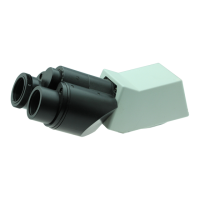
Various observation tubes are compatible, including binocular tubes like U-BI30-2 (field number 22) and trinocular tubes such as U-TBI-3 (field number 22, tilting type), U-SWTR-3 (field number 26.5), U-SWETTR-5 (field number 26.5, tilting type, for upright image observation), U-TR30-2 (field number 22), U-TR30IR (field number 22, for infrared observation), U-ETR-4 (field number 22 for upright image observation), and U-TTR-2 (field number 22, tilting type).
Illuminators for reflected light observation include:
- BX3M-KMA-S: For brightfield/DIC/simple polarization observations, built-in LED light source.
- BX3M-RLA-S: For brightfield/darkfield/DIC/simple polarization/infrared observations.
- BX3M-RLAS-S: For brightfield/darkfield/DIC/simple polarization observations, coded type, built-in LED light source.
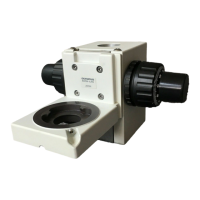
- BX3M-URAS-S: For brightfield/darkfield/simple polarization/fluorescence/infrared observations, coded type, detachable mirror unit.
- U-KMAS: For brightfield/DIC/simple polarization observations, field number 26.5.
Light sources for reflected light illumination include:
- LED lamp housing (BX3M-LEDR): White LED, maximum current 700 mA.
- Halogen lamp housing (U-LH100L-3, U-LH100IR): Applicable bulb 12V100WHAL (7724 made by PHILIPS), 12V100WHAL (7023 made by PHILIPS). Average bulb lifetime is approximately 2,000 hours (U-LH100L-3) or 100 hours (U-LH100IR). Bulb voltage adjustment range: DC 10.0 V to 12.0 V.
- Mercury lamp housing (U-LH100HGAPO, U-LH100HG): Applicable burner USH-103OL (made by Ushio Co.). Average burner lifetime is approximately 300 hours.
- Light source for light guide illumination (U-HGLGPS): Applicable burner SHI-103OL (made by Ushio Inc.), light guide U-LLG150, U-LLG300, light guide adapter U-LLGAD.
The microscope supports various nosepiece types:
- Manual type: U-RE-2 (5 holes), U-D6RE (6 holes, detachable slider, support ESD), U-D5RE (5 holes, detachable slider), U-D4RE (4 holes, detachable slider), U-D5BDRE (5 holes, darkfield observation available, detachable slider), U-D6BDRE (6 holes, darkfield observation available, detachable slider), U-5RES-ESD (5 holes, support ESD).
- Coded type: U-D5RES (5 holes, detachable slider), U-D6RES (6 holes, detachable slider), U-D5BDRES-ESD (5 holes, darkfield observation available, detachable slider, support ESD), U-D6BDRES-S (6 holes, darkfield observation available, detachable slider, support ESD).
- Motorized type: U-D5BDREMC (5 holes, darkfield observation available, detachable slider), U-D6REMC (6 holes, detachable slider), U-D6BDREMC (6 holes, darkfield observation available, detachable slider).
Sliders for differential interference contrast include U-DICR (standard type), U-DICRH (high resolution type), and U-DICRHC (high contrast type). For MIX observation, the U-MIXR slider is equipped with LED ring illumination, light control by hand switch.
Operating environment requirements:
- Indoor use only.
- Altitude: Max. 2,000 meters.
- Ambient temperature: 5 to 40 °C (41 to 104 °F).
- Maximum relative humidity: 80% for temperatures up to 31 °C (88 °F) (without condensation), decreasing linearly through 70% at 34 °C (93 °F), 60% at 37 °C (99 °F), and 50% at 40 °C (104 °F).
- Supply voltage fluctuations: Not to exceed ±10% of the nominal voltage.
- Pollution degree 2 (in accordance with IEC60664-1).
- Installation/Overvoltage category: II (in accordance with IEC60664-1).
Usage Features
The manual provides detailed procedures for basic operations and various observation methods.
- Turning ON the main switch: Instructions vary depending on the control box (BX3M-CB or U-CBS) and specific lamp housings (mercury, light source, halogen, LED).
- Selecting observation method: This involves using selector knobs or turrets on illuminators like BX3M-RLAS-S, BX3M-KMA-S, BX3M-RLA-S, or BX3M-URAS-S to choose between brightfield, darkfield, DIC, polarization, or fluorescence.
- Changing light path: A light path selection lever on trinocular tubes allows switching between eyepiece and camera light paths (e.g., 100% eyepiece, 20% eyepiece/80% camera, 100% camera).
- Placing a sample: Samples are placed on the stage plate, secured with a specimen holder.
- Selecting objective: Objectives are selected by turning the nosepiece. For motorized nosepieces, a hand switch (BX3M-HSRE) is used.
- Focusing: The BXFM frame moves vertically using coarse and fine focusing knobs. The tension of the coarse focusing knob is adjustable.
- Adjusting brightness: Brightness is adjusted via control knobs on the LED lamp housing (BX3M-PSLED), halogen lamp housing (TH4), or mercury lamp housing. For light sources like U-HGLGPS, a dial adjusts light volume in 7 levels.
- Adjusting observation tube: Includes tilting adjustment for comfortable viewing, using eye shades, adjusting interpupillary distance, and adjusting diopter for individual eye focus.
- Adjusting diaphragms: Field and aperture diaphragms for reflected light illumination are adjusted using knobs or levers to optimize contrast and resolution. Centering procedures are provided for both diaphragms.
- Centering mercury burner: Essential for mercury lamp housings (U-LH100HG/U-LH100HGAPO) to ensure uniform illumination.
- Inserting filters: Reflected light illumination filters (e.g., ND filters, color conversion filters, band-pass filters) are inserted using levers or sliders.
- Specialized observation methods: Detailed steps are provided for darkfield, simple polarization, DIC, fluorescence, infrared, and simultaneous BF/DF observations, including setting analyzers, polarizers, DIC sliders, and MIX sliders.
- Oil immersion objectives: Specific instructions for using oil immersion objectives, including applying immersion oil and cleaning.
Maintenance Features
The manual outlines several maintenance and preventive inspection guidelines:
- Cleaning: Regular cleaning of lenses, filters, and other optical components with a blower, lens paper, or cotton swabs moistened with absolute alcohol.
- Lamp replacement: Procedures for replacing halogen bulbs and mercury burners, emphasizing safety precautions such as disconnecting power and allowing components to cool.
- Preventive inspection sheet: A checklist for periodic inspections (every 6 months or with lamp replacement) covering various aspects of illumination devices, including lamp functionality, physical condition, and wiring. This helps identify potential issues early and ensures safe operation.
- Troubleshooting: A comprehensive section addressing common phenomena, their causes, and remedies for optical systems, focusing, and observation tubes. Examples include dark fields of view, image blur, flickering lights, and issues with diaphragm centering.
- Power cord selection: Guidance on selecting the appropriate power supply cord based on country-specific regulations and certifications to ensure electrical safety and EMC performance.
The document stresses the importance of using only Olympus-approved components and following all instructions to maintain safety, performance, and product longevity.

 Need help?
 General

 To Next Page