3-20
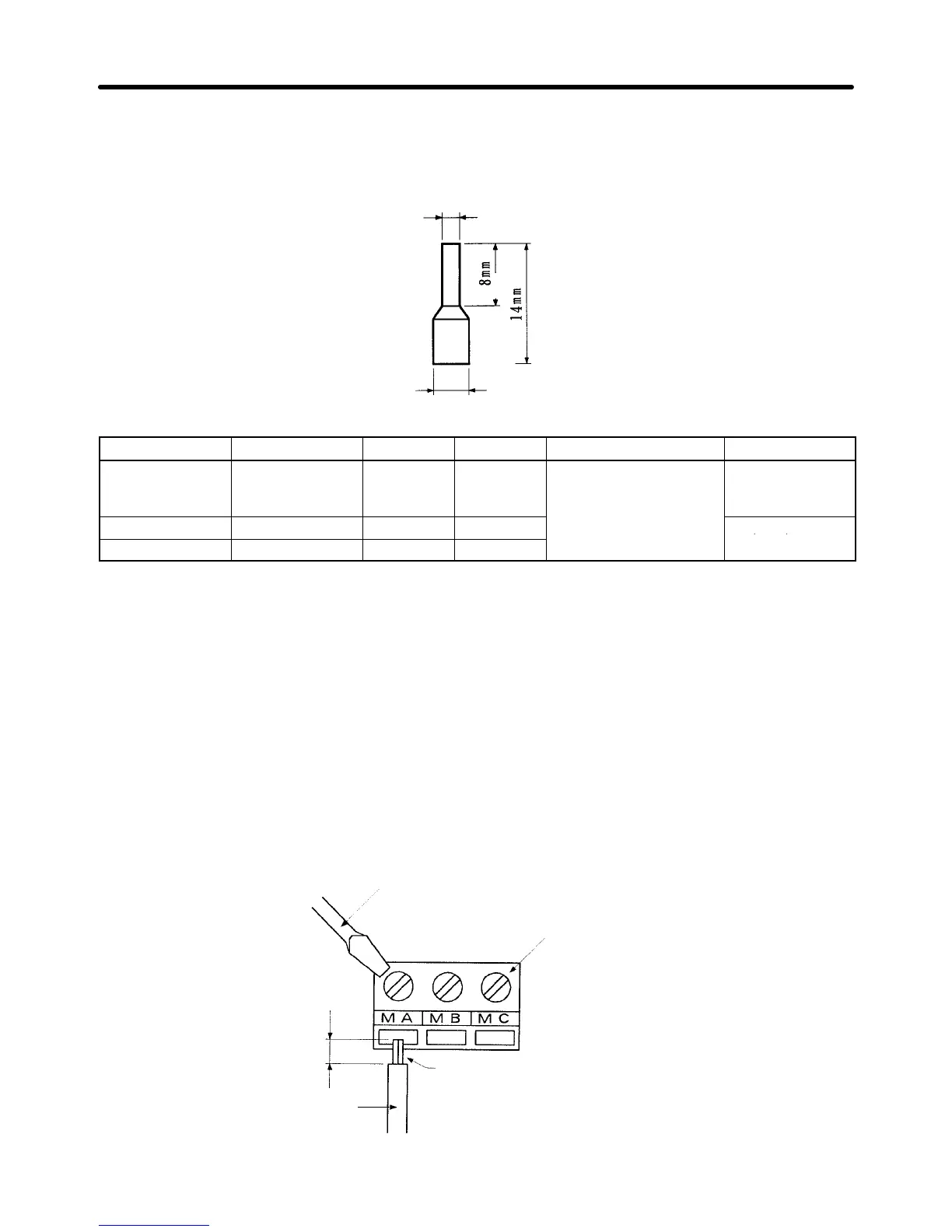
D Solderless Terminals for Control Circuit Terminals
The use of solderless terminals for the control circuit terminals is recommended because solderless
terminals are easy to connect securely.
d1 dia.
d2 dia.
Wire thickness Model d1 d2 Manufacturer Terminal
0.5 mm
2
A1 0.5-8WH 1.00 2.60
Phoenix Contact
SF, SR, S1 to
S3, SC, FS, FR,
FC
0.7 mm
2
A1 0.75-8GY 1.20 2.80
MA, MB, MC
1 mm
2
A1 1-8RD 1.40 3.00
D Wiring Method
• Wire each terminal as follows:
a) Loosen the terminal screw with a thin-slotted screwdriver.
b) Insert the wire from underneath the terminal block.
c) Tighten the terminal screw firmly.
• Always separate the control signal line from the main circuit cables and other power cables.
• Insulate the shielded sections with insulation tape, etc., from other signal lines or equipment and
ground on the Inverter side.
Thin-slotted screwdriver
Length of stripped
portion: Approx. 5.5 mm
Wire
Control circuit
terminal block
Do not solder this portion.
(Otherwise, faulty contact may result.)
Design Chapter 3



 To Next Page