T5 Flare Gas Transducer Installation Guide 31
Chapter 3. Installing the Transducer Assemblies
Chapter 3. Installing the Transducer Assemblies
3.1 Introduction
Transducers and their holder assemblies are installed into a meter body, which is a section of pipe that contains the
ports for mounting the transducer assemblies. The meter body may be prefabricated or created by installing ports
on an existing pipe. The transducers can be inserted into the meter body using the following holder methods:
• Low-pressure insertion mechanism
• Barrel holder
• Flanged holder
Note:
As an example, this chapter describes the use of the low-pressure insertion mechanism type only.
3.2 Using the Low-Pressure Insertion Mechanism
Note:
The
Low-Pressure Insertion Mechanism
is designed for manual (non-assisted) transducer insertion into
operating pipes at low pressure. The mechanism uses an isolation valve and a packing gland for sealing.
Inserting the transducers into the pipe requires the following steps:
• Preparing for installation
• Mounting the insertion mechanism
• Inserting the transducer into the pipe
• Aligning the transducers
3.2.1 Preparing for Installation
Before you begin, find a work area where you can stand the insertion mechanism upright without placing any weight
on the transducer (e.g., a bench with a cutout large enough for the transducer to slide through).
You will need the following items for installation:
• A packing tool (may be shipped with the flowmeter)
• A gasket for the isolation valve
• A straight edge ruler
• A tag to place on the isolation valve
• Bolts
3.2.2 Mounting the Insertion Mechanism
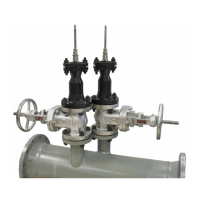
1. Before mounting the insertion mechanism on the isolation valve you should familiarize yourself with its
components (see the figure below):
• Junction box
• Barrel
• Packing gland
• Transducer
Note:
Explosion-proof junction boxes are not pre-mounted on the end of the transducer when shipped.
WARNING! The manual insertion mechanism is used for low-pressure applications (80 psig/6.5
bar absolute or less). Use the appropriate safety precautions when inserting or
withdrawing the insertion mechanism.


 To Next Page