PAGE 46
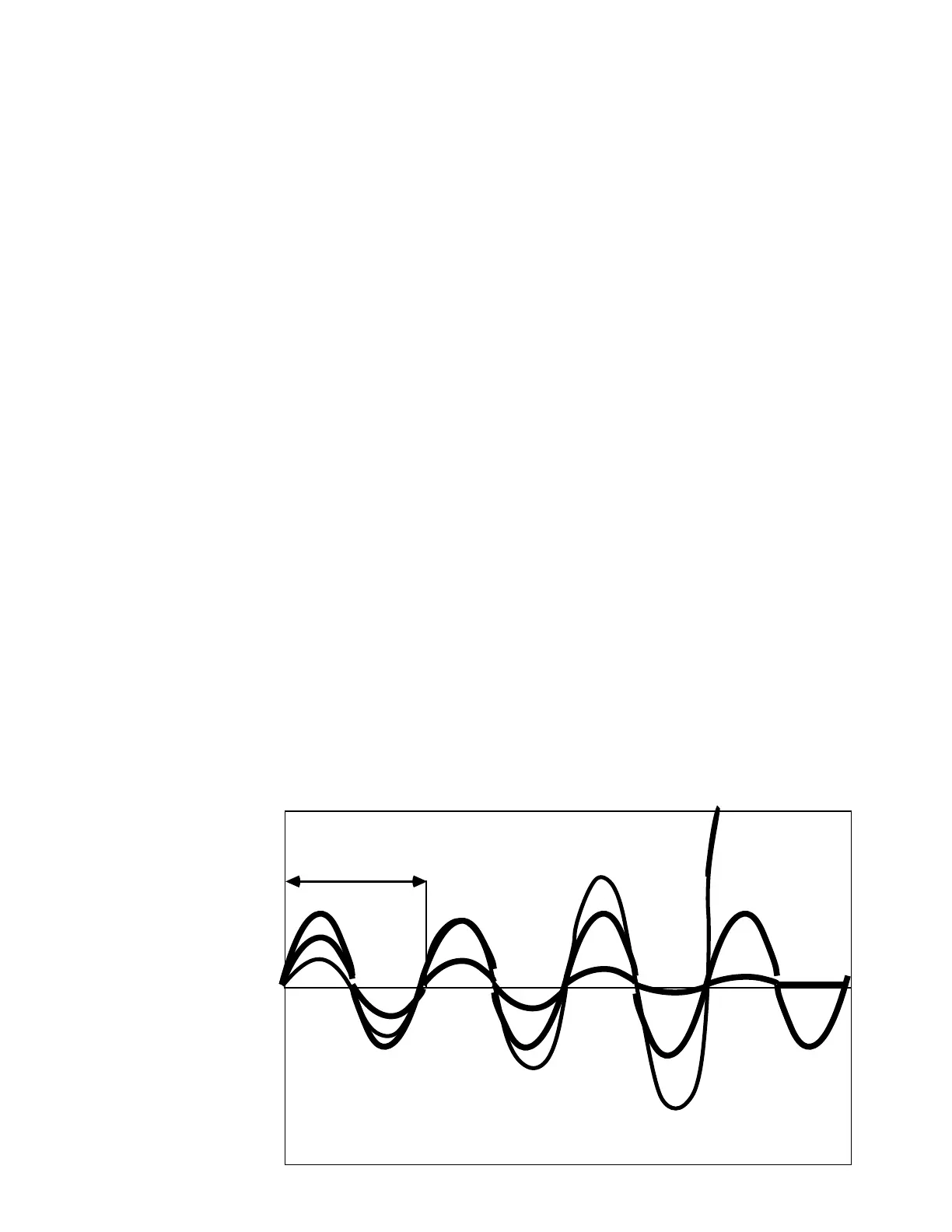
4. Achieve a response curve similiar to the sustained oscillation (curve C), this is the
Ultimate Proportional Band (UPB) and Ultimate Time Period (UTP).
a) If the response curve from step 3 does not damp out, as in Curve A from
the drawing, the PB is too low. The PB should be increased and step 3
repeated.
b) If the response in step 3 damps out, the PB is too high. The PB should
be decreased and step 3 repeated.
These values obtained for Ultimate Proportional Band (UPB) and Ultimate Time Period (UTP)
are used to calculate ideal P, PI, PD, PID tuning parameters using the following Ziegler-
Nichols equations:
Proportional only control (P) -
P(Pb) = 2 x UPB (degrees or units)
Proportional plus automatic reset (PI) -
P (Pb) = 2.2 x UPB (degrees or units)
I (ArSt) = 1.2 / UTP (repeats per minute)
Proportional plus derivative (or rate) (PD) -
P (Pb) = 1.7 x UPB (degrees or units)
D (rAtE) = UTP / 8 (minutes)
Proportional plus automatic reset plus derivative (PID)
P (Pb) = 1.7 x UPB (degrees or units)
I (ArSt) = 2 / UTP (repeats per minute)
D (rAtE) = UTP / 8 (minutes)
If an overdamped response is desired, multiply the proportional band by two.
Period
Curve A : unstable
Curve B : stable
Curve C : continuously cycling,
ultimate PB and period
C
B
A


 To Next Page