Need help?
Do you have a question about the Partlow MIC 2000 and is the answer not in the manual?
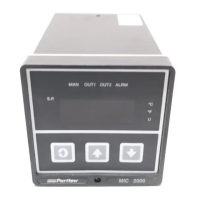
This instrument is a microprocessor based single loop controller capable of measuring, displaying and controlling temperature, pressure, flow, and level from a variety of inputs.
The instrument can be programmed for on-off, time proportioning, current proportioning, or position proportioning control implementations.
Alarm indication is standard on all instruments. Alarm type may be set as PROCESS DIRECT or REVERSE.
Recommended panel opening sizes and installation procedures for the instrument housing.
Guidelines for minimizing electrical noise and ensuring proper wiring practices for instrumentation.
Instructions for connecting AC power to the instrument for 115 VAC and 230 VAC operation.
Details on making thermocouple connections and recommended practices for noisy environments.
Instructions for making 2-wire and 3-wire RTD connections, including jumper settings.
Procedures for connecting Volt, mV, and mADC inputs, including shunt resistor requirements.
Diagrams for connecting Relay A, B, and C outputs, rated for 5A resistive load at 115 VAC.
Instructions for connecting Solid State Relay (SSR) driver outputs located in Relay A, B, and C positions.
Connecting mADC outputs 1 and 2, including load resistance and optional 0-20mADC selection.
Wiring for position proportioning output using relays and slidewire feedback.
Steps to follow before applying power and during the instrument's power-up sequence.
Description of parameter selection and data entry via the front keypad using different modes.
Detailed explanation of the Scroll, Up, and Down keys and their functions.
Detailed usage of UP and DOWN keys for parameter adjustment and mode navigation.
Procedure for enabling or disabling access to setpoint changes and non-control modes.
Description of how to configure or re-configure the instrument using the Program mode.
Procedure for adjusting tuning parameters and alarm settings in the Tune mode.
Step-by-step guide for adjusting PID tuning parameters for optimal control.
Empirical procedure to determine tuning parameters using sustained oscillation.
Lists programmable control features like On-Off, Time Proportioning, and Alarm Functions.
Configuration for 3-mode proportional control with PID, Integration, and Derivative responses.
How direct operation controls outputs, typically used for cooling applications.
Implementation and hysteresis adjustment for On-Off and Latched On-Off control.
Switching between automatic and manual control modes and bumpless transfer.
Local and remote setpoint adjustment, including range limiting and ramp rate features.
Instructions for initiating the calibration mode and navigating through calibration steps.
Guide for identifying and resolving common instrument conditions and malfunctions.
Steps to diagnose and fix issues when the instrument display is blank or dark.
Steps to resolve incorrect model number display during the power-up sequence.
Troubleshooting steps for Relay or SSR Driver output failures.
Troubleshooting steps for mADC output failures.
Explains how error codes affect outputs and lists troubleshooting for SnSr (Sensor Break) errors.
Troubleshooting guidance for Remote Setpoint, Slidewire Feedback, and RAM/EPROM errors.
Troubleshooting for RTD Mismatch, Zero Crossings, AC Line errors, and CAL 2 Volt Input errors.
Troubleshooting for ADC errors, Cold Junction, RTD calibration, Ground Reference, and Program/Tune errors.
Troubleshooting for digital communication errors related to crystals, microcontrollers, and data transmission.
 General
| Display | Dual 4-digit LED |
|---|---|
| Communication | RS-485 Modbus RTU |
| Input | Thermocouple, RTD, mA, V, mV |
| Output | Relay, SSR, mA, V |
| Control Modes | On/Off, PID |
| Power Supply | 24 VAC/VDC, 100-240 VAC |
| Dimensions | 96 x 96 mm |
| Enclosure Rating | IP65 front panel |
| Alarms | 4 programmable alarms |

 To Next Page