DATASHEET
α
4
4. GLOSSARY AND GENERAL CRITERIA
Following is a list of definitions used in the following sections, completed by indications of a general nature:
•
Master
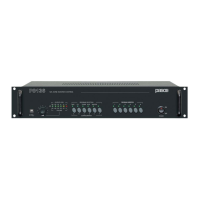
address (M): continuously ascending settings from 0 to 5 identifying the single P8136 master units interconnected by means of the
MASTER LINK sockets (20). In a multi-master system there must always be a master with the address 0 and there can be no two masters with the
same address..
•
Slave
address
(S): the address of the slave unit within each P8136 master must be 0. Any P8236 slave units interconnected to the same master
by means of the SLAVE LINK sockets (33) must have addresses numbered progressively from 1 to 5. There can be no two slaves with the same
address in a subsystem formed by each master.
•
Master
Units: PMB microphone stations and ACIO8136 I/O cards connected to the master by means of the TO MASTER UNITS connector (24).
They can make remote calls to any zone throughout the system (up to max. 216 zones); the associations between call zones and keys/activation contacts
are configured via a PC (using the P8136 Manager software).
•
Master
Unit adresses: ascending settings from 1 to 16 identifying the single Master Units univocally. There can be no two slaves with the same
address connected to the same TO MASTER UNITS socket (24).
When assigning the addresses of the Master Units, consider first of all the ACIO8136 cards which, if any, must be set with addresses between
1 and 6. Then set the PMB stations using the remaining free addresses (for a maximum total of 16).
•
Local Units
: PMB microphone stations and ACIO8136 I/O cards connected to the master (or to the group-leader slave) by means of the TO LOCAL
UNITS connector (30). They can ONLY make local calls to the zones managed directly by the group of the master (or of the group-leader slave). To
programme the call zones, consult the station manual and the instructions for the ACIO8136 configured as the Slave Unit.
•
Local
Unit adresses: Ascending settings from 1 to 16 identifying the single Local Units univocally. There can be no two units with the same address
connected to the same TO LOCAL UNITS socket (30).
When assigning the addresses of the Master Units, consider first of all the ACIO8136 cards which, if any, must be set with addresses between
1 and 6. Then set the PMB stations using the remaining free addresses (for a maximum total of 16)
• Priority: Ascending settings from 1 to 7 identifying the level of priority with which the SPEECH channel can be engaged by the sources listed
below:
• PMB microphone stations (refer to the P8136 Manager software, default setting = 1)
• VOX1 input (refer to the P8136 Manager software, default setting = 5)
• VOX2 input (refer to the P8136 Manager software, default setting = 2)
• Timer Events (requiring an optional ACMG8136 card, refer to the P8136 Manager software)
• Input contacts ACIO8136 configured as a Master Unit (refer to the P8136 Manager software)
• ACIO8136 expansion card configured as a Slave Unit (fixed setting = 5)
Conflicts between calls from Local Units, that are therefore connected to the same group-leader slave, are managed on the basis of caller priority: a
call in progress can only be cut off by one with a higher priority.
Conflicts between calls from Master Units connected to the same P8136 are governed on the basis of caller priority: a call in progress can only be cut
off by one with a higher priority.
In any case, calls coming from any
master
always have priority over those from
slaves
.
5. SOUND-BROADCASTING SYSTEMS
This section suggests some system prototypes of a general nature, on which it is possible to base a configuration for the desired system:
5.1 System with amplification of a single speech/program channel
5.2 System with dual amplification, separate for the Speech and Music channels
5.3 System with dedicated amplification for each zone
5.4 System with amplification according to multiple groups
For the sake of completeness, P8236 slave unit control panels will also be considered.
• Group: Common setting from 0 to 5 identifying the series of slaves associated with the same group. If more than one salve units are connected to
the same amplifier for SPEECH signals, it is ESSENTIAL that they be associated with the same group value. Among slave units in the same group, the
one with the lowest address is considered the Group-leader Slave.
Systems with several groups (including the limit case of 6 slaves in 6 groups) have the advantage that they can make more than one local call
at the same time, each within the group to which the call belongs. The Local Unit, however, cannot call a zone of a slave belonging to a group
other than its own. In a system with several slaves associated with the same group and the Local Units connected to the only Group Leader,
on the other hand, it is possible to select the zones of all the slaves of the group to which the Local Unit belongs.


 To Next Page