Circuit Description
GB 56 L01.1E9.
9. Circuit Description
Index of this chapter:
1. Introduction
2. Audio Signal Processing
3. Video Signal Processing
4. Synchronisation
5. Deflection
6. Power Supply
7. Control
8. Abbreviations
Notes:
• Figures can deviate slightly from the actual situation, due
to different set executions.
• For a good understanding of the following circuit
descriptions, please use the block diagram in chapter 6,
or the electrical diagrams in chapter 7. Where necessary,
you will find a separate drawing for clarification.
9.1 Introduction
The L01 chassis is a global TV chassis for the model year
2001 and is used for TV sets with screen sizes from 14” - 21”
(small screen) to 21” - 32” (large screen).
The standard architecture consists of a Main panel, a Picture
Tube panel, a Side I/O panel (not al executions) and a Top
Control panel.
The Main panel consists primarily of conventional
components with hardly any surface mounted devices.
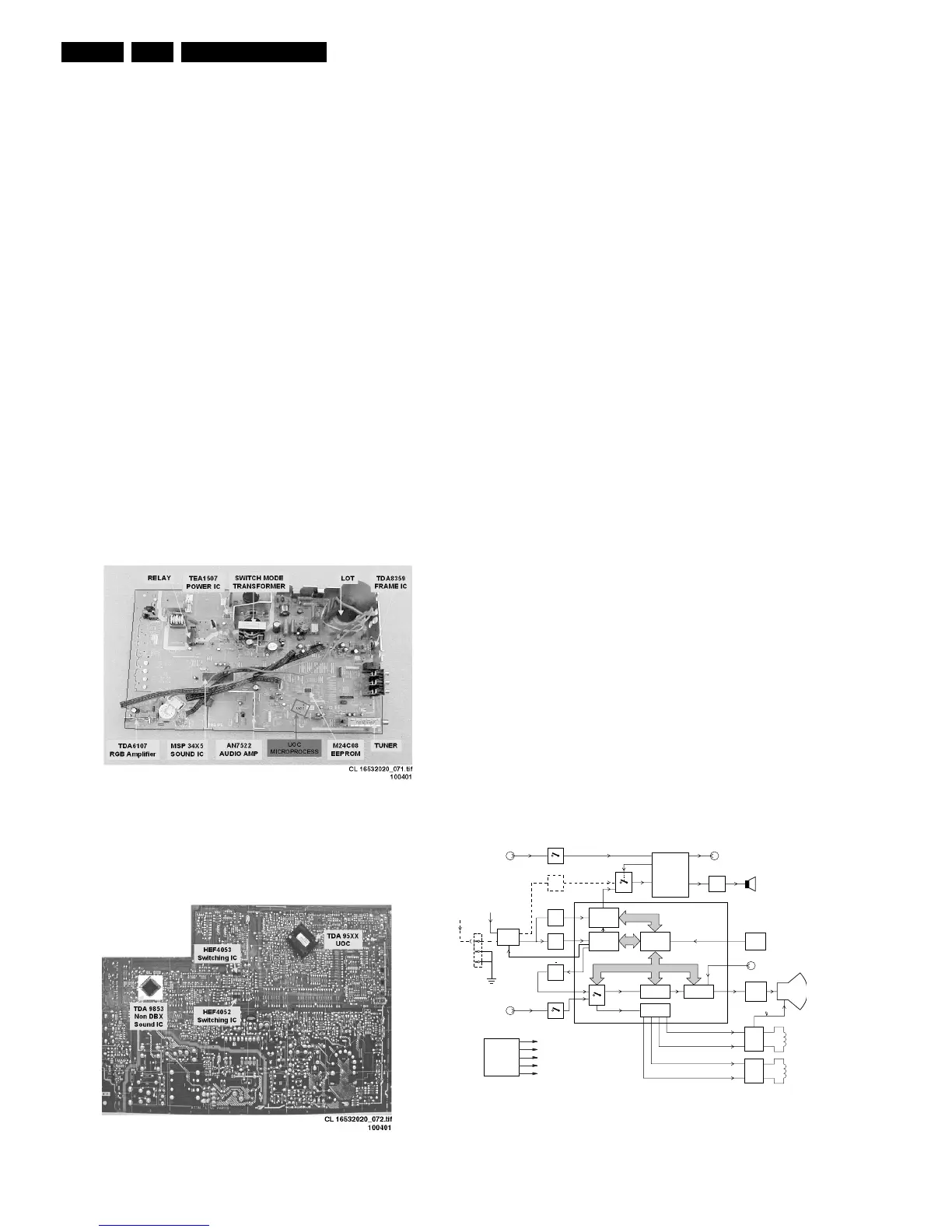
Figure 9-1
The functions for video processing, microprocessor (mP) and
teletext (TXT) decoder are combined in one IC (TDA958xH),
the so-called Ultimate One Chip (UOC). This chip is (surface)
mounted on the copper side of the main panel.
Figure 9-2
The L01 is divided into 2 basic systems, i.e. mono and stereo
sound. While the audio processing for the mono sound is
done in the audio block of the UOC, an external audio
processing IC is used for stereo sets.
The tuning system features 100 video channels with on-
screen display. The main tuning system uses a tuner, a
microcomputer, and a memory IC mounted on the main
panel.
Also, in some type numbers, an FM radio is implemented
with 40 pre-set channels.
The microcomputer communicates with the memory IC, the
customer keyboard, remote receiver, tuner, signal processor
IC and the audio output IC via the I
2
C bus. The memory IC
retains the settings for favourite stations, customer-preferred
settings, and service/factory data.
The on-screen graphics and closed caption decoding are
done within the microprocessor, and then sent to the signal
processor IC to be added to the main signal.
The chassis uses a Switching Mode Power Supply (SMPS)
for the main voltage source. The chassis has a ‘hot’ ground
reference on the primary side and a cold ground reference on
the secondary side of the power supply and the rest of the
chassis.
9.2 Audio Signal Processing
9.2.1 Stereo
In stereo sets, the signal goes via the SAW filter (position
1004 in case of QSS demodulation and 1003 in case of
Intercarrier demodulation), to the audio demodulator part of
the UOC IC7200. The stereo audio output on pin 33 goes, via
TS7201, to the stereo decoder 7831.
The switch inside the stereo decoder 7831 selects (via I
2
C)
either the internal decoder or an external source.
The NICAM + 2CS AM/FM stereo decoder is an ITT
MSP34X5.
The output is fed to the to the audio amplifier (AN7522 at
position 7901). The volume level is controlled at this IC (pin
9) by a control line (VolumeMute) from the microprocessor.
The audio signal from 7901 is then sent to the speaker/
headphone output panel.
Figure 9-3
TUNER
V
BAT
AUDIO
12V
3.9V
3.3V
FM IF
BUFFER
VIDEO SOURCE
SELECTION
RF ANT.



 To Next Page