EasyManua.ls Logo

Philips PCL304 - Page 80

Philips PCL304
82 pages
Print Icon
To Next Page IconTo Next Page
To Previous Page IconTo Previous Page
Loading...
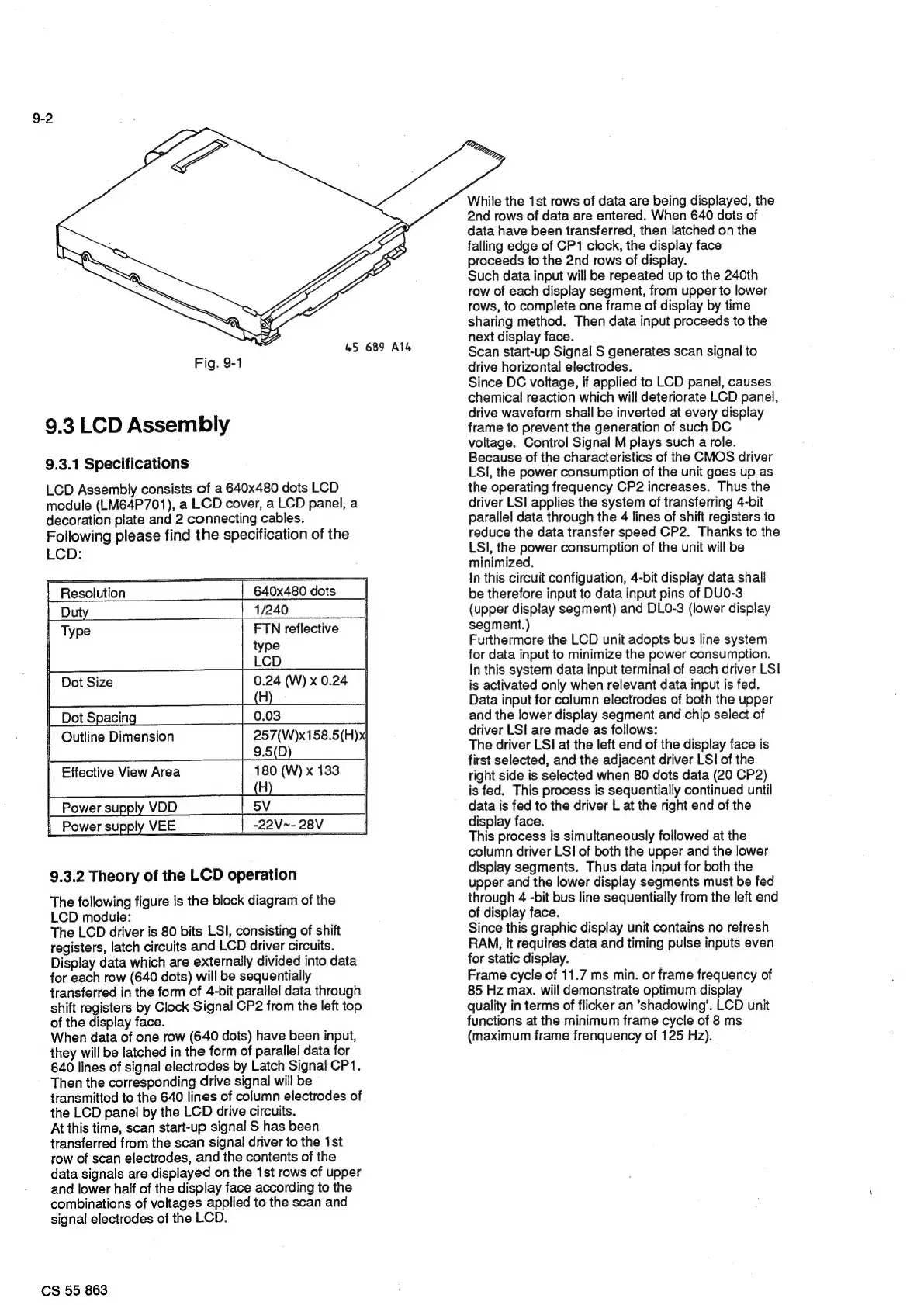
Fig.
9-1
9.3
LCD
Assembly
9.3.1
Specifications
LCD
Assembly
consists
of
a
640x480
dots
LCD
module
(LM64P701),
a
LCD
cover,
a
LCD
panel,
a
decoration
plate
and
2
connecting
cables.
Following
please
find
the
specification
of
the
LCD:
esolution
640x480
dots
pI
to)
1
[Duy
«10240
|
|
Type
FTN
reflective
=|
type
|
|
LCD
|
|
Dot
Size
0.24(W)x0.24
|
H
257(W)x158.5(H)x
9.5(D
180
(W)
x
133
H
|
Power
supply
VDD
DD
Ph
ro
rrr
hh
ne
emcee
O
fo.
Outline
Dimension
Effective
View
Area
9.3.2
Theory
of
the
LCD
operation
The
following
figure
is
the
block
diagram
of
the
LCD
module:
The
LCD
driver
is
80
bits
LSI,
consisting
of
shift
registers,
latch
circuits
and
LCD
driver
circuits.
Display
data
which
are
externally
divided
into
data
for
each
row
(640
dots)
will
be
sequentially
transferred
in
the
form
of
4-bit
parallel
data
through
shift
registers
by
Clock
Signal
CP2
from
the
left
top
of
the
display
face.
When
data
of
one
row
(640
dots)
have
been
input,
they
will
be
latched
in
the
form
of
parallel
data
for
640
lines
of
signal
electrodes
by
Latch
Signal
CP1.
Then
the
corresponding
drive
signal
will
be
transmitted
to
the
640
lines
of
column
electrodes
of
the
LCD
panel
by
the
LCD
drive
circuits.
At
this
time,
scan
start-up
signal
S
has
been
transferred
from
the
scan
signal
driver
to
the
ist
row
of
scan
electrodes,
and
the
contents
of
the
data
signals
are
displayed
on
the
1st
rows
of
upper
and
lower
half
of
the
display
face
according
to
the
combinations
of
voltages
applied
to
the
scan
and
signal
electrodes
of
the
LCD.
CS
55
863
4&5
689
Al4&
While
the
1st
rows
of
data
are
being
displayed,
the
2nd
rows
of
data
are
entered.
When
640
dots
of
data
have
been
transferred,
then
latched
on
the
falling
edge
of
CP1
clock,
the
display
face
proceeds
to
the
2nd
rows
of
display.
Such
data
input
will
be
repeated
up
to
the
240th
row
of
each
display
segment,
from
upper
to
lower
rows,
to
complete
one
frame
of
display
by
time
sharing
method.
Then
data
input
proceeds
to
the
next
display
face.
Scan
start-up
Signal
S
generates
scan
signal
to
drive
horizontal
electrodes.
Since
DC
voltage,
if
applied
to
LCD
panel,
causes
chemical
reaction
which
will
deteriorate
LCD
panel,
drive
waveform
shall
be
inverted
at
every
display
frame
to
prevent
the
generation
of
such
DC
voltage.
Control
Signal
M
plays
such
a
role.
Because
of
the
characteristics
of
the
CMOS
driver
LSI,
the
power
consumption
of
the
unit
goes
up
as
the
operating
frequency
CP2
increases.
Thus
the
driver
LSI
applies
the
system
of
transferring
4-bit
parallel
data
through
the
4
lines
of
shift
registers
to
reduce
the
data
transfer
speed
CP2.
Thanks
to
the
LSI,
the
power
consumption
of
the
unit
will
be
minimized.
In
this
circuit
configuation,
4-bit
display
data
shall
be
therefore
input
to
data
input
pins
of
DU0-3
(upper
display
segment)
and
DLO-3
(lower
display
segment.)
Furthermore
the
LCD
unit
adopts
bus
line
system
for
data
input
to
minimize
the
power
consumption.
In
this
system
data
input
terminal
of
each
driver
LSI
is
activated
only
when
relevant
data
input
is
fed.
Data
input
for
column
electrodes
of
both
the
upper
and
the
lower
display
segment
and
chip
select
of
driver
LSI
are
made
as
follows:
The
driver
LSI
at
the
left
end
of
the
display
face
is
first
selected,
and
the
adjacent
driver
LSI
of
the
right
side
is
selected
when
80
dots
data
(20
CP2)
is
fed.
This
process
is
sequentially
continued
until
data
is
fed
to
the
driver
L
at
the
right
end
of
the
display
face.
This
process
is
simultaneously
followed
at
the
column
driver
LSI
of
both
the
upper
and
the
lower
display
segments.
Thus
data
input
for
both
the
upper
and
the
lower
display
segments
must
be
fed
through
4
-bit
bus
line
sequentially
from
the
left
end
of
display
face.
Since
this
graphic
display
unit
contains
no
refresh
RAM,
it
requires
data
and
timing
pulse
inputs
even
for
static
display.
Frame
cycle
of
11.7
ms
min.
or
frame
frequency
of
85
Hz
max.
will
demonstrate
optimum
display
quality
in
terms
of
flicker
an
’shadowing’.
LCD
unit
functions
at
the
minimum
frame
cycle
of
8
ms
(maximum
frame
frenquency
of
125
Hz).

Related product manuals