3
Test
5
(counter test)
Test 5 activates
the counter and counter input control circuit, and
the
AZC
flip-flop
D1903.
Signature
analysis
is
possible.
Test
6
(interrupt
controller
test)
Test 6
activates the
interrupt control circuit.
Signature
analysis in this test is also possible.
NOTE:
AH the signatures
are given
in circuit
diagrams.
The signatures
signed with
a
*
seem to
be iogic
0 or
iogic
1
signatures, but the
difference
is
that
they have activity at that point, (biinking iamp)
(e.g. oniy iogic
0
or iogic
1
between
start
and
stop).
7.
HOW
TO
USE THE DOCUMENTATION AND THE TESTROM
This service manual
should be used
in combination
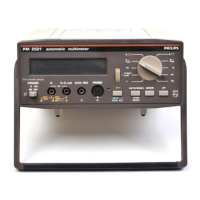
with the service manual of the PM2521
.
The user
of the
fault-finding procedure
in
the
PM2521 service
manual will be directed to
a
certain part
of
the PM2521
.
If
the
fault-finding procedure does
not
solve the problem, then select
a
signature analysis test which is
associated with
the part
of the PM2521
.
Begin always with the microcon;iputer,
or with
the
inputs
of the integrated circuits, and try to
find
the
faulty
node. Bear
in
mind that when the faulty node has been found, more than one circuit can cause the
faulty
signature.
8.
FAULT-.F1NDING HINTS
The first thing to do is to get
an analysis of what is wrong.
If this is not
possible (e.g.
continuously —cal—),
get
the PM2521 in
the free run mo'de by
breaking the bus
system between the
microcomputer and
the
ROMs. This is
done by
removing the ROMs.
The
microcomputer is now
forcing—in some instruction
that will
cause
a
repeated
increment of the
address
lines.
So
at this
point the
microcomputer is scanning the
whole address
field.
With
START
and STOP
lines from the
signature analyser,
both connected to the most
significant address bit
and triggering on
different edges, a
measurement will be
defined. Connecting the CLOCK
line of the
signature
analyser to the
ALE signal of the microcomputer
and selecting the edge at
which the address
is valid,
the input
probe will get
a
signature at
every address line.
By touching
the probe in
every test to a logic 1
level,
a
characteristic
signature is obtained. This is
the
result of shifting
ones (logic
1)
in
for every cycle that occurs
while the gate is open. So
the characteristic
signature can be
used to
diagnose this condition
elsewhere. The logic 0 is
always
a
signature of
"0000".
Assume
there are no bad
signatures in the free-run test,
then the TESTROM can
be placed in the D1909
socket and
it
is possible to
start measuring with
test
0.
If
an
incorrect part can
be located
with
the
fault-finding procedure it is
recommended to start with
the
test
which
is
responsible
for
that
fixed part of the PM2521
.
To
do
this, short
circuit TP10
and
TP1 1
for
a
short
period-
9.
HOW TO
ORDER
THE SIGNATURE
ANALYSIS
TESTROM
AND THE
DOCUMENTATION
Under ordering
number
5322 694 54013
the testrom
and the
documentation
can be
ordered
from
Concern
Service.


 To Next Page