EasyManua.ls Logo

Philips pm2521 - 6.4.1.4. Direct current measurements (A.)

Philips pm2521
187 pages
Print Icon
To Next Page IconTo Next Page
To Previous Page IconTo Previous Page
Loading...
39
1.4.3.
Analog section
(extended
measurements)
1.4.3. 1.
Frequency
measurements
(Hz)
The
Hzl function
switch
connects the
input signal to
be
measured to
the voltage
attenuator.
After
attenuation
it is
applied via
function
switch contact
Hz2
to
the
impedance convertor.
The low
impedance output
is
applied
to
the
+
input
of
the comparator A502.
When
positive
triggering
is selected, the +10V
is
applied via R502
to one
end
of the TRIGGER
LEVEL
potentiometer R502
and the
resulting
+
signal
selected is fed
via the
+
input of
the
buffer amplifier A501
to
impedance
convertor V302,
which gives a
+
input to
pin
3
of the
comparator A502.
When the
signal
pulse peaks cross
the trigger
level threshold,
the
comparator
produces output
pulses via the
grounded base
transistor V501
.
On
comparator
output
pulses,
V502
conducts
and the
resistor R512
results in a drop
in
output of 50mV
approx.
This is
done to
prevent
unwanted oscillation.
When
the
negative
triggering is selected,
control relay
ReM causes V507
to
conduct (logic
1
)
which means
that —10V is
applied
via R505 to
the end of
the TRIGGER
LEVEL
control.
Although the +10V
is still
applied
via R504,
the
smaller
value of
R505
makes
the input
negative. Diode V551
also conducts to
give a
negative
polarity
signal
to
invert the comparator
output
in the digital
section.
In
the negative
trigger mode, V502
is already conducting, so V503
and V504
act as a
level
shifter to compen-
sate for the
difference
in levels between logic 0
and logic 1
.
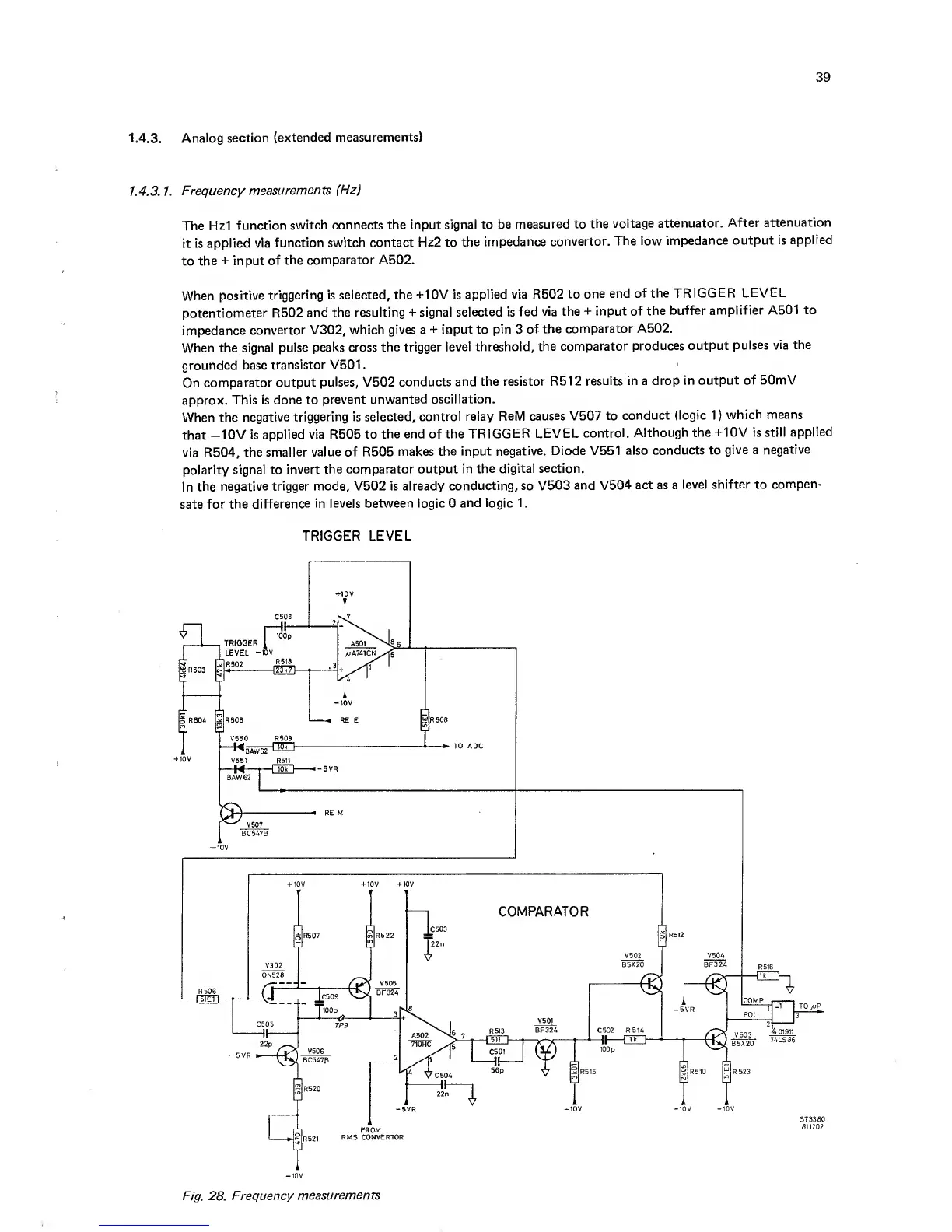
TRIGGER LEVEL
Fig. 28.
Frequency
measurements

Other manuals for Philips pm2521

Related product manuals