EasyManua.ls Logo

Philips PM3350A - Page 71

Philips PM3350A
109 pages
Print Icon
To Next Page IconTo Next Page
To Previous Page IconTo Previous Page
Loading...
4
-
38
4
APPLICATIONS
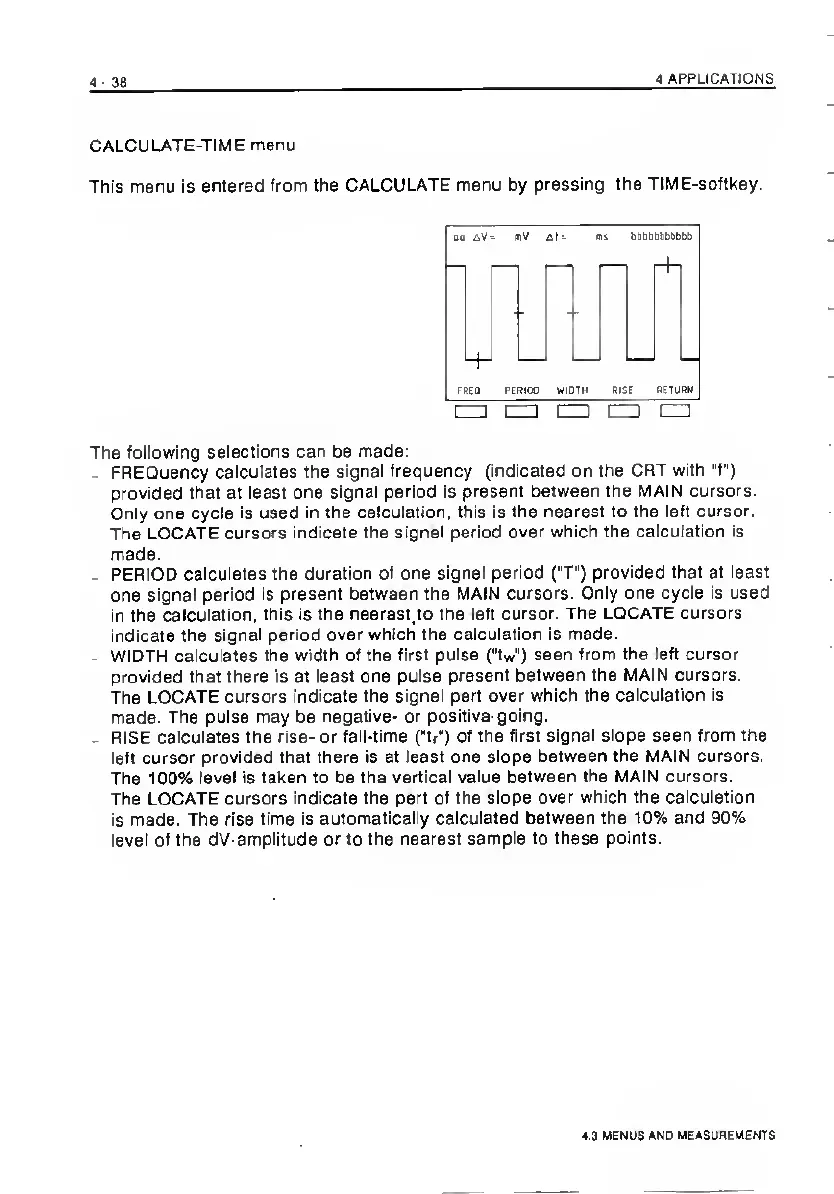
CALCULATE-TIME
menu
This
menu
is
entered
from
the
CALCULATE
menu
by
pressing
the
TlME-softkey.
ao
AV-
At
s
fi&
bbbbbbbbbbb
1
1
1
-
h
1
1
PERIOD
WIDTH
RISE
RETURN
[=
IZZI
1=]
The
following
selections
can
be
made:
-
FREQuency
calculates
the
signal
frequency
(indicated
on
the
CRT
with
"f)
provided
that
at
least
one
signal
period
Is
present
between
the
MAIN
cursors.
Only
one
cycle
Is
used
in
the
calculation,
this
Is
the
nearest
to
the
left
cursor.
The
LOCATE
cursors
indicate
the
signal
period
over
which
the
calculation
is
made.
.
PERIOD
calculates
the
duration
of
one
signal
period
("T")
provided
that
at
least
one
signal
period
is
present
between
the
MAIN
cursors.
Only
one
cycle
Is
used
in
the
calculation,
this
is
the
nearest.to
the
left
cursor.
The
LOCATE
cursors
indicate
the
signal
period
over
which
the
calculation
is
made.
-
WIDTH
calculates
the
width
of
the
first
pulse
("tw‘)
seen
from
the
left
cursor
provided
that
there
is
at
least
one
pulse
present
between
the
MAIN
cursors.
The
LOCATE
cursors
indicate
the
signal
part
over
which
the
calculation
Is
made.
The
pulse
may
be
negative-
or
positive-going.
-
RISE
calculates
the
rise-
or
fall-time
(‘tr")
of
the
first
signal
slope
seen
from
the
left
cursor
provided
that
there
is
at
least
one
slope
between
the
MAIN
cursors.
The
100%
level
is
taken
to
be
the
vertical
value
between
the
MAIN
cursors.
The
LOCATE
cursors
indicate
the
part
of
the
slope
over
which
the
calculation
is
made.
The
rise
time
is
automatically
calculated
between
the
10%
and
90%
level
of
the
dV-amplitude
or
to
the
nearest
sample
to
these
points.
4.3
MENUS
AND
MEASUflEUENTS

Related product manuals