OPERATING AND INSTALLATION MANUAL HEAT PUMP COMBI UNIT PKOM4 PAGE 40
USER
GENERALSPECIALIST PERSONNEL
15. Maintenance and cleaning
Always switch o the apparatus
for cleaning and maintenance of
the heat pump combi unit.
Be acutely aware of hazards and safety
when opening or unscrewing the front hood
or covers.
If possible, use a vacuum cleaner to remove
dirt and dust. Applying force or using
compressed air for cleaning may dam-
age components and surfaces. Never use
aggressive or solvent-containing cleaning
agents. The electrical components must not
be exposed to moisture or wet conditions.
Heed the Safety notes in Section 5.2 and in
particular Section 5.4 Electrical connections
when performing any electrical work.
15.1
CHECKLIST FOR MAINTENANCE
WORK
WHAT TASK INTERVAL WHO
Filter service Check / replace ca. 2-3 times p.a. User / technical sta
Counterflow heat exchanger Check / clean annually Technical sta
Fans Check / clean annually Technical sta
Heat exchanger
and condensate trays
Check / clean annually Technical sta
Refrigerant circulation Inspection annually
1)
(recommended) Technical sta
Service water tank - sacrifi-
cial anode
Check / replace
Depending on the water
quality
Technical sta
1)
EU Regulation 517/2014 does not prescribe regular checks for leakage in the refrigerant circulation if the fill
quantity is < 5 t CO2 equivalent. GWP for 134a: 1,430
specialist personnel - commissioning
15.2 CHECK AND CLEANING OF COUN-
TERFLOW HEAT EXCHANGER
Soiling of the counterflow heat exchanger
will normally be only slight if the air filters
are serviced at regular intervals.
• Remove the front hood. To do this,
unscrew the securing screws.
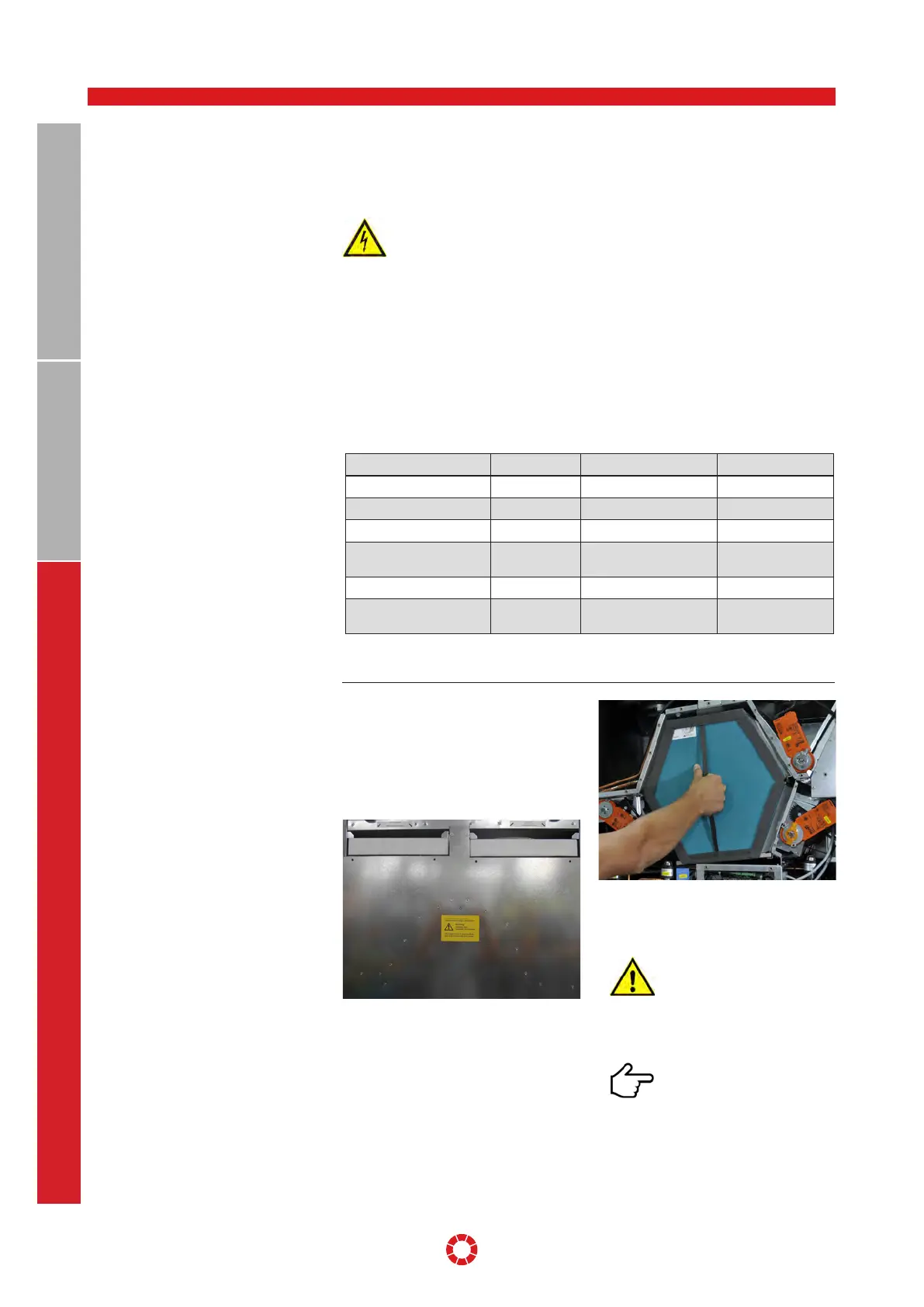
• Remove the sealing plate.
• Use the strap to carefully extract the
counterflow heat exchanger from its
bracket.
• The condensate drainage pipes are after-
wards only cleaned by rinsing with luke-
warm water.
Under no circumstances use
aggressive cleaning agents.
Blowing out with compressed
air may destroy the heat exchanger.
• After drying the counterflow heat
exchanger it can be carefully re-inserted.
Ensure that the sealing profiles
are properly seated.
Illustration: Sealing plate
Illustration: Counterflow heat exchanger


 To Next Page