22
463X Chlorine Systems Manual
Refer to your pH sensor manual.
The pH sensor needs to be calibrated against two different pH
buffer references to calibrate the offset (standard) and slope.
Electrode offset is any deviation from 0 mV in a pH 7 buffer at
25 °C. Slope is the ratio of mV to pH units.
• Always keep any output devices offl ine when calibrating.
Set pH Offset (Standard)
The transmitter must be powered on and the pH sensor must
be connected.
1. Turn off the water fl ow through the system, then remove
the pH sensor from its fl ow cell.
2. Using pH buffer 7.0, place enough pH buffers into
clean calibration cups, supplied with the pH calibration
kit 3-2700.395 (159 001 605), to cover the tip of the
electrode.
3. Pour distilled water in another clean cup for rinsing the
electrode between buffers.
4. Rinse probe, place the pH sensor in the pH 7.0 buffer
and allow the mV reading to stabilize.
Example: Set pH Standard to 7.00.
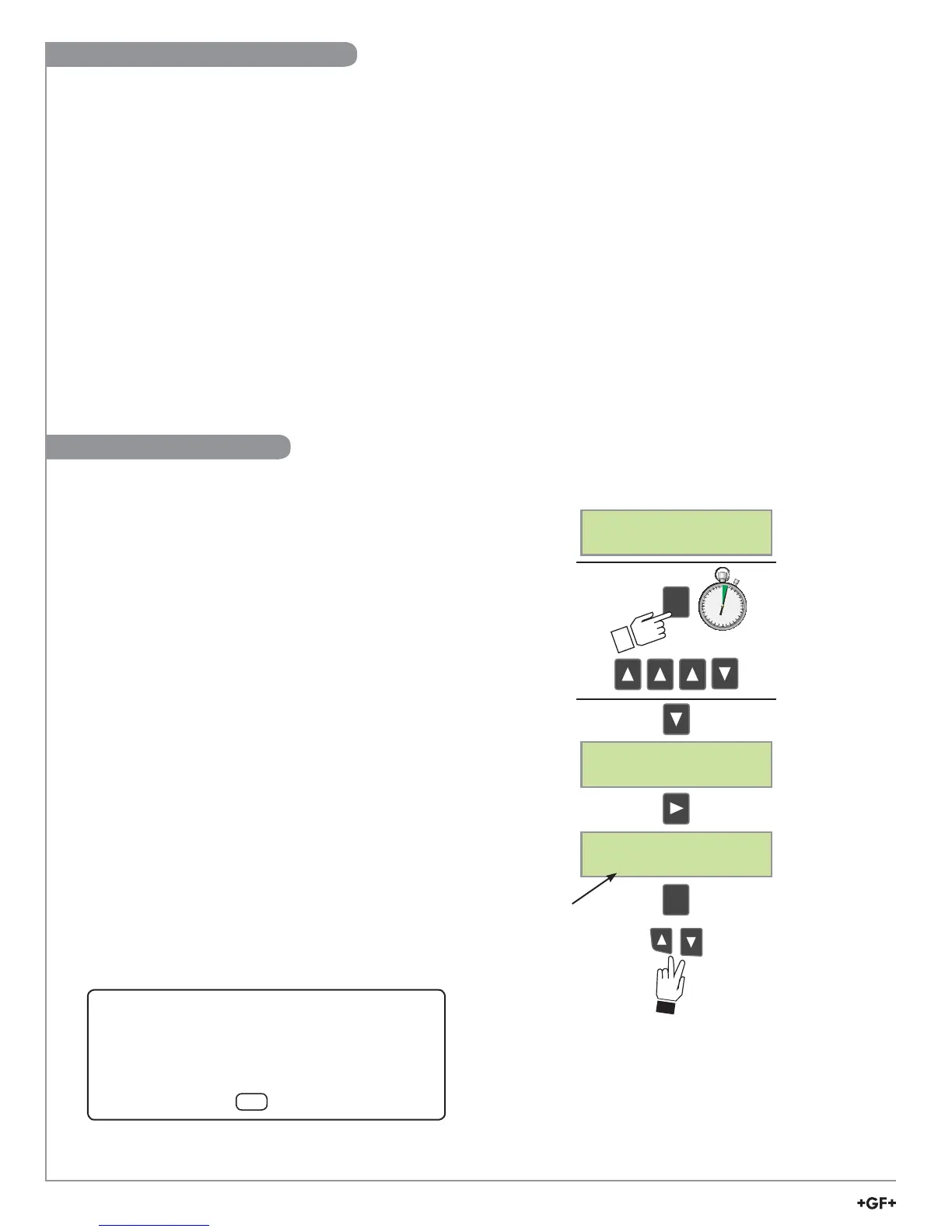
5. Go to the Calibrate Menu.
6. Scroll down ▼ 5 menus to the pH Standard menu.
7. Press ► to enter Edit Mode.
8. Enter the pH value of the buffer that the electrode is
placed in; 7.00 in this case.
9. Press the Enter button to save the setting.
10. Exit to the View Menu. ▲▼
EXAMPLE
If a pH sensor is part of the system, use the Calibration
Kit 3-2700.395 (159 001 605) prior to initially installing
the sensor and during its normal lifetime. If a pH sensor is
not available but pH determination is necessary, measure
process pH with a separate test and enter the value in the
Options Menu.
NOTE: The pH sensor will not calibrate when the mV value
exceeds 50 mV from the original new electrode specifi cation.
Electrode: pH 4.01 = + 177 mV.
A new chlorine sensor or one that has had the electrolyte
or membrane replaced must be conditioned to generate
stable and accurate readings. To condition a chlorine sensor,
the sensor and sensor electronics must be installed and
powered, and must also have chlorinated water fl ow across
the membrane.
Chlorine Sensor Conditioning
1. Turn on and adjust water fl ow rate. Condition a new
chlorine sensor for 4 hours. Conditioning time for a
membrane cap replacement and/or electrolyte refi ll is
2 hours.
2. Keep offl ine any 4 to 20 mA devices or relay actuated
output devices that connect to the transmitter.
NOTE: The membrane cap may have to be replaced when
electrolyte is changed. Replace membrane if damaged.
The electrolyte should be replaced every 3 to 6 months.
NOTE: Temperature must be calibrated before calibrating the
pH sensor. See Chlorine Sensor section.
View Menu
Calibrate Menu
FCl: 2.67 ppm
7.11 pH 25.3°C
pH Standard
Calibration: >
pH Standard Cal:
07.00 pH/ 0 mV
pH buffer value
entered here
6
7
8
Step 4
EXAMPLE
ENTER
ENTER
5X
5
ENTER
ENTER
2s
(Hold)
Chlorine Sensor Conditioning
pH Sensor Calibration


 To Next Page