22
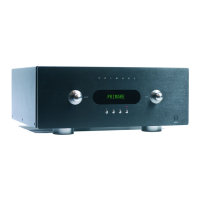
SPA21 SURROUND AMPLIFIER USER GUIDE
23
SPA21 SURROUND AMPLIFIER USER GUIDE
SETTING UP THE SOURCES
This chapter gives details of the standard inputs
that are dened when the SPA21 is rst supplied.
It then explains how to modify the standard inputs,
or dene new inputs, to give you total exibility
in the way you set up the SPA21 in your own
system.
Standard sources
The SPA21 Surround Amplier allows you to dene up to
15 sources, referred to as INPUT 1 to INPUT 15. Each
source can use one of the four digital and eight analog
inputs, and any source can be combined with one of the
video inputs. Alternatively, a multi-channel source can be
dened using the dedicated eight-channel external input.
This feature limits the analog inputs to a total of ve.
The SPA21 Surround Amplier is supplied with the
standard sources shown in the table below already dened:
Source Audio Video Surround Description
mode
CD Analog 1 None Bypass High quality
CD player
DVD Digital 1 S-Video 1 2-CH DVD player
Tape2 Digital 2 None 2-CH Digital tape
recorder or
minidisc player
Laser Digital 3 S-Video 2 Dolby Pro LaserDisc player
Logic II
Tuner Analog 2 None Stereo FM radio tuner
TV Analog 3 Video 1 Dolby Pro Television or
Logic II monitor
TapeA Analog 4 None Stereo Analog tape output
Sat Analog 5 Video 2 Dolby Pro Satellite receiver
Logic II
For each source you can dene:
• A name for the source, to identify it on the front panel
display.
• The analog or digital audio input used for the source.
• The video input used for the source, if the source inclu-
des video.
• The standard surround mode used for the source.
• For analog sources, an offset to balance the loudness
when switching between sources.
• TV-system
• Trigger #2
If this standard set of sources meets your requirements,
you will get excellent results by using them, and you can
ignore the remainder of this chapter.
If these standard sources meet all your requirements, but
include additional sources that you do not need, you may
like to remove the unused sources to avoid having to step
past them when selecting sources from the front panel or
remote control. To do this, see the next section, Removing
sources.
Alternatively, it may be that these standard sources gen-
erally meet your requirements, with one or two minor
changes. For example, if your DVD player does not pro-
vide a digital output you can modify the DVD source so
that it uses one of the analog inputs instead of the digital
input as currently dened. To make changes to the existing
sources see Editing sources, page 24.
Finally, you may prefer to create your own set of sources to
suit the particular requirements of your system. To do this
you should read all the remaining sections in this chapter.
Removing sources
Every source can be enabled or disabled. If a source is
enabled it will appear in the sequence of sources when you
select sources using the SELECTOR on the front panel or
the or buttons on the remote control. If a source is
disabled it cannot be selected, but the settings are retained
in case you want to enable the source again at a later date.


 To Next Page