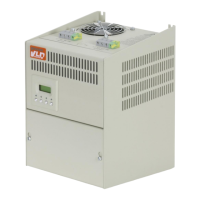
▪ Check up the operational data of the frequency converter to be put in operation.
page 4. - General features
▪ Install the device according to the instructions.
page 5. - Mechanical installation
▪ Study the safety measures to be complied with.
page 6. - Test run
▪ Connect the cables of the power line, the motor and the control elements to the corresponding terminal
blocks.
page 10. - Assignment and connection of the V3D terminal block
page 13. - Assignment and connection of the VLD / VHD terminal block
▪ If the device is equipped with brake check up the value and the placing of the brake resistor.
page 20. - Selection guide for brake resistors
▪ Switch the line power to the device.
▪ At devices without programming unit the motor can be started with the device’s control elements according
to the default setting (or the required setting).
▪ At devices with programming unit check up and if necessary modify the preset parameters (rising times and
fall times, minimum and maximum frequency etc.)
▪ If possible, perform a trial start with unloaded motor:
• inspect the operation of the motor,
• in case of opposite direction of rotation interchange both phase wires of the motor to achieve the right
basic direction of rotation,
• with changing the reference signal (e.g. potentiometer) scan the operating frequency band,
• try the functioning of the other controls (e.g. change of direction of rotation)
▪ Let the motor run with load!
▪ If necessary modify the parameters (rising times and fall times, minimum and maximum frequency etc.)
▪ In regulating mode tune the PID parameters
▪ If the settings are appropriate save the parameters!
Programmer’s manual - menu 11-1-2: Save parameters



 To Next Page