k) Using your twist throttle
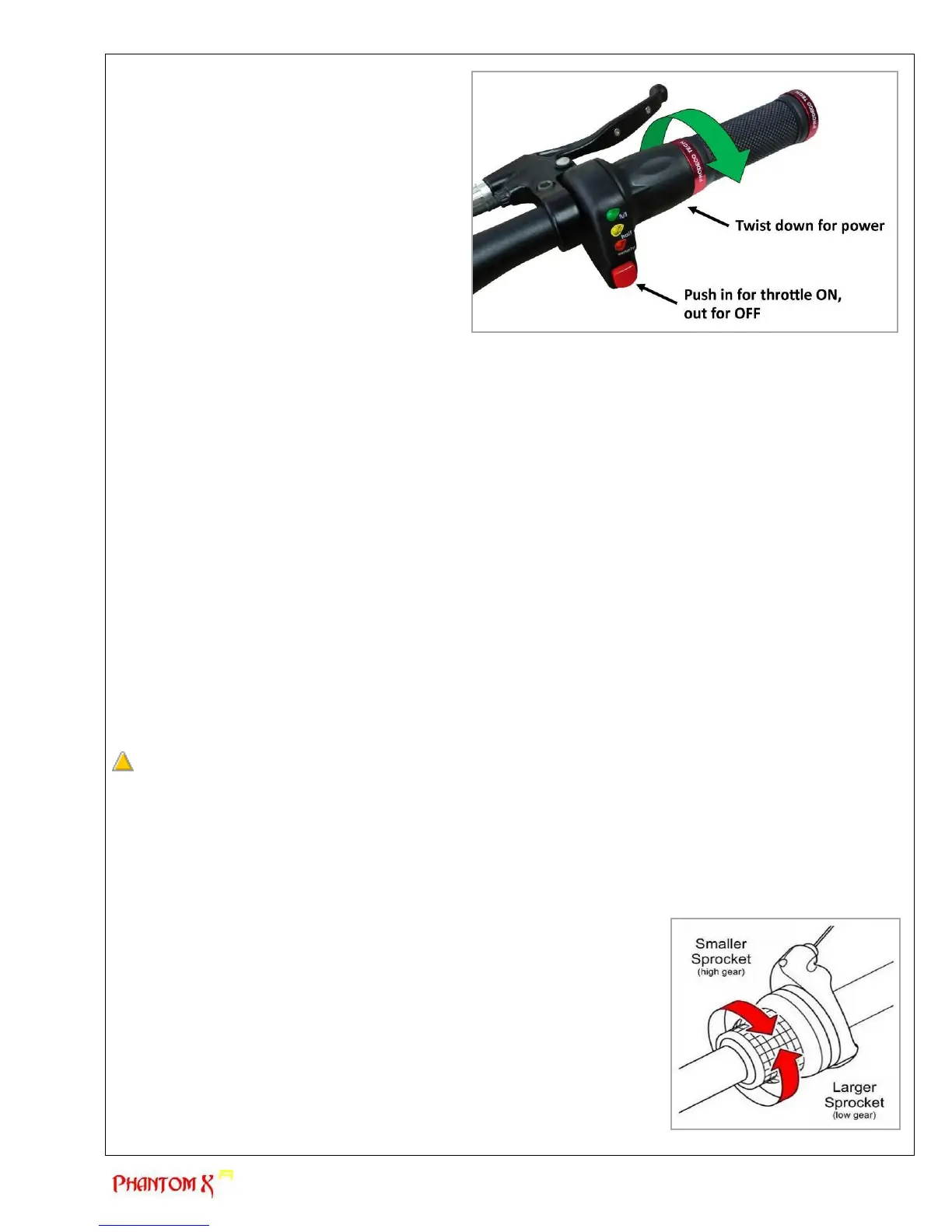
The variable throttle on your Phantom X R was
designed to allow you the ability to choose the
speed to ride at and determine the amount of
torque off the line. The throttle operates similar to
an automobile; the twisting of the throttle mimics
the depressing of the accelerator. The throttle is
located on the right side grip and considered a half
twist throttle. It is a half twist, as only the inside
portion will twist to power the bicycle. The grip itself
will not twist. Using you forefinger and thumb, you
can safely twist the throttle to propel the bike
forward. A half twist throttle is used to avoid
accidentally twisting the full grip when mounting
and dismounting the bicycle. Your throttle also
includes a Power ON and Power OFF button. It is
the red button located underneath the LED lights.
Depressing the button in activates the throttle and
pressing the button out will deactivate the throttle.
The ON / OFF button is for further safety. There is also an LED set of lights which assist in determining the amount of
battery storage capacity remaining. This is discussed in further detail later in the manual. Throttling is an important
factor with any electric bicycle and the distance of traveling available per charge. The higher the speed, the less
distance per charge, the faster you accelerate off the line, the less distance per charge. If there are multiple stops and
take offs, this also affects the range of distance per charge. It is recommended you become accustomed to your style
of riding and adjust the style depending on distance needed per charge. For example: if you are planning a short local
trip, full throttle at takeoff and top speed will not be an issue due to your ability to be able to recharge the battery prior
to the next trip. If you are planning a longer trip, 10-15 miles or more, it is suggested you add pedaling, hold throttle
back 10% and whenever possible allow the bicycle to coast under no power. Coasting under no power is similar to
riding a traditional pedal powered bicycle. When riding, a rider will pedal for a few seconds and then stop pedaling,
allowing the bike to coast with no power being used. This will greatly increase your distance between charging.
l) Using your brakes
Your Phantom is equipped with a high performance Avid hydraulic disc brake system. The hydraulic front and rear
disc brakes allow your new Phantom to stop quickly and accurately. Larger than industry average Avid HS “Heat
Shedding” stainless steel disc rotors were utilized for their increased heat dissipation. One of the great features
associated with hydraulic brakes is no pad adjustments. Once the calipers are properly installed, there are no further
adjustments required as the pads wear. When properly mounted, the Phantom high performance disc brake system
offers tremendous stopping power. Prior to leaving the factory, the Phantom brakes were properly mounted and
tested. Disc brakes however do require a bed-in process which occurs naturally after 20-40 stops. It can be sped up
by following the bed-in guidelines detailed in Chapter 9 “Maintenance and Replacement”, section c) “Brake pad
bed in”. When braking, both brake levers should be applied simultaneously. Your left brake lever manages your front
brake and your right brake lever manages your rear brake. You should become accustomed to the stopping power of
each brake (front & rear). Test each brake separately in a controlled environment for their ability to stop the bicycle.
Front brakes when locked can cause the rear wheel to come off the ground and the rider can be thrown off the
bicycle. In emergency situations, apply pressure to each brake lever, shift your weight to the back of the bicycle and
only attempt to use full force on the front brakes when the bicycle is not stopping quickly enough. Always keep a safe
distance between other vehicles, pedestrians and other riders.
WARNING: Locking the front wheel during braking can cause the rear wheel to lift off the ground and
throw the rider off the bicycle. Both brake levers should be applied simultaneously. In an emergency situation
shift your weight to the back of the bicycle. Locking the front wheel can cause the rider to lose control, be
thrown off the bicycle and cause serious injury or death.
m) Pedaling
Pedaling your Phantom X R is the same as pedaling a traditional bicycle. It is recommended you add pedaling to the
power of the bicycle to enhance the distance per charge. The Phantom X R is a 8 speed bicycle and has the ratio of a
42T front chain ring (sprocket) against a 11-32T rear freewheel which is designed to offer an easy pedaling pace at
any speed from 1 MPH to 20 MPH. It is recommended on steep inclines, the rider utilizes the throttle to assist in
powering the bicycle up the incline and simultaneously drop the bicycle to a
lower gear. If a rider’s style of riding is throttle only with no pedaling, distance
per charge will be decreased on a steep incline, the rider is required to assist
the motor by pedaling to power up the incline.
n) Shifting gears (SEE PHOTO)
The shifting of gears is required to change the ratio of the rotation of pedaling to
allow more or less torque and lower or higher speeds according to one complete
rotation of the crank set. If requiring more torque, you will shift to a larger rear
sprocket for a higher rotation of pedaling to a lower speed of the rear wheel. To
switch to a larger rear sprocket, you will need to shift to a lower gear. Gear 1 is the
largest sprocket which is 32 Teeth and your lowest gear. One full crank rotation
creates a 1.3 turns of the rear wheel. For higher speeds from less rotation of the
crankset on flat pathways, you will shift to a smaller rear sprocket for a higher wheel
rotation to a lower crankset speed. To shift to a smaller sprocket, you will need to
shift to a higher gear. Gear 8 is the smallest sprocket with 11 Teeth and your
highest gear. One full crank rotation creates a 3.8 turns of the rear wheel.


 To Next Page