“Drive” with Care: Share the Road - When you ride, consider yourself the driver of a vehicle and always keep
safety in mind. Choose to ride in the bike lane, if available. If the roadway or bike lane is wide, ride to the right; if the
lane is narrow, you may choose to ride in the middle of the lane. Take extra precautions when riding on a roadway.
Bicycles are smaller than automobiles, and don’t protect the operator like an automobile. You should: Make eye
contact, smile, or wave to communicate with motorists. Courtesy and predictability are a key to safe cycling; be
considerate and aware of motorists and pedestrians. Learn to anticipate their actions. Remember, pedestrians have
the right of way; Ride far enough away from the curb to avoid the unexpected from parked cars (i.e. opening doors
or drivers pulling out without checking); Keep control of your bicycle: look behind you while maintaining your bicycle
in a straight path; be able to ride with one hand on the handlebars and signal a turn. (Practice these skills in a
parking lot); Always look over your shoulder, and if possible, signal before changing lanes; Make sure that books,
clothes, and other items are securely attached to the bicycle or carried in a backpack; and Use bells, horns, or your
voice to alert pedestrians and bicyclists that you are approaching or passing.
Stay Focused: Stay Alert - Never wear headphones; they hinder your ability to hear traffic. Always look for
obstacles in your path (potholes, cracks, expansion joints, railroad tracks, wet leaves, drainage grates, or anything
that could make you fall). Before going around any object, scan ahead and behind you for a gap in traffic, signal
your intentions to move, and then follow through with your intentions. Be aware of the traffic around you. Ride
defensively. Use extra care when riding in wet weather, ice, frost, or snow. Slow your speed and allow extra time
and space to stop. Use extra care when crossing bridges which are extra slippery under wet conditions. Use
caution when crossing a railroad track; cross tracks at a 90-degree angle and proceed slowly.
c) Wet weather riding
Whenever possible, you should avoid riding your bicycle in the rain. Riding a bicycle in the rain is like driving a car in the
snow. You will not be able to stop as fast and must leave a larger distance between you and the obstacles around you.
Your brakes will not work as efficiently when they are wet. You will not be able to turn as sharp without the danger of
slipping. You must also ride away from or be cautious around painted lines, pot holes, sewer or drain grates, rail road
crossings, bridges, wet leaves and any other area where a slippery surface can appear with water. Keep an eye out for
puddles and turn your lights on if you have them. If you live in an environment where rain riding is expected, you should
install front and rear fenders if you have not already done so. Use a cover for your bicycle if leaving it outdoors. Extensive
rain can seep into the motor, controller, throttle and battery and cause water damage.
d) Reflectors
The CPSC (US Consumer Product Safety Commission) requires front, rear, wheel and pedal reflectors. Your Phantom X R
includes federal regulated reflectors and they should not be removed. If needing to be replaced, replace them with authorized
ProdecoTech reflectors or reflectors approved by the CPSC.
e) Night riding
Almost anywhere in the world today, bicycle night riding requires front and rear lights on your bicycle. You must install front and
rear lights if you plan on riding at night. Check your local laws on what is required for night riding. Always wear retro-reflective
clothing or material, not just white or florescent, especially on your ankles, wrists, back, and helmet. Only ride in areas familiar
to you. Brightly lit streets are best. Always assume you are not seen by a driver. Children should NOT ride at night.
f) Adding accessories
When adding accessories to your bicycle you must check to confirm they do not lower the safety value of your bicycle.
Prodeco Technologies offers authorized accessories for your bicycle which have been approved not to lower the safety value.
Ask your authorized dealer or contact us if you are not sure about adding an accessory to your bicycle and the possibility of
lowering your bicycle’s overall safety.
Chapter 7: Perfect Fit and Ride
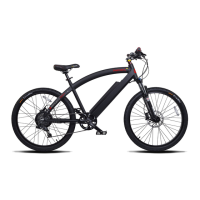
It is very important your new Phantom X R is adjusted properly for your size and for comfort. The Phantom X R has multiple
adjustments available to offer a comfortable and safe position for riding. A properly sized and adjusted bicycle allows the rider
to remain fully alert and avoid injury. Review this chapter carefully and all the adjusting points of your new Phantom X R. If you
have difficulty in obtaining the most comfortable riding position or performing available adjustments, contact your authorized
dealer for advice. You can contact Prodeco Technologies directly by phone or email and we will assist you with the proper
adjustments for your bicycle and your size. The following list is the areas of adjustability the Phantom X R offers:
Saddle height
Saddle nose angle
Saddle distance to handlebar
Handlebar height
Stem rise and rotation
Brake lever angle
Brake lever reach
Fork suspension firmness
a) The basics
Understanding the basics of a bicycle frame size will help in determining the correct positions and adjustments for your body
size and comfort. The Phantom X R’s frame was designed to easily accommodate all riders from 5’ 6” to 6’ 6” utilizing the
available adjustments. The frame size can be considered anywhere from an 18” to 23” if comparing to traditional
measurements. The most important information to remember when sizing your bicycle is that you are comfortable riding,
especially when pedaling. With throttled electric bicycles some riders may choose not to pedal and the measurement will be
different than for a rider who chooses to pedal and is the same size. Scooters for instance have a much lower saddle height
than bicycles due to scooters not being pedaled. A higher saddle height is only recommended for riders who pedal allowing
them a full extension of their leg per rotation of the crank.


 To Next Page