If the chain of your bicycle falls off at the largest COG/sprocket or the chain is having problems remaining on the
correct gear, you may need to adjust your derailleur. There are a multiple ways to adjust your derailleur but for a
simple adjustment on the changing of gears, follow these instructions.
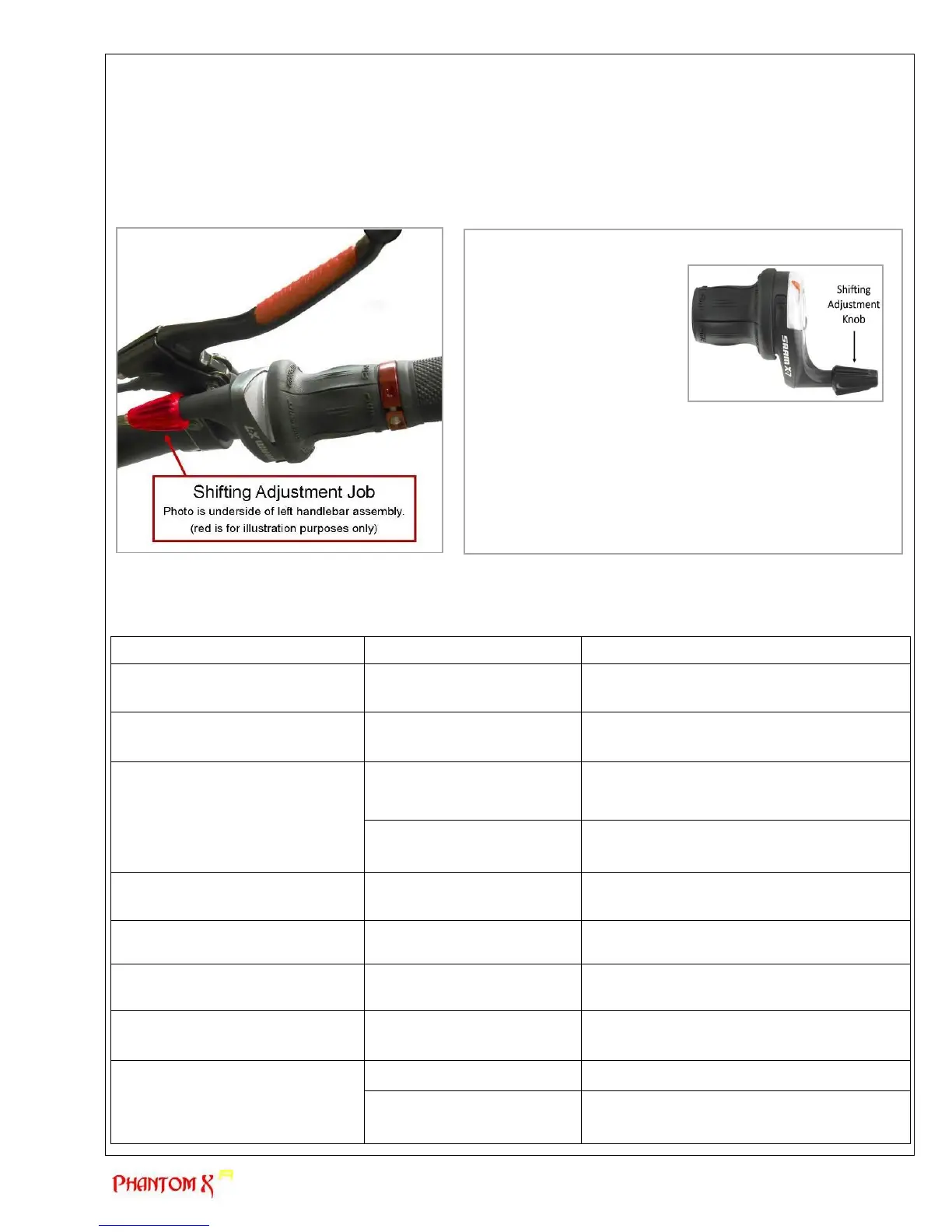
Located at the shifter on your handlebar, there is an adjusting knob where the cable enters the shifter. This
know will fine tune and adjust your derailleur gear shifting. The knob allows the loosening or tightening of
the cable which in turn moves the derailleur. Rotate this knob clockwise or counterclockwise until the
derailleur is properly changing gears. This is a fine tune and quick fix but for a correct adjustment, the
permanent adjustment should be at the derailleur cable locking plate and fixing bolt leaving the shifter knob
for fine tuning only.
For a more detailed adjustment of the derailleur, you should bring your bicycle to an authorized ProdecoTech dealer or a
neighborhood bike shop who services SRAM derailleurs. There is also a SRAM derailleur guide included with your bike.
Derailleur Troubleshooting
Chain jumps from smallest
sprocket to frame dropout.
High gear limit screw is not
adjusted properly.
Turn in "screw H" until the guide pullet is
aligned with the smallest sprocket.
Difficult or impossible to shift
chain onto smallest sprocket.
High gear limit screw is not
adjusted properly.
Unscrew "screw H" until the guide pullet is
aligned with the smallest sprocket.
Chain jumps over largest sprocket
and falls between the spokes and
largest sprockets or inner cage
plate scrapes on spokes.
Low gear limit screw is not
adjusted properly.
Turn in "screw L" until the guide pullet is
aligned with the largest sprocket.
Rear derailleur or derailleur
hanger is bent.
Clearance between guide
pulley / sprocket is too large.
Adjust 'b-adjust screw" by rotating
counterclockwise.
Clearance between guide
pulley / sprocket is too small.
Adjust 'b-adjust screw" by rotating clockwise.
Shifts more gears onto smaller
sprockets than intended.
Shift cable insufficiently
tensioned.
Turn barrel adjuster on the shifter
counterclockwise.
Delayed shifting onto larger
sprocket.
Shift cable insufficiently
tensioned.
Turn barrel adjuster on the shifter
counterclockwise.
Delayed shifting onto smaller
sprocket.
Shift cable is too tight.
Turn barrel adjuster on the shifter clockwise.
Excessive cable friction,
pinch or poorly routed cable.
Lubricate or replace cable & housing. Check
for excessive bending of cable housing.
SHIFTING ADJUSTMENT
Check that the chain and
the rear derailleur are in
the smallest cog position.
While pedaling, twist the
shifter up one detent.
If the chain hesitates or
does not shift to the
second cog, increase the
cable tension by turning
the shifting adjustment
knob counter clockwise.
If the chain shifts beyond the second cog, decrease the cable
tension by turning the shifting adjustment knob clockwise.
Repeat the two former steps until shifting and cable tension is
accurate.
While turning the crank, shift the chain up and down the
cassette several times to ensure your derailleur is shifting
smoothly.



 To Next Page