EasyManua.ls Logo

Quectel RM502Q-GL - GNSS Performance

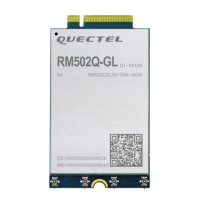
Quectel RM502Q-GL
84 pages
Print Icon
To Next Page IconTo Next Page
To Previous Page IconTo Previous Page
Loading...
5G Module Series
RM502Q-GL Hardware Design
RM502Q-GL_Hardware_Design 63 / 83
1. Keep the characteristic impedance for the trace of GNSS antenna (ANT2_GNSSL1) to 50 Ω.
2. Place the π-type matching components as close to the antenna as possible.
3. Keep the digital circuits, such as that of (U)SIM card, USB interface, camera module, display
connector and SD card, away from the antenna traces.
4. Keep 75 dB isolation between each antenna trace.
5. Keep 15 dB isolation between each antenna to improve the receiving sensitivity. and 20 dB isolation
between 5G NR UL MIMO TRX0 and TRX1 antennas.
5.2.3. GNSS Performance
The following table shows GNSS performance of RM502Q-GL series module.
Table 36: GNSS Performance
1. Tracking sensitivity: the minimum GNSS signal power at which the module can maintain locked (keep
positioning for at least 3 minutes continuously).
2. Reacquisition sensitivity: the minimum GNSS signal power required for the module to maintain

Parameter
Description
Conditions
Typ.
Unit
Sensitivity
(GNSS)
Cold start
Autonomous
-145
dBm
Reacquisition
Autonomous
-157
dBm
Tracking
Autonomous
-157
dBm
TTFF
(GNSS)
Cold start
@ open sky
Autonomous
177
s
XTRA enabled
14
s
Warm start
@ open sky
Autonomous
140
s
XTRA enabled
2
s
Hot start
@ open sky
Autonomous
50
s
XTRA enabled
1.5
s
Accuracy
(GNSS)
CEP-50
Autonomous
@ open sky
2.6
m
NOTES
NOTES

Table of Contents

Related product manuals