
 Need help?
Do you have a question about the Radioddity GD-73 and is the answer not in the manual?
Process for inputting personal call sign and DMR ID into the code plug settings.
Steps to define digital contacts, including talkgroups and individual IDs, for communication.
How to navigate and select a zone on the GD-73 radio.
How to navigate and select a specific channel within a zone.
How to identify and monitor incoming DMR group calls on the radio.
Steps to transmit a response to an incoming DMR group call.
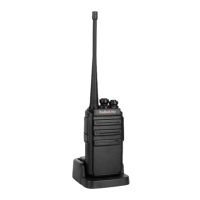
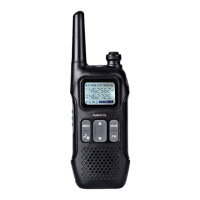
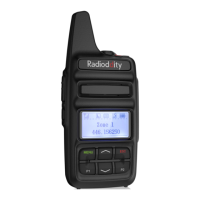
The Radioddity GD-73 is a compact and versatile UHF radio designed for both digital DMR (Digital Mobile Radio) and analogue FM operation. It serves as a personal communication device, particularly useful for amateur radio enthusiasts, offering a comprehensive set of features for on-air communication. The device is designed to be user-friendly, with a focus on direct operation and straightforward programming.
The primary function of the Radioddity GD-73 is to facilitate two-way radio communication across UHF frequencies. It supports both Tier I and Tier II DMR digital modes, allowing for clear, digital voice communication, and also operates in traditional analogue FM mode. This dual-mode capability makes it adaptable to various radio environments and networks.
The GD-73 boasts a substantial capacity for storing communication parameters. It can accommodate up to 1024 channels, which can be a mix of analogue and digital configurations. These channels are organized into a maximum of 64 zones, with each zone capable of holding up to 16 channels. This hierarchical structure allows users to logically group channels based on geographic area, repeater, or specific talkgroup, enhancing operational efficiency. Furthermore, the radio can store up to 1024 digital contacts, which include both individual DMR IDs and talkgroup (TG) IDs.
A core aspect of the GD-73's functionality is its reliance on a "code plug." This is a configuration file created using the Computer Programming Software (CPS) that contains all the necessary frequencies, talkgroups, contacts, and other operating parameters. The radio's performance and available features are directly determined by the code plug loaded onto it.
For digital communication, the GD-73 supports Digital RX Group Lists, allowing a digital channel to receive transmissions from one or many talkgroups. This feature is crucial for managing group calls and ensures that users only hear relevant conversations. The radio also incorporates emergency system definitions and encryption settings for secure and critical communications.
The device includes standard radio features such as a scan list, enabling the radio to automatically scan through a predefined set of channels. It also supports "Talk Around" functionality, which allows direct radio-to-radio communication without relying on a repeater, by swapping transmit and receive frequencies. The "Access Policy" feature, also known as "admit criteria," controls when a transmission is allowed to be sent, ensuring proper network etiquette. For hands-free operation, the GD-73 is equipped with VOX (Voice Operated eXchange), which activates transmission when voice is detected.
Operating the Radioddity GD-73 is designed to be intuitive, with clear controls and a structured menu system.
Turning On/Off: The radio is powered on or off by pressing and holding the on/off button, located on the right side of the radio, for approximately 3 seconds. A brief red LED light and an ascending 4-tone sequence confirm power-on, while the display goes off upon power-off.
Volume Adjustment: Volume control is managed by dedicated up and down buttons located above the on/off button. These buttons adjust the volume for both the built-in speaker and any attached external earphone.
Menu Navigation: The GD-73 features a MENU button for accessing the radio's settings and functions. Navigation within the menu is performed using the up and down selector buttons, with selections confirmed by pressing the MENU button again.
Zone and Channel Selection: To select a zone, users press the MENU button, navigate to 'settings', then 'zone', and use the up/down buttons to choose the desired zone, confirming with MENU. Once a zone is selected, the display shows the selected zone and the currently active channel within it. Channels within a selected zone can then be navigated using the up/down buttons.
Initiating a DMR Group Call: To initiate a group call, users first select the desired channel, ideally one named to reflect its associated talkgroup. The radio should be held vertically, 2.5 to 5cm from the mouth. Pressing the PTT (Push-To-Talk) key initiates transmission, indicated by a red status LED and the display showing 'Group', the DMR-ID of the caller, and 'Calling'. Releasing the PTT key returns the radio to receive mode. If the "Channel Free Indication Tone" is enabled, a short beep confirms the end of transmission.
Receiving and Answering a DMR Group Call: When a DMR group call is received, the status LED lights up green. If the channel is not active, the display shows the zone name and the selected group name. If active, it shows 'Group', the caller's DMR ID, and 'Calling'. To answer, hold the radio vertically, 2.5 to 5cm from the mouth, and press the PTT key. The status LED turns red. Releasing the PTT key returns to receive mode.
Programming the Radio (Code Plug Creation): The GD-73 is programmed using dedicated Computer Programming Software (CPS) on a PC. This involves several steps:
The Radioddity GD-73 is designed for straightforward maintenance, primarily through software updates and careful handling.
Firmware and CPS Updates: Radioddity regularly provides updates for both the CPS and the radio's firmware. These updates introduce new features, fix bugs, and improve performance. Users are advised to visit the Radioddity website to download the latest versions. It is crucial that the software version of the CPS matches the firmware version on the radio (e.g., software version 1.00 with firmware version 1.00).
Code Plug Management: Users are strongly advised to save their created code plugs locally on their PC. This allows for easy modification and restoration of radio configurations in the future. Creating a code plug from scratch is recommended over using someone else's, as it ensures all settings are tailored to the user's specific needs and local network requirements.
USB Driver Management: In case of installation errors with the USB driver, users are guided to stop the process, save the driver files to a different location, and retry. Windows Device Manager can be used to verify correct driver loading. If automatic loading fails, 32-bit and 64-bit drivers are available for manual download.
Radio Identification: The programming cable for the GD-73 does not contain special electronics. The radio's internal communications port is only identified by the PC when the GD-73 is switched on and connected via the micro USB cable.
Operational Best Practices: The manual emphasizes the importance of proper registration for a DMR ID to operate within a DMR network. It also highlights that operating the radio with an unregistered or incorrect ID can lead to license issues in amateur radio networks. Users are encouraged to gather detailed information about DMR stations (repeaters, talkgroups) from sources like BrandMeister or DMR-MARC networks to ensure correct channel setup.
By following these guidelines for function, usage, and maintenance, users can effectively operate and manage their Radioddity GD-73 for reliable communication.
 General
| Operating Voltage | 7.4V |
|---|---|
| Waterproof Rating | IP54 |
| Bluetooth | Yes |
| GPS | No |
| Frequency Range | VHF: 136-174MHz, UHF: 400-470MHz |
| Power Output | 5W / 1W |
| Battery | 2000mAh Li-ion |
| Weight | 220g |
| Display | LCD Display |
| Operating Mode | Digital/Analog |


 To Next Page