RTL8169
2002/03/27 Rev.1.21
37
8.1.4 64-Bit Data Operation
The RTL8169 samples the REQ64B pin at PCI RSTB deasserted to determine if the bus is 64-bit capable.
8.1.5 64-Bit Addressing
The RTL8169 supports 64-bit addressing (Dual Address Cycle, DAC) as a bus master for transferring descriptor and packet data
information. The DAC mode can be enabled or disabled through software. The RTL8169 only supports 32-bit addressing as a
target.
8.2 Bus Operation
8.2.1 Target Read
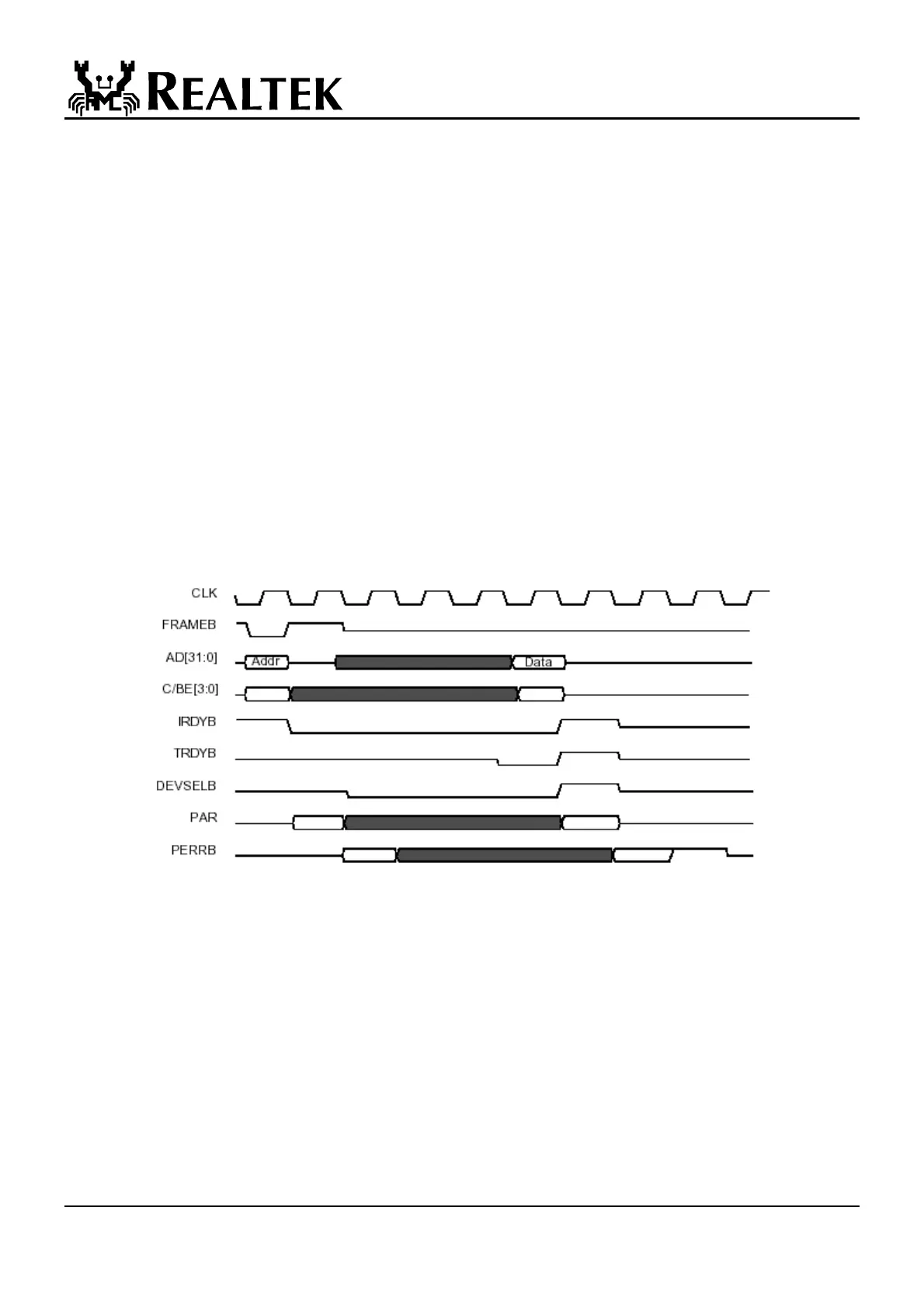
A Target Read operation starts with the system generating FRAMEB, Address, and either an IO read (0010b) or Memory Read
(0110b) command. If the 32-bit address on the address bus matches the IO address range specified in IOAR (for I/O reads) or the
memory address range specified in MEM (for memory reads), the RTL8169 will generate DEVSELB 2 clock cycles later
(medium speed). The system must tri-state the Address bus, and convert the C/BE bus to byte enables, after the address cycle. On
the 2nd cycle after the assertion of DEVSELB, all 32-bits of data and TRDYB will become valid. If IRDYB is asserted at that
time, TRDYB will be forced HIGH on the next clock for 1 cycle, and then tri-stated.
If FRAMEB is asserted beyond the assertion of IRDYB, the RTL8169 will still make data available as described above, but will
also issue a Disconnect. That is, it will assert the STOPB signal with TRDYB. STOPB will remain asserted until FRAMEB is
detected as deasserted.
Target Read Operation



 To Next Page