Rev 19 Page16
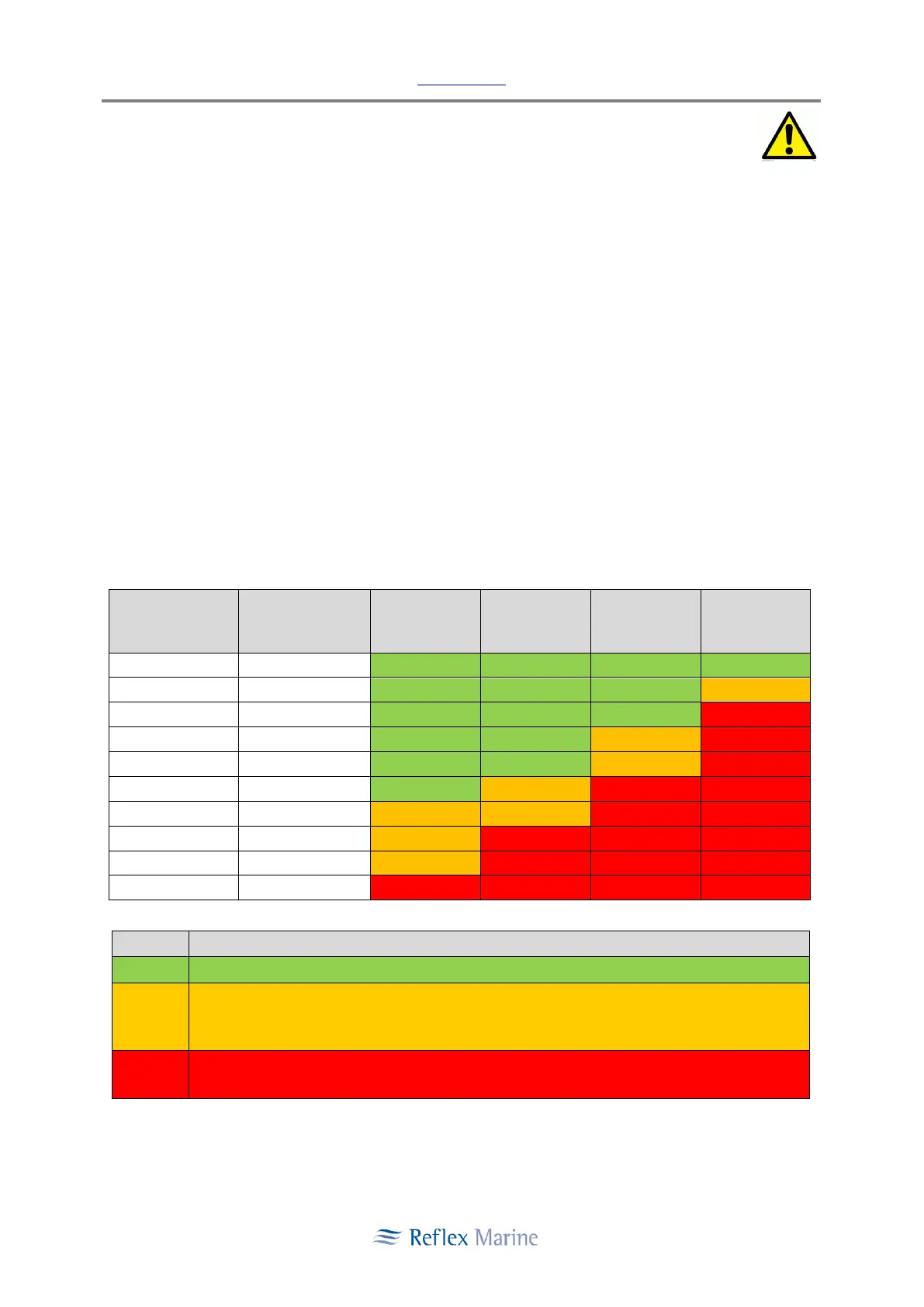
3.2 Operating Parameters - Sea State
The FROG-3 has an inbuilt damping system which prevents passengers from experiencing shock
loads up to relative landing and take-off velocities of 4 m/s (13.1 ft/s). A maximum recommended
sea state, or significant wave height, for the operation of the FROG-3 is determined by the maximum
relative velocity between the FROG-3 (or hook) and the landing deck.
The calculation for relative velocity used here is based on the European offshore crane standard, EN
13852-1:2004. Whereby the maximum anticipated relative velocity between a load and a vessel
deck, is given by the following;
Relative velocity = Hook velocity* + √ (Vessel deck velocity 2 + Boom tip velocity 2)
* Equal to 1.67 m/s (100 m/min, 330 ft/min) for lifts below 5 tonnes. Higher crane hook speeds may be available, and it
follows that the higher the available crane speed the higher the possibility of a heavy landing or take off. However, with a
qualified Crane Operator, it is considered unlikely that the FROG-3 will be landed at full hook speed on a deck rising at full
speed.
If there are concerns about heavy landings, operators may wish to consider the following methods to reduce risk of heavy
landings and take-off; dry runs without passengers, landing in centre of deck where less vessel movement, transfer of fewer
passengers to increase damping, hook speed indicator.
Table 1: Recommended Sea States for FROG-3
Low risk of high landing or take-off velocity and exceeding FROG-3 personnel damping.
Increasing risk of high landing or take-off velocity. Consideration of hook speed and all
other factors is recommended to ensure controlled landing and take-off. A dry run to
gauge risk (without personnel) is also recommended.
High risk of high landing or take-off velocity. Not suitable for routine operations unless
a specific hazard analysis can demonstrate otherwise.
In all cases, adequate planning and risk assessment must be performed.
Sig. Wave
Height
(m / ft)
Max. Wave
Height
(m / ft)


 To Next Page