INSTALLATION
17
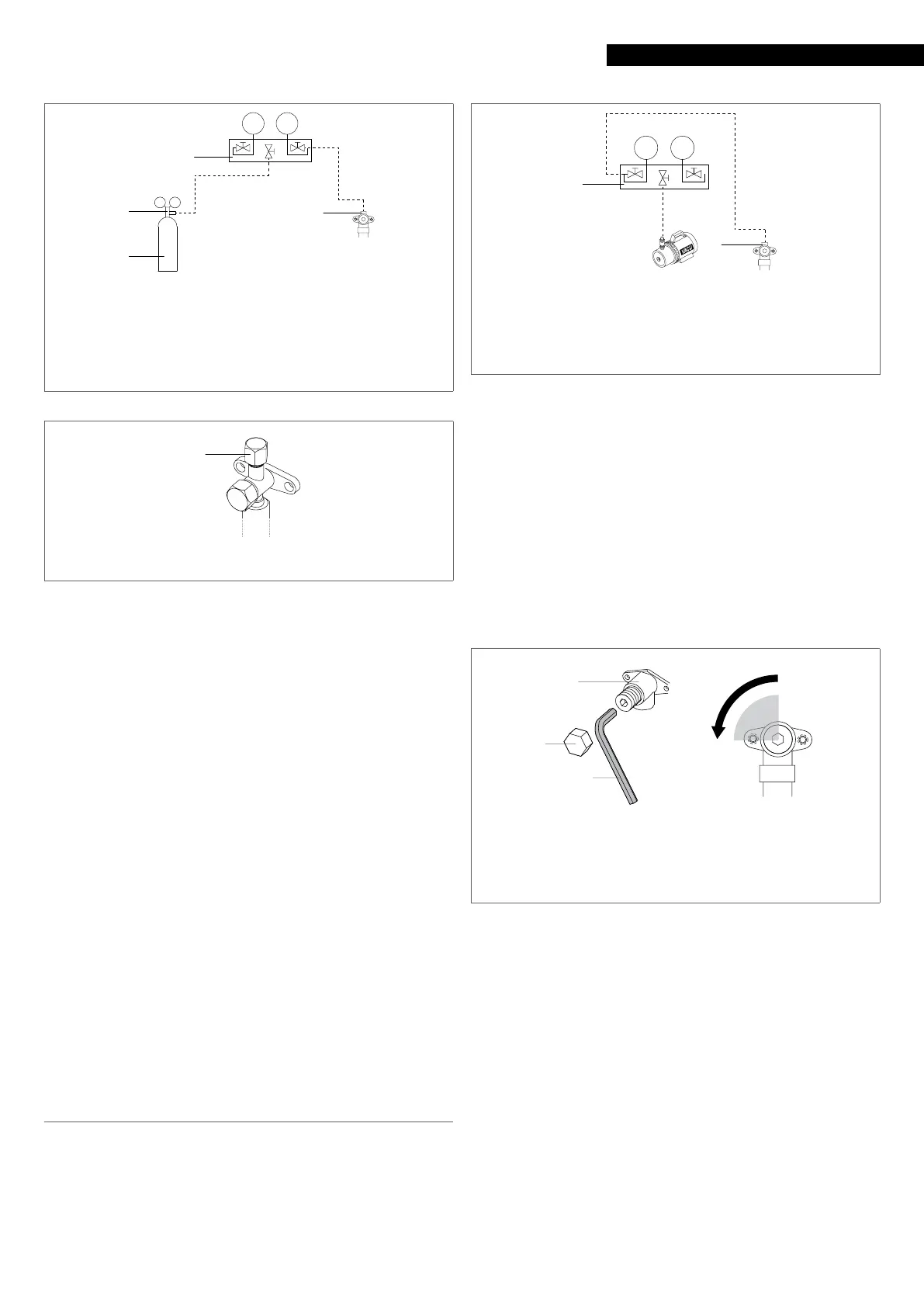
A High pressure
B Low pressure
1 Nitrogen cylinder
2 Pressure regulator
3 Pressure gauge unit
4 3-way valve service connection
N2
AB
1
2
3
4
1 3-way valve service connection
1
— charge the circuit with nitrogen through the service con-
nection on the 3-way shut-off valve
0
Do not use oxygen or acetylene or other flammable or poi-
sonous gases in the refrigerating circuit, as they can cause
explosions.
— reach a pressure equal to 0.3 Mpa
— wait 3 minutes.
— check that the pressure has not dropped
— reach a pressure equal to 1.5 Mpa
— wait 3 minutes.
— check that the pressure has not dropped
— reach a pressure equal to 3 Mpa
— adjust the reached pressure and room temperature
— leave the circuit pressurised for 1 day
— check that the pressure has not dropped
9
If the temperature has changed with respect to the noted
value consider that the pressure varied by 0.01 Mpa for 1 °C.
9
If pressure has dropped, detect the leak, fix it and repeat
the test.
9
To detect the leak, use a solution of water and soap and
check all the joints and welds, if any.
Having verified the absence of leakages:
— create a pneumatic vacuum inside the circuit
Pneumatic vacuum
To create vacuum in the circuit:
— keep the outdoor unit shut-off valves closed
A High pressure
B Low pressure
1 Pressure gauge unit
2 Vacuum pump
3 3-way valve service connection
AB
1
2
3
— connect the vacuum pump to the pressure gauge unit
— connect the pressure gauge unit to the service connection
on the 3-way shut-off valve
— completely close the pressure reducing valve of the pres-
sure gauge
— fully open the low pressure valve of the pressure gauge unit
— let the vacuum pump work for at least 15 minutes
— reach a pressure that is close to -0.1 Mpa
— close the low pressure valve of the pressure gauge unit
— switch off the vacuum pump
— wait 5 minutes
— check that the pressure has not risen again
If the pressure has risen again:
1 2-way shut-off valve
2 On-off valve cover plug
3 Hex wrench
A Opening by 1/4 of a turn
A
3
1
2
— open the 2-way shut-off valve by a quarter of a turn
— close it after 6 seconds so as to allow a small quantity of
refrigerant into the circuit
— detect the leak using a solution of water and soap
— fix the leak
— recreate the pneumatic vacuum
9
Take the necessary safety precautions for the system refrig-
erant.
9
It is forbidden to carry out welding operations with refrig-
erant inside the cooling circuit. If necessary, the refrigerant
must be recovered and the circuit must be cleaned with ni-
trogen without oxygen.
0
It is forbidden to use detergents containing chlorine be-
cause it could react with the refrigerant and corrode the
copper pipes.





 To Next Page