INSTALLATION
16
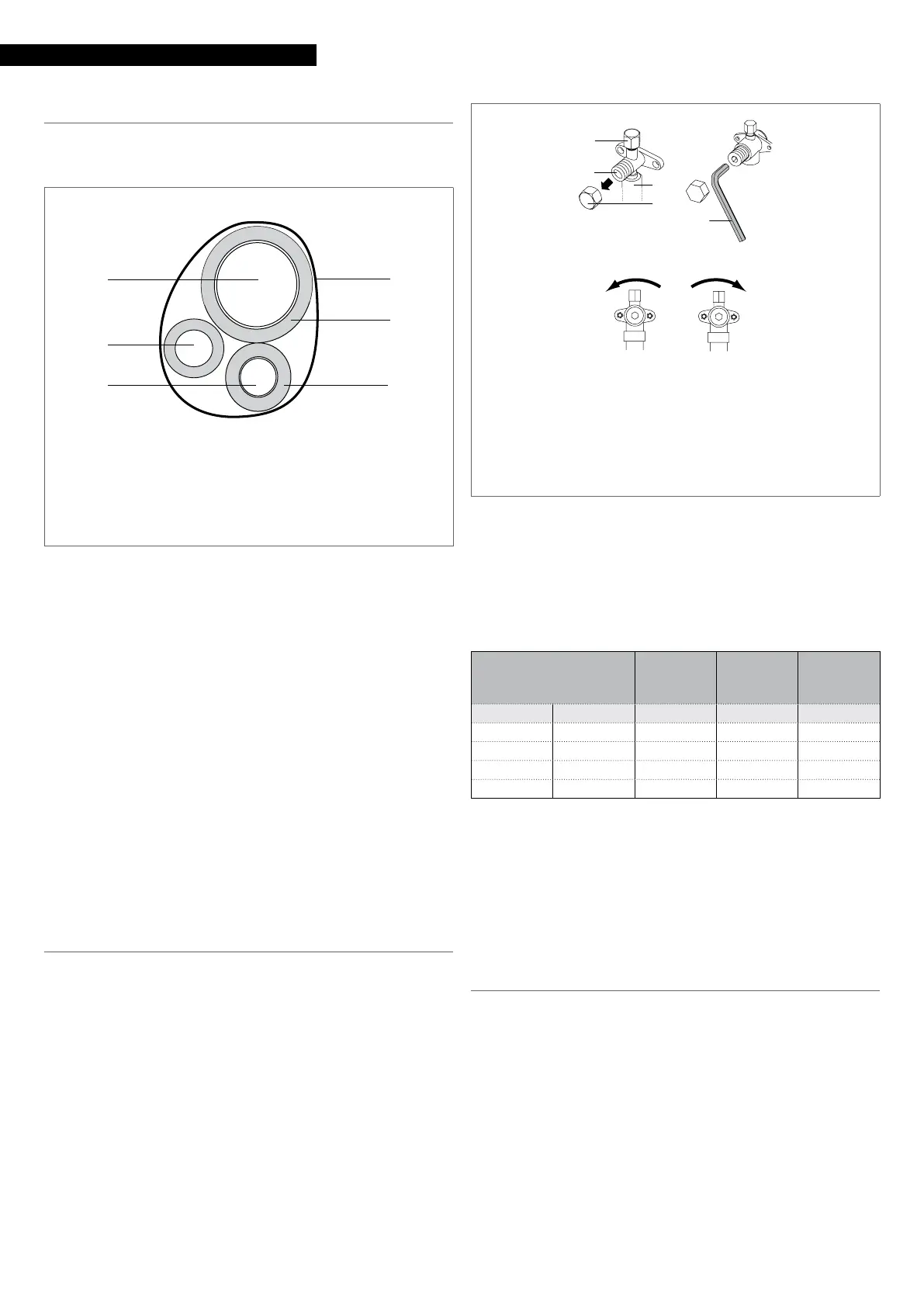
Pipe insulation
Connection pipes must be thermally insulated to prevent dis-
persions of heat or formation of condensate.
1 Gas pipe
2 Condensation discharge
3 Liquid pipe
4 Heat insulation
5 Adhesive tape
5
4
4
1
2
3
— insulate the liquid and gas pipes separately
— use insulating material that is thicker than 15 mm
— ensure that the insulating material adheres to the pipe
without gaps
— fix using adhesive tape
9
Do not tighten the adhesive tape excessively to prevent
damaging the insulation.
9
Avoid partial insulation of the pipes.
9
In case of use with outdoor temperature above 30 °C and
relative humidity above 80%, increase wall thickness up to
20 mm.
For gas pipes:
— ensure that the material used resists to temperatures up
to 120°C
For liquid pipes:
— ensure that the material used resists to temperatures up
to 70°C
Stop valves
Cooling connections feature shut-off valves.
During operations on the cooling circuit, start-up and service, it
may be required to open and close the valves.
A Opening
B Closing
1 Service connection blanking plug
2 On-off valve shaft
3 Refrigerating pipe attachment
4 On-off valve cover plug
5 Hex wrench
1
2
3
4
5
AB
If required:
— remove the valve covering plug
— operate on the valve shaft with an hex wrench
— open or close according to what is needed
— immediately stop as soon as the valve shaft has reached
the stop point
— use a torque wrench calibrated on the valve diameter
Pipe Ø
Hex
wrench
Valve
tightening
torque
Plug
tightening
torque
mm inches mm Nm Nm
6,35 1/4 5 6 25
9,52 3/8 5 6 25
12,70 1/2 5 8 30
15,88 5/8 5 10 35
9
Do not force beyond the stop point to prevent damaging the
shaft and causing leakage as a consequence.
At the end of the operations:
— refit the valve covering plug
9
Carefully check for absence of leakages from the closing
point of the plug.
Circuit tightness check
The appliance is tested at the factory and the indoor refrigerat-
ing circuit tightness does not usually need to be checked.
The refrigerating circuit built on site needs to be checked instead.
To check tightness:
— keep the outdoor unit shut-off valves closed





 To Next Page