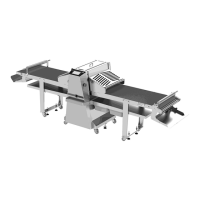
The device is a Dough Sheeter, available in models R62, R62T, R65, and R65T. Its primary function is to produce sheets from bread, pastry, and pizza dough by passing the dough through calibrating cylinders with alternating forward and backward movement. The "T" models (R62T, R65T) are equipped with an additional cutting station for cutting dough and making products like croissants.
Important Technical Specifications:
- Cylinder Length: 600 mm for R62/R62T, 660 mm for R65/R65T.
- Cylinder Diameter: 71 mm for all models.
- Cylinder Opening (Dough Thickness): 0-48 mm for all models.
- Table Width: 590 mm for R62/R62T, 650 mm for R65/R65T.
- Table Lengths (available models):
- R62: 1000 mm, 1200 mm, 1300 mm, 1400 mm.
- R62T: 1200 mm, 1300 mm, 1400 mm.
- R65: 1200 mm, 1400 mm, 1600 mm.
- R65T: 1400 mm, 1600 mm.
- Machine Body Weight: 182 kg for R62/R62T, 192 kg for R65/R65T.
- Table Weight (varies by length):
- R62/R62T: 31 kg (1000 mm), 35 kg (1200 mm), 37 kg (1300 mm), 39 kg (1400 mm).
- R65/R65T: 43 kg (1200 mm), 47 kg (1400 mm), 64 kg (1600 mm with fixed leg and shelf).
- Overall Weight (varies by model and table length): Ranges from 244 kg (R62/1000) to 307 kg (R62/1600).
- Nominal Voltage/Frequency:
- R62-R65: 400V*; 230V* / 50; 60 Hz (Admissible tolerance: +/- 10%).
- R62T-R65T: 230V* / 50; 60 Hz (Admissible tolerance: +/- 10%).
- Number of Electrical Phases: 3/2~ + PE.
- Min/Max Room Temperature: -5 / +40 °C.
- Maximum Average Room Temperature (over 24 hours): 35 °C.
- Maximum Relative Room Humidity (with T<40 °C): 50%.
- Maximum Altitude Above Sea Level: 2000 m.
- Noise Level: Lower than 70 dB(A) (equivalent continuous A-weighted sound pressure level) under normal operating conditions without load.
Usage Features:
The machine is designed for "standard" intermittent use over work shifts in closed and protected environments. It must not be used outdoors, in marine environments, or in areas with fire/explosion risks, high humidity, excessive water/oil vapors, dust, or corrosive substances.
- Controls and Adjustments:
- Main Power Switch: O (OFF) / I (ON).
- Flour Collection Drawer Control Microswitch: Ensures the machine won't operate if the drawer is not correctly located.
- Mobile Guards Control Microswitch: Prevents operation if guards are open.
- EMERGENCY STOP Push-button: Red mushroom on yellow background.
- Belt Speed Adjustment: (Only for R62T, R62-I, R65T, R65-I models) Allows selection of required work speed.
- Operation Enable Push-button: With a pilot light indicating operating status (fixed green for power, flashing green for machine ready).
- Start, Reversal, and Operating Cycle Pause Push-buttons: Used to initiate operation and reverse belt direction.
- Operating Cycle Reversal Pedal (option): Provides an alternative for reversing belt direction.
- Inversion Pause Selector (3-position): Allows selecting a pause interval during belt reversal.
- Roller Opening Adjustment Handle/Handwheel: Adjusts dough thickness (0-48 mm) with a system for setting final thickness for repeatability.
- Dough Sheeting Process:
- Place dough on the work table.
- Adjust cylinder thickness using the handle/handwheel.
- Press the start push-button on the side where the dough is deposited; the belt starts moving.
- Pressing the push-buttons (or pedal) reverses the belt direction.
- To stop for folding/turning dough, press a start push-button for a longer period.
- Resume by pressing the push-button on the dough's side.
- Cutting Station (R62T, R65T models):
- Features levers for lifting/lowering knives, a quick-release system, and pressure adjustment knobs.
- Allows for easy assembly/disassembly of cutting disks (knives) of different diameters (D < 115 mm or D1 > 115 mm).
- Knife cutting pressure can be adjusted to achieve the desired cut.
- Flour Duster (optional for R65, R65T, R65-I):
- Hopper capacity of approximately 5.5 kg.
- Dividers allow limiting the dusting width.
- Handwheel adjusts flour quantity.
- Push-button activates the duster.
- Hopper is quickly removable for cleaning.
- Dough Reeler (optional for R65-I):
- Used to roll the dough sheet.
- Has a resting position (A) and a working position (B).
- Lever rotates the reeler into working position, dropping the rolling pin onto the table.
- Belt speed can be reduced during rolling and increased once rolling begins.
Maintenance Features:
Maintenance is divided into Ordinary and Extraordinary.
- Ordinary Maintenance (operator can perform):
- Daily Cleaning: Thorough cleaning of the machine, belts, and work tables at the end of each working day/shift. This includes emptying and cleaning the flour collection drawer.
- Safety Device Checks: Ensure all safety devices are efficient at the beginning of each working day/shift.
- Belt Tension Adjustment: Belts stretch over time. Loosen side screw (A), use an Allen wrench on screw (B) to adjust tension and alignment on both sides, then fasten screw (A).
- Extraordinary Maintenance (authorized engineers only):
- Chain Tension Adjustment: Involves removing the back guard, loosening lock nut (1), fastening nut (2), and then re-fastening lock nut (1) after adjustment.
- Chain Replacement: Requires removing the back guard, completely loosening lock nut (1) and nut (2), lifting the electric motor saddle, removing worn chains, replacing them, locking nut (2) until chains are stretched, fastening lock nut (1), and reassembling the back guard. Both chains must be replaced.
- Handle Lubrication: Involves removing the front lid, sliding out the handle, loosening a grub screw to remove the graded sector, lubricating with an oil pump, and reassembling.
- Electrical Maintenance: Any work on electrical components must be performed by specialized, professionally trained engineers after disconnecting power.
- Cleaning the Scrapers:
- Upper Roller Scraper: Open mobile guards, push scraper against the roller, slide it into position, then remove and clean.
- Lower Roller Scraper: Open mobile guards, rotate handle/handwheel to maximum cylinder opening, rotate locking knob anti-clockwise, lift scrapers using side flaps, clean, reposition (recess on opposite side of cylinder, blades vertical), and lock the knob clockwise.
- Replacing the Belts: Disassemble the work table, remove protection and table support, loosen tensioning screws, push resting roller, remove old belt, insert new one (two people required), reposition table, stretch belt, and reassemble.
- Long Stops/Service Discontinuation: Disconnect from electric grid, clean thoroughly, cover with waterproof sheets, and protect from damage. Before reuse, perform a thorough check as if it were a first start-up.
Safety Features:
The machine incorporates several safety devices to mitigate risks:
- Mobile Guards with Safety Microswitches: Prevent operation if guards are not closed.
- Flour Collection Drawer Closing Control Microswitch: Prevents operation if the drawer is not correctly inserted.
- Emergency Stop Switch: For immediate shutdown in emergency situations.
- Fixed Guards: Including front and back transmission guards, electric board door, fixed cutting station guard (on T models), and flour tray, which require tools for removal.
- Residual Risks: While risks like crushing, cutting, gripping, and electrocution are minimized, residual risks exist, especially during maintenance operations where fingers could get trapped in openings.
- Safety Procedures: Operators must be adequately trained and informed. All maintenance and cleaning operations must be performed with the main switch OFF and power plug disconnected. Guards should only be removed if absolutely necessary by authorized personnel, and immediately reinstalled and safety devices enabled once the task is complete. Daily checks of fixed and mobile guards are mandatory.

 Need help?
 General

 To Next Page