EB 8097 EN 3-1
Design and principle of operation
3 Design and principle of oper-
ation
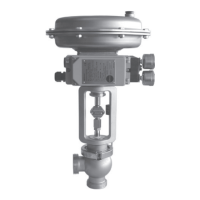
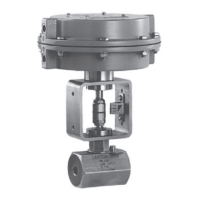
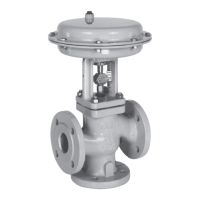
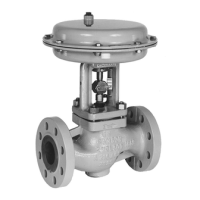
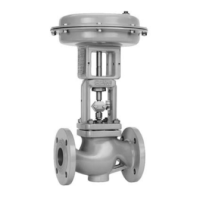
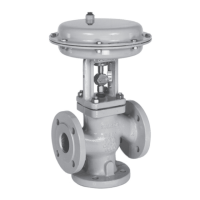
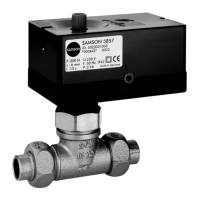
See Fig.3-1 to Fig.3-4
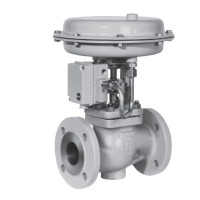
The Type3347 Angle Valve is preferably
combined with a SAMSON Type3271 or
Type3277 Pneumatic Actuator. It can also
be combined with other actuators (e.g.
Type3372 Electropneumatic Actuator). We
recommend using a Type3379 Pneumatic
Actuator for high cleanability requirements.
The standard valve body is designed for
welding into pipelines. Other versions can
be equipped with threaded or anged ends
or clamp connections.
The control valve is tted with an easily de-
tachable clamp connection between valve
body and yoke. The body free of dead cavi-
ties is suitable for CIP (Cleaning-In-Place).
The control valves are mainly designed for
use as control or on/off valves in the food
industry.
The medium ows through the valve in the
direction indicated by the arrow. The plug
(2) is moved by changing the signal pressure
acting on the diaphragm of the actuator.
The plug stem with plug (2) and actuator
stem (8.1) are connected by the stem con-
nector (7 or 8.4) and sealed by seals.
In the special version with steam barrier, an
additional spring-loaded PTFE ring packing
is used. In this case, the plug stem can be
cleaned by using a steam barrier.
3.1 Fail-safe position
The fail-safe position of the control valve up-
on air supply or control signal failure de-
pends on the actuator used (see associated
actuator documentation).
Depending on how the compression springs
are arranged in the SAMSON pneumatic
actuator, the valve has two different fail-safe
positions:
− Actuatorstemextends: when the signal
pressure is reduced or the air supply
fails, the springs move the actuator stem
downward and close the valve.
The valve opens when the signal pressure
is increased enough to overcome the
force exerted by the springs.
− Actuatorstemretracts: when the signal
pressure is reduced or the air supply
fails, the springs move the actuator stem
upward and open the valve.
The valve closes when the signal pressure
is increased enough to overcome the
force exerted by the springs.
The actuator's direction of action can be re-
versed, if required. Refer to the mounting
and operating instructions of the pneumatic
actuator:
Tip



 To Next Page