5-4 EB 8097 EN
Installation
Risk of valve damage due to the use of un-
suitable tools.
Î Only use tools approved by SAMSON
(see the 'Tightening torques, lubricants
and tools' chapter in the Appendix).
Risk of control valve damage due to incor-
rect handling.
Make sure that the stem seal is not dam-
aged.
Î The plug must not be moved beyond the
valve travel.
5.3.1 Mounting the actuator
onto the valve
Risk of personal injury due to preloaded
springs.
Actuators with preloaded springs are under
tension. They can be identied by the long
bolts protruding from the bottom of the actu-
ator.
Î Before starting any work on the actuator,
relieve the compression from the pre-
loaded springs (see associated actuator
documentation).
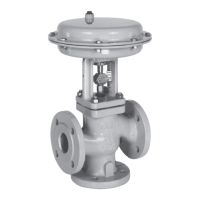
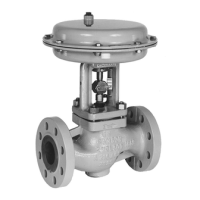
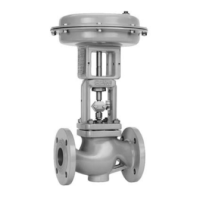
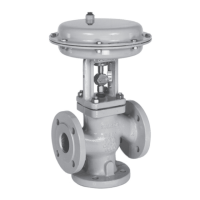
Depending on the version, SAMSON control
valves are either delivered with the actuator
already mounted on the valve or the valve
and actuator are delivered separately. When
delivered separately, the valve and actuator
must be assembled together on site.
A valve assembly tted with a SAMSON
Type3379 Pneumatic Actuator is always de-
livered with the actuator ready mounted.
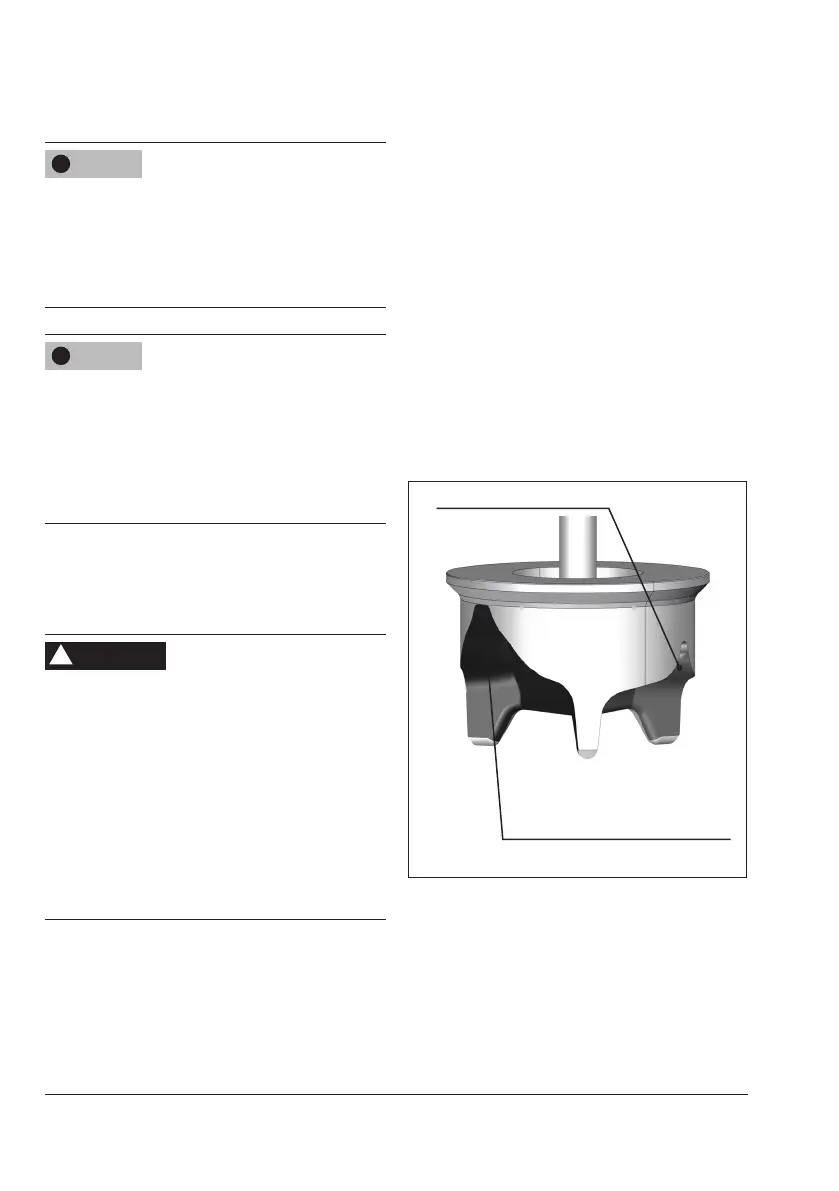
Versions with V-port plug and
Type3271/3277orType3372Actuator
To achieve the best ow conditions inside the
valve, the V-port plug must always be in-
stalled with the port that releases the ow
rst when the valve opens facing toward the
valve outlet. This is the largest of the three
V-shaped ports (see Fig.5-1).
1x large V-port:
First to release the ow when the
plug is lifted out of the seat.
2x small V-ports
Fig.5-1: V-port plug
Î Before mounting the actuator, determine
which V-shaped port is uncovered rst
when the plug is lifted out of the seat.
Î On mounting the actuator, make sure
that the V-shaped port uncovered rst
faces toward the valve outlet:
NOTICE
!
NOTICE
!
WARNING
!



 To Next Page