EB 8313-3 EN 3-1
Design and principle of operation
3 Design and principle of oper-
ation
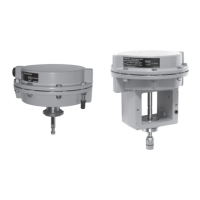
The Type3372 Electropneumatic Actuators
have an actuator area of either 120 or
350cm². They are mainly used for attach-
ment to SAMSON Series V2001 Valves:
− Type3321 Globe Valve
− Type3323 Three-way Valve
− Type3531 Globe Valve for Heat Transfer
Oil
− Type3535 Three-way Valve for Heat
Transfer Oil
Table 3-1 and Table 3-2 provide an over-
view of the possible combinations and how
the actuator is mounted on the valve.
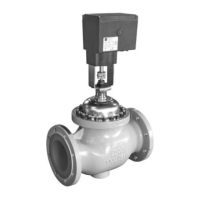
The electropneumatic actuators mainly con-
sist of two diaphragm cases, a diaphragm
and internal springs. The actuator is connect-
ed to the valve bonnet using a rod-type
yoke. The stem connector clamps connect the
actuator stem with the plug stem of the valve.
The Type3725 Electropneumatic Positioner is
attached to the rod with the largest diameter
using a support element. This positioner con-
verts the control signal received from a con-
trol system (4 to 20mA reference variable)
into a proportional pressure signal.
The signal pressure p
st
creates the force F =
p
st
· A at the diaphragm surface A, which is
opposed by the springs in the actuator. The
bench range is determined by the number of
springs used and their compression, taking
into account the rated travel. The travel is
proportional to the signal pressure p
st
.
3.1 Direction of action
The direction of action is determined by how
the springs and diaphragm plate are ar-
ranged in the actuator. The direction of ac-
tion is xed at the ordering stage and cannot
be changed.
Actuator stem extends (FA)
With direction of action "actuator stem ex-
tends", the compressed air is applied to the
signal pressure connection on the bottom di-
aphragm case.
Actuator stem retracts (FE)
With direction of action "actuator stem re-
tracts", the compressed air is applied to the
signal pressure connection on the top dia-
phragm case.



 To Next Page