2 - Features
Stationary Air Compressor System Operating Instructions
13
Bulk vs. Cascade Storage Systems
Storage receivers can be congured together as a single
bulk storage bank, or separately in a cascade system.
When congured as a single bank, cylinders are “piped”
together into a single volume. Storage pressure is
indicated by a single gauge on the main control panel.
Cylinders in a cascade system are plumbed separately
which allows for more efcient use of compressed air
since each cylinder can be isolated when accessing
system air. With a manual cascade system, a cascade
panel with individual ll control valves and gauges for
each cylinder or bank require the operator to control the
selection and ow of air from each bank.
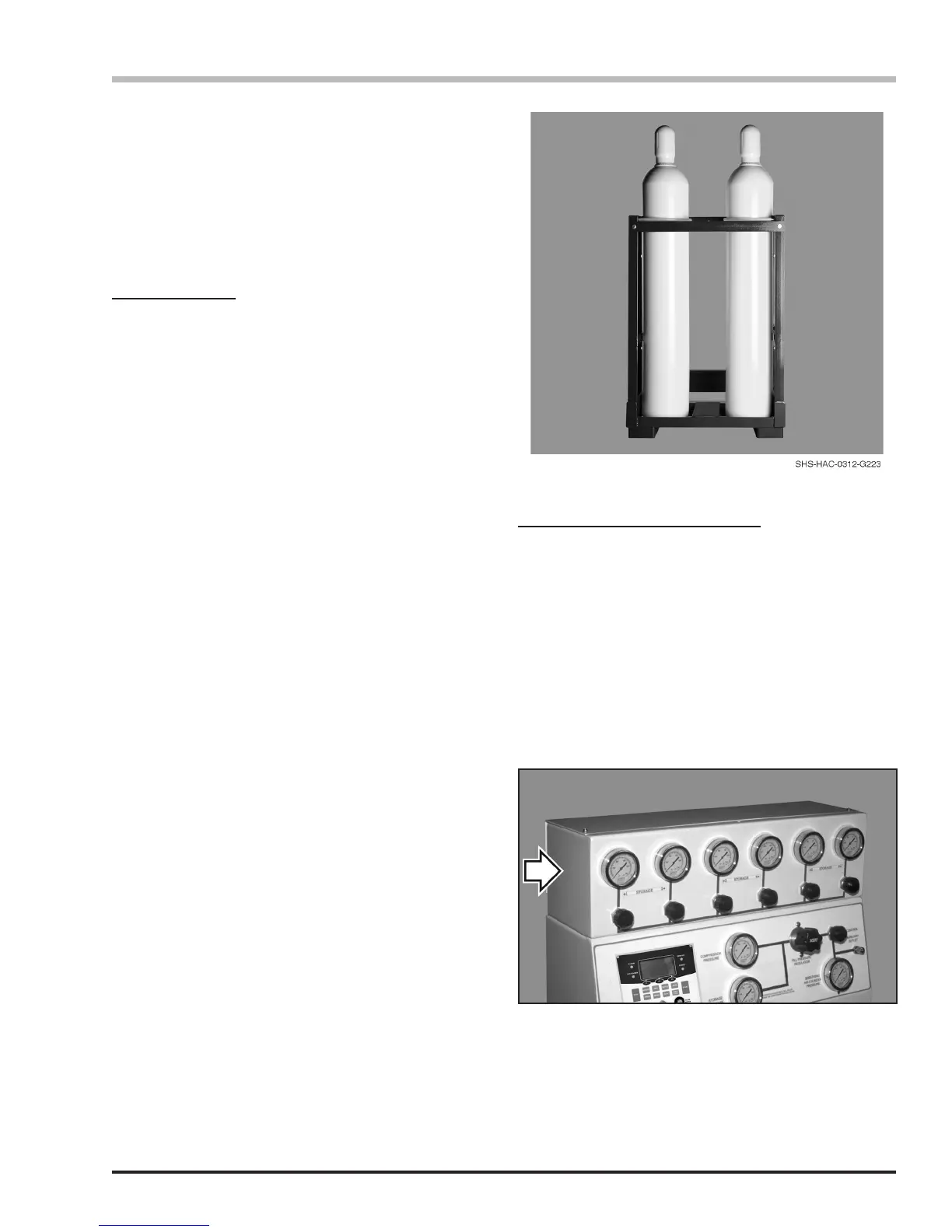
DOT Storage Cylinders
Storage
The Stationary Air compressor may be congured to direct
compressed air to an optional air storage system.
Storage systems can meet peak demands for compressed
air without the requirement of full-time compressor
operation. Stored air can also be used to carry on
operations in the event of compressor failure, loss
of power to run a compressor, or in areas where
compressors are not available.
Storage Cylinders
A standard air storage system consists of a set of two,
four, or six ASME or DOT certied storage cylinders.
ASME cylinders are designed and constructed in
accordance with Section Eight of the American Society of
Mechanical Engineers (ASME) code for Unred Pressure
Vessels. ASME cylinders may be installed vertically or
horizontally, depending upon system options. All storage
systems are equipped with a service valve and a relief
device.
DOT cylinders meet the standards set by the Department
of Transportation (DOT); these cylinders are generally
lighter in weight (approximately 200 lbs each) and are
always installed vertically.
Each DOT cylinder stores 509 standard cubic feet at
6000 psi. Each ASME cylinder has the capacity to store
454 standard cubic feet (SCF) at 5000 psi, or 525 SCF
at 6000 psi.
DOT cylinders must be visually inspected and
hydrostatically tested by a licensed cylinder re-tester
in accordance with the appropriate US Department
of Transportation (DOT) specification or applicable
DOT exemption, or in accordance with the appropriate
Transport Canada (TC) Permit of Equivalent Level of
Safety. Depending on when the DOT storage cylinders
were purchased, this may be ve (5) or ten (10) years.
Verify the required re-test schedule for your DOT storage
cylinders and establish a procedure for haveing the
cylinders re-tested to that schedule.
The date of manufacture marked on the cylinder is also
the date of the rst hydrostatic test. Subsequent test
dates are indicated by labels afxed to the cylinder.
If the required hydrostatic test date has expired for
the DOT cylinder, DO NOT USE the cylinder. Notify a
supervisor or other certied personnel responsible for
cylinder inspection.
ASME cylinders do not require hydrostatic testing, but
include a drain valve and gauge. If installed, safety valves
on ASME cylinders must be tested on an annual basis.
ASME safety valves can by identied by a tag or label
showing traceability to the National Bureau of Standards
(NB) and a tamper evident seal. Some SCOTT storage
systems with ASME storage cylinders are protected by
single use rupture disks that cannot be tested.
Refer to specic ASME or DOT safety standards for
additional testing information.
Manual Cascade Air Storage - Control Panel
With the SCOTT Smart Fill Auto Cascade cylinder
filling system, the selection and flow are managed
automatically. Instructions for use of a cascade storage
system are included in the separate procedures for lling
breathing air cylinders.


 To Next Page