SECTION
5
SCALE MODE
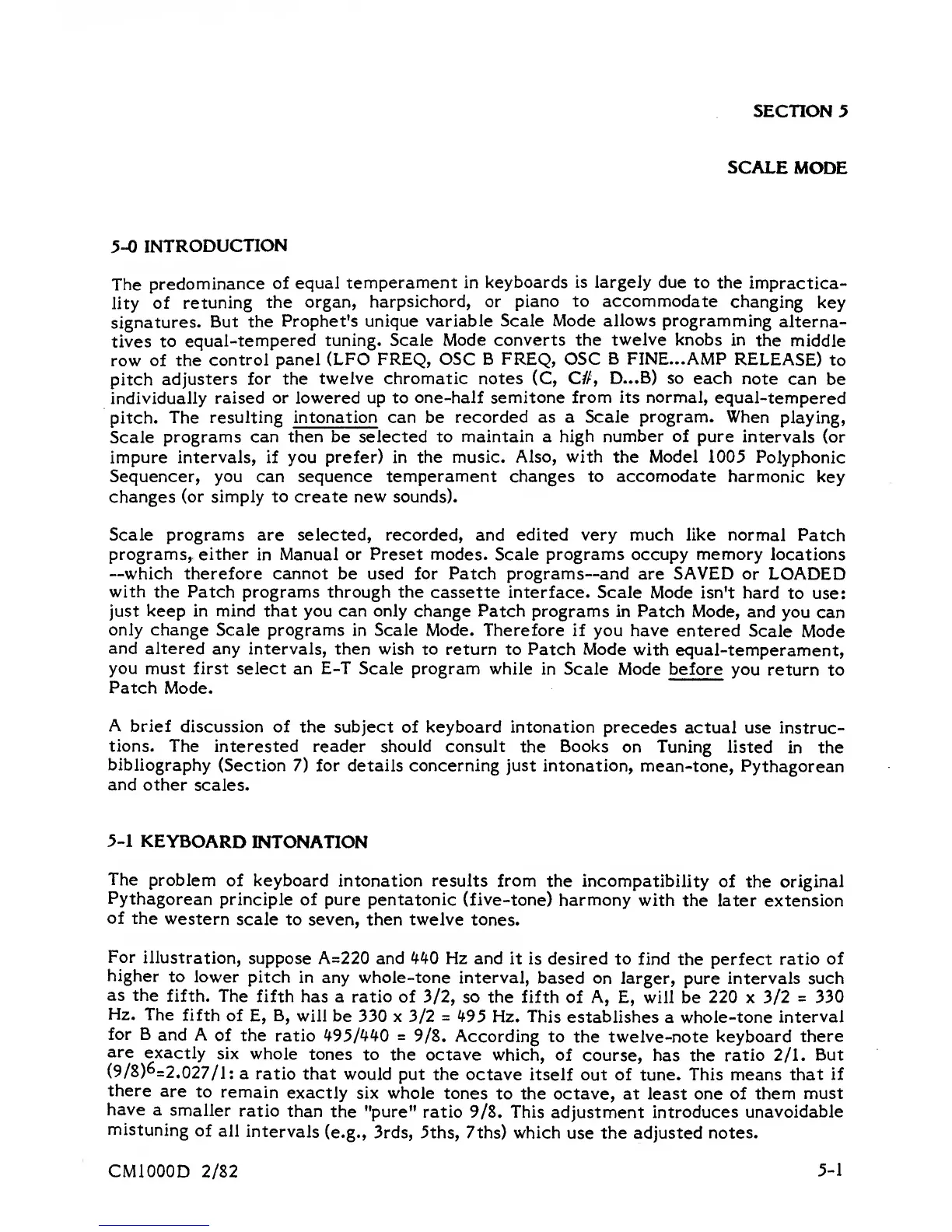
5-0 INTRODUCTION
The
predominance
of
equal
temperament in
keyboards is largely due
to the
impractlca-
lity
of
retuning
the
organ,
harpsichord, or piano
to accommodate
changing
key
signatures.
But the
Prophet's unique
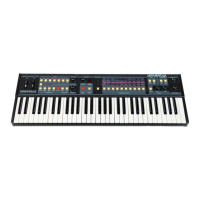
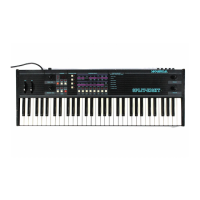
variable Scale Mode allows programming
alterna-
tives to
equal-tempered
tuning. Scale Mode
converts the
twelve
knobs in
the middle
row
of the
control
panel
(LFO
FREQ,
OSC B FREQ, OSC B FINE...AMP
RELEASE)
to
pitch
adjusters for the
twelve chromatic notes (C, C//,
D...B) so each
note
can
be
individually raised
or lowered up to one-half semitone
from its normal,
equal-tempered
pitch.
The resulting intonation can be
recorded as
a
Scale
program.
When
playing,
Scale
programs
can then be selected to maintain a
high number
of
pure
intervals (or
impure intervals, if you
prefer)
in
the music. Also,
with
the Model 1005
Polyphonic
Sequencer, you can sequence
temperament
changes to
accomodate
harmonic
key
changes
(or
simply to create new sounds).
Scale programs are selected, recorded, and edited very much like
normal Patch
programs, either
in
Manual or Preset modes. Scale programs occupy memory locations
—which
therefore cannot
be used for Patch programs—and are SAVED
or LOADED
with
the
Patch
programs through the
cassette interface. Scale
Mode isn't hard
to use:
just keep in mind that you can only change Patch programs
in Patch Mode,
and
you can
only change
Scale programs in Scale Mode. Therefore
if you have
entered
Scale
Mode
and
altered
any intervals, then
wish to return to Patch Mode
with
equal-temperament,
you
must first select an E-T Scale program while
in Scale
Mode before
you return
to
Patch
Mode.
A
brief
discussion of
the subject of keyboard intonation
precedes
actual use
instruc-
tions. The
interested reader should consult
the
Books
on Tuning
listed
in the
bibliography
(Section
7)
for details concerning just
intonation,
mean-tone,
Pythagorean
and
other
scales.
5-1
KEYBOARD
INTONATION
The
problem
of keyboard intonation results
from the
incompatibility
of the
original
Pythagorean
principle of pure pentatonic
(five-tone) harmony
with
the later extension
of the
western
scale to seven, then twelve
tones.
For
illustration,
suppose A=220 and
^i^O
Hz and
it is desired to
find
the
perfect ratio
of
higher
to
lower
pitch
in any whole-tone interval,
based
on larger, pure intervals such
as the
fifth. The
fifth
has a ratio of
3/2,
so the
fifth of A,
E, will be
220
x 3/2
=
330
Hz.
The
fifth
of
E,
B,
will be
330 x
3/2
=
k95
Hz. This
establishes
a
whole-tone
interval
for B
and A
of the
ratio ^^95/440
=
9/8. According to
the twelve-note
keyboard
there
are
exactly
six
whole
tones
to the
octave which,
of course, has the ratio 2/1.
But
(9/8)6=2.027/1:
a ratio
that
would put the octave
itself out of tune. This means
that if
there
are
to
remain
exactly six whole
tones
to the octave, at least one of them
must
have
a
smaller
ratio
than
the "pure"
ratio
9/8.
This
adjustment
introduces
unavoidable
mistuning
of all
intervals
(e.g., 3rds, 5ths, 7ths) which
use the adjusted
notes.
CMIOOOD
2/82
5-1


 To Next Page