About
the
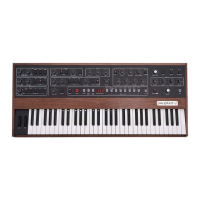
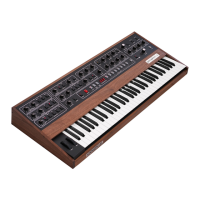
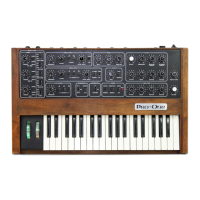
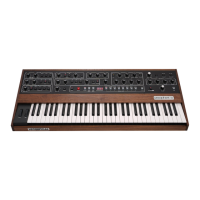
Prophet-5
The
Prophet-5 has
been the world's
leading
polyphonic
keyboard
synthesizer since its
appearance
in January,
1978. Renowned
among
professionals
for
the
range and quality
of
its sound,
it provides
five-voice
capability
and
now
allows
the
keyboardist to
instantly select
from
120
sounds
(programs).
All
programs can
be
fully customized
(edited)
and stored
internally, or
on audio
tape
via the
built-in
cassette
interface.
The
Prophet-5
actually
contains five
individual
synthesizers,
termed 'Voices."
For its
principle sound
sources, each
voice
contains
two
voltage-controlled
oscillators (VCOs),
referred to as
OSC A and
OSC B.
OSC A,
OSC
B, and a
white
noise source can
be
mixed into
a
resonant low-pass
voltage-controlled
filter
(VCF). The
filter modifies the
voice
timbre
under
control of its
four-stage
envelope
generator.
The filter may also
serve as a sound
source.
Following
each
filter, a
voltage-controlled amplifier
(VGA)
also controlled
by a
four-stage
envelope
generator
shapes the voice amplitude. Only
one voice is
depicted
on the
control
panel,
because
the voice
controls "patch"
the five
voices identically.
This makes
the
voices
homophonous—they
sound alike—with pitch
differences
corresponding to
(at
most)
five
simultaneously-held
keys.
Supplementing the
basic
voice
are
polyphonic
modulation
(POLY-MOD)
signal routings
within each
voice that
allow
OSC
B and
the
filter envelope
generator
to function
as
modulation
sources
applied
to
OSC A
frequency or
pulse-width,
or
to
the filter
frequency.
Finally, there
is a
single
low-frequency
oscillator (LFO)
and a pink noise
source which
can
be mixed to
modulate all
five voices, as adjusted by the modulation
(MOD)
wheel.
The
PITCH wheel
raises
or lowers the
pitch
of all voices
by
the same
interval.
The term
"digital-analog hybrid"
is often
used
to
describe the Prophet. This
means that
instead of
directly
controlling the analog
synthesizer voices, the keyboard
and most
controls are
actually
devices which
input "data" to a microcomputer system
which
in
turn "programs" the
voices. The
microcomputer system has three main functions.
First, it solves
the problem of
generating five independent sets of voice
control
voltages and gate signals
(which
operate
the envelope
generators) from
a single
keyboard. Second,
its digital
memory
provides
a way
to store all of the
switch and
knob settings which
form
a
program.
These
programs are retained
by
the
microcompu-
ter's
memory even when
the
Prophet is turned
off, thanks
to a
small
battery with
a
10-
year life. Third,
the
microcomputer
system
keeps the
ten
voice
oscillators
in tune.
Accessories
specifically
designed
for the
Prophet-5 include the Model 1005 Polyphonic
Sequencer which
allows
direct
storage
of lengthy
keyboard
sequences, and the Model
1001
Remote
Keyboard.
For
increased
performance flexibility, the Model
8'>2
Analog
Interface
Adapter
enables
remote
control of the
PITCH
and
MOD
wheels by two
Model
St^O
Voltage
Pedals.
Congratulations
on choosing the
Prophet-5.
It has already become
a
classic.
1X1


 To Next Page