EasyManua.ls Logo

Sequential prophet 5 - Data Format; Error Checking

Sequential prophet 5
94 pages
Print Icon
To Next Page IconTo Next Page
To Previous Page IconTo Previous Page
Loading...
6-1
DATA
FORMAT
Both
the
DATA
TO
and DATA FROM
SYNTH
signals
use
the
standard
asynchronous
serial
format:
start bit; eight data
bits; parity
(odd);
stop bit.
Start bit
is
low,
data
is
positive,
stop
is high.
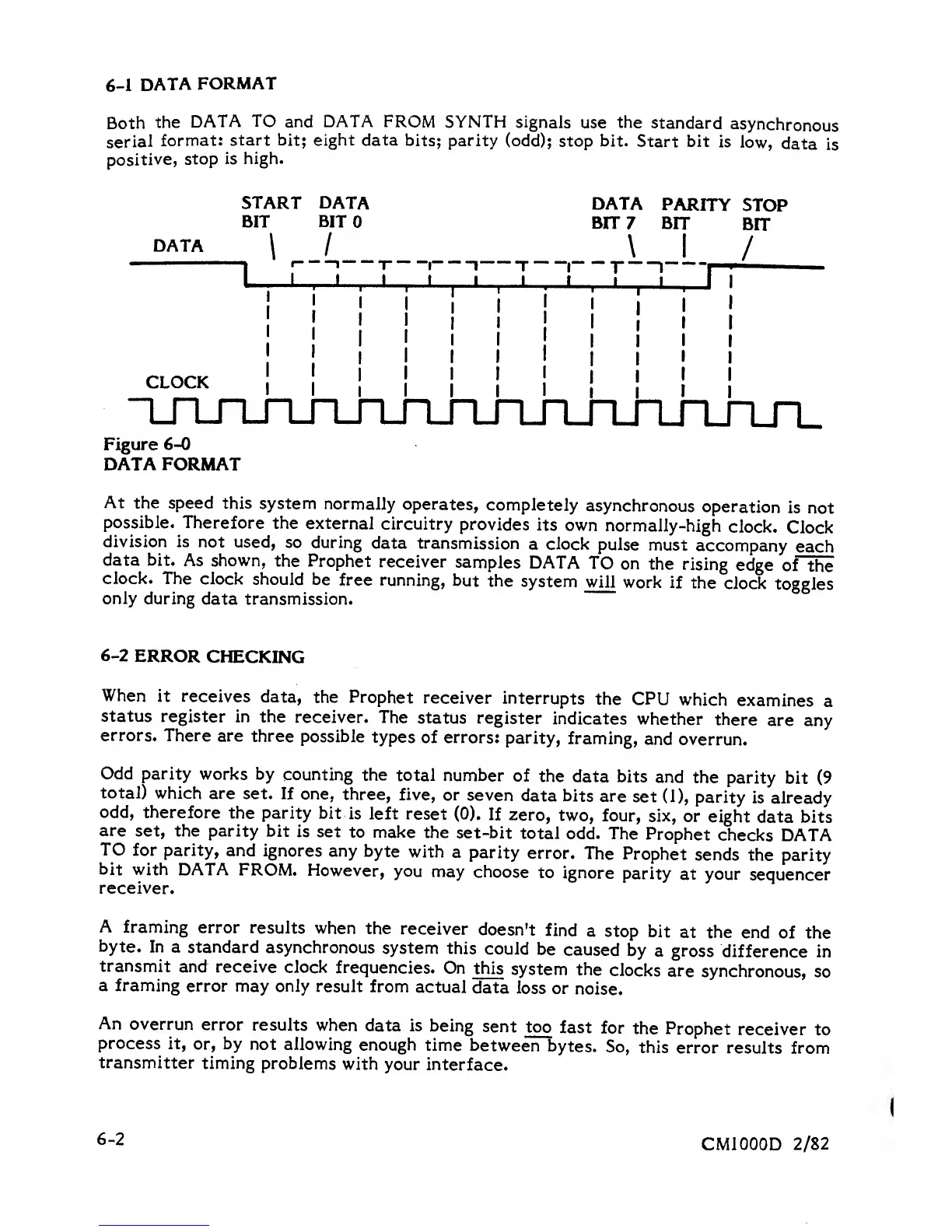
START DATA
BIT
BIT
DATA \
/
1
t
I
DATA
PARITY
STOP
NT
7 BIT
\
-1
r
r
I I
r
T
1-
U^
BIT
/
CLOCK
njnjnjnjTJiJiJTJiJiJnJi_rij~LrL
Figure
6-0
DATA FORMAT
At the
speed this
system
normally
operates,
completely
asynchronous
operation
is
not
possible.
Therefore
the
external
circuitry
provides
its
own
normally-high
clock.
Clock
division is
not used,
so during
data
transmission
a clock
pulse
must
accompany
each
data bit.
As shown,
the
Prophet
receiver
samples
DATA
TO on
the
rising
edge
oflhe
clock. The
clock
should
be
free running,
but the
system
will
work if
the
clock
toggles
only
during
data transmission.
6-2
ERROR
CHECKING
When
it receives
data,
the
Prophet
receiver
interrupts
the CPU
which
examines
a
status
register
in the
receiver. The
status
register
indicates
whether
there
are any
errors. There
are
three
possible
types
of errors:
parity,
framing,
and
overrun.
Odd parity
works by
counting the
total
number
of
the data
bits
and
the
parity
bit
(9
total)
which are
set. If
one,
three, five,
or
seven
data
bits
are
set
(1),
parity
is already
odd,
therefore
the parity
bit
is left
reset
(0).
If
zero,
two,
four,
six,
or
eight
data bits
are
set, the parity
bit
is set
to make
the
set-bit
total
odd. The
Prophet
checks
DATA
TO
for parity,
and ignores
any
byte
with
a
parity
error.
The
Prophet
sends the
parity
bit with
DATA
FROM.
However,
you
may
choose
to
ignore
parity
at your
sequencer
receiver.
A
framing
error results
when
the
receiver
doesn't
find
a stop
bit
at the
end of
the
byte.
In a standard
asynchronous
system this
could
be
caused
by
a
gross
difference in
transmit
and receive
clock
frequencies.
On
this
system
the
clocks
are
synchronous, so
a framing
error
may only result
from
actual
data
loss
or
noise.
An
overrun
error
results
when
data is
being
sent
too
fast
for
the
Prophet
receiver to
process
it,
or, by
not allowing
enough
time
between
bytes.
So,
this
error results from
transmitter
timing
problems
with
your interface.
6-2
CMIOOOD
2/82

Other manuals for Sequential prophet 5

Related product manuals