REPAIR PROCEDURES
AB18EJ&18HJ Maintenance Manual 6-35 © Oct 2020
• Inspect the battery. The top of the battery and
terminal connections must be kept clean and free
from dust and corrosion and must remain dry.
• Liquid on top of the battery could indicate there is
too much water in the battery.
• Inspect the connections between the battery cables
and other components. Tighten all loose
connections.
• Replace damaged battery cables.
• Be sure the vent caps are properly installed on the
battery.
Cleaning
• Clean the top, terminals and connections of the
battery with a cloth or brush and mixed solution of
sodium bicarbonate and water. Do not let the
cleaning solution enter the battery.
• Clean the top, terminals and connections with water
and wipe them dry with a cloth. Apply a thin layer of
petroleum jelly to the terminals or use terminal
protector.
• Keep the area around the battery clean and dry.
Filling in Distilled Water
• If necessary, add distilled water into the battery. The
frequency of adding water depends on the battery
applications and working temperature. Inspect the
battery every few weeks to determine if water needs
to be added. Generally, frequent battery use
requires frequent additions of water.
• Fully charge the battery before filling it with distilled
water. Only add distilled water into the discharged or
partially charged battery if the plate electrode is
exposed; in this case, fill it with distilled water to the
level just above the plate. Then, charge the battery
as follows:
1. Clean the vent caps before removing them to
prevent dirt and debris from entering the battery.
Inspect the electrolyte level. If the level is highe
than the plate, add water. If the level is lower
than the plate, add distilled water or deionized
water.
2. With a standard battery, add water until the level
is 3 mm (0.12 in) below the vent well(the plastic
cover inside the vent).
3. After filling the battery with water, install the vent
caps on the battery.
BATTERY CHARGING
Proper charging is essential for maximizing the battery
performance. Insufficient or excessive charging may
shorten the service life of the battery significantly. Most
chargers are automatic and pre-programmed, but some
chargers allow the user to set the voltage and current
values. Details about proper charging are as follows:
• The charge for this equipment is automatic and
preprogrammed so that the user does not need to
interfere with the charging process.
• Charge the battery fully after each use.
• The lead-acid battery does not have battery
memory. It is unnecessary to fully discharge it
before recharging it.
• Inspect the electrolyte level height and ensure the
positive and negative electrode plates are not
flooded by the water before charging.
• Before charging, be sure all the vent caps are
properly installed.
• Charge the battery only in a well-ventilated place.
• The battery will discharge gas (bubble) at the end of
charging. This bubbling indicates the electrolyte
solution is charged.
• Avoid charging the battery when the temperature is
above 49°C (120°F).
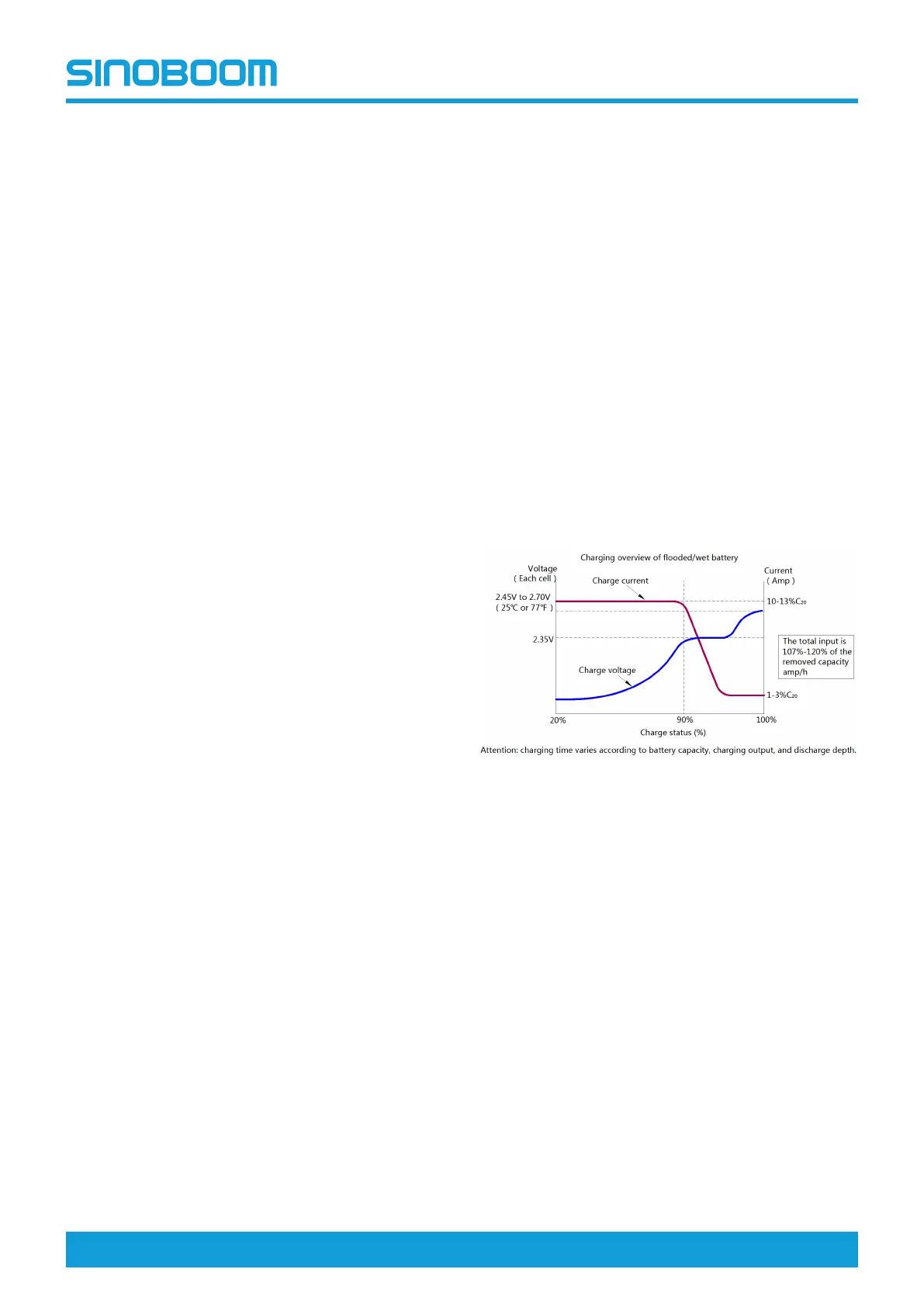
The following figure shows the battery charging
process.
Figure 6-20
EQUALIZATION
Equalization is the deliberate process of overcharging
the flooded/wet battery after it has been fully charged.
Equalize the battery only when the specific gravity of
battery is low (less than 1.25) or the scope (0.030) of
the specific gravity is wide after the battery is fully
charged. Do not equalize other batteries. The
conditions for equalizing a battery are as follows:
• Verify whether the battery is flooded/wet battery.
• Inspect the electrolyte level height to ensure that the
positive and negative electrode plates have not
been flooded before charging.
• Before charging, confirm that all the vent caps have
been fixed on the battery properly.
• Set the charger to equalization mode.
• The battery will bleed air in the equalization process
(forming bubbles).


 To Next Page