EasyManua.ls Logo

Sinoboom GTTZ10EJ - User Manual

Sinoboom GTTZ10EJ
88 pages
Print Icon
To Next Page IconTo Next Page
Loading...
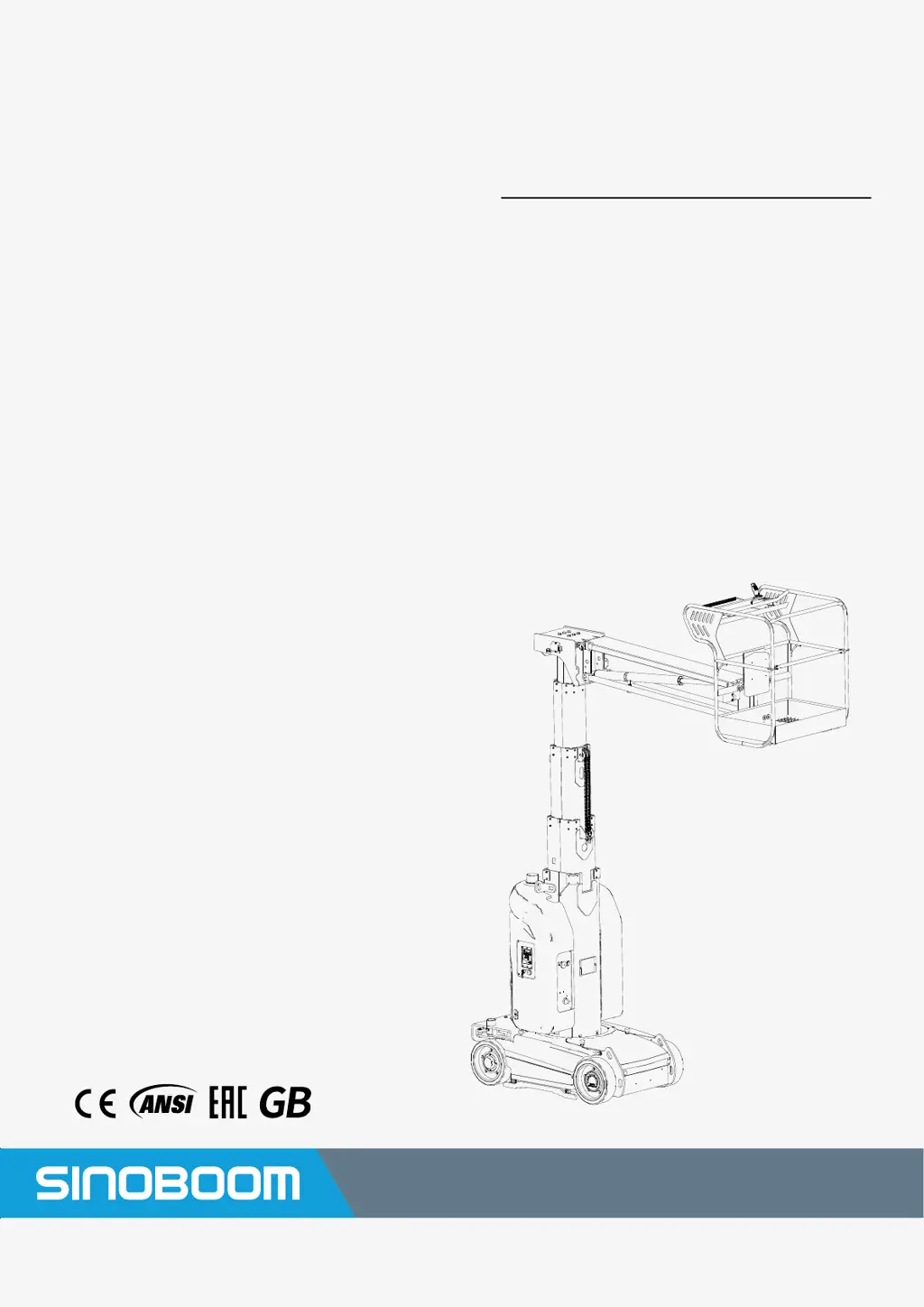
GTTZ10EJ/ML10EJ/ML340EJ
Operation
Manual
Part No.509002100002
Rev: A
Nov. 2020
G T JZ
0608E (2132E)
G T JZ
0808E (2732E)
G T JZ
0808E (2732E)
G T JZ
0808E (2732E)
长沙市宁乡高新技术产业园区金洲大道东
128
0731-87116111 hr@sinoboom . c om . cn ww w .sinoboom . c om . cn
Al w ays F or B e t t er A cc ess Solution s
我们一直在追求新的高
尺寸
210×285mm
20mm
20mm
产品说明书
PRODU C T MAN U AL

Table of Contents

Other manuals for Sinoboom GTTZ10EJ

Questions and Answers

  • S
    Shawn SilvaAug 20, 2025
    Why is the forward moving function inoperative on my Sinoboom Boom Lifts?
    • N
      Nicole GutierrezAug 20, 2025
      If the forward moving function is inoperative on your Sinoboom Boom Lift, it could be because the forward moving function is abnormal. Inspect whether the motor controller has an alarm, whether the line is connected improperly or is abnormal, and whether the lower platform controller is abnormal.
  • S
    steven89Aug 22, 2025
    Why is the backward moving function inoperative on my Sinoboom Boom Lifts?
    • A
      Angela CookAug 22, 2025
      If the backward moving function is inoperative on your Sinoboom Boom Lift, it could be because the backward moving function is abnormal. Inspect whether the motor controller has an alarm, whether the line is connected improperly or is abnormal, and whether the lower platform controller is abnormal.
  • T
    thowardAug 25, 2025
    Why is my Sinoboom Boom Lift overweight warning when it is no-load?
    • J
      jennifernashAug 25, 2025
      An overweight warning on your Sinoboom Boom Lift when it's no-load could be due to the load not being calibrated or because it is the first lifting/lowering operation. To resolve this, recalibrate the load coefficient.
  • M
    Maureen YorkAug 26, 2025
    What to do if the power indicator lamp is not lit up on my Sinoboom Boom Lifts?
    • A
      Andrew BoydAug 27, 2025
      If the power indicator lamp on your Sinoboom Boom Lift isn't lit, it could be due to several reasons: * The equipment hasn't been powered on. * The key is in the middle position. * The upper or lower platform emergency stop button is pushed down. Also, inspect the leads of the power supply and communication to ensure they are properly and reliably inserted. Check the upper platform plug and the connecting cable plug between the upper and lower platforms for good contact. Verify that the Deltatech plug of the lower platform controller is firm and correct. Finally, inspect the upper and lower platform controllers for any abnormalities.
  • K
    Kevin MooreAug 28, 2025
    Why is my Sinoboom Boom Lift tilting warning?
    • S
      sheparddarleneAug 28, 2025
      A tilting warning on your Sinoboom Boom Lift indicates a problem with the level switch. This could be because the level switch air bubble is not in the middle position, the level switch is not properly connected or not firmly inserted, or the lower platform controller is abnormal.
  • M
    Michael MeadowsAug 30, 2025
    What to do if my Sinoboom Boom Lift machine moves and then stops intermittently?
    • D
      David KingAug 30, 2025
      If your Sinoboom Boom Lift moves and then stops intermittently, it could be due to a low battery level or incorrect calibration. Try recalibrating the parameters. Note that the electricity meter can only be referred to for battery power status.
  • R
    Rebecca MitchellAug 31, 2025
    Why is my Sinoboom Boom Lift level status tilting always alarming?
    • J
      John BeckerAug 31, 2025
      If the level status tilting is always alarming on your Sinoboom Boom Lift, it's likely due to the level switch not being connected or having trouble. Inspect whether the level switch is inserted properly and firmly, and check the level switch for any abnormalities.
  • S
    Shawn PrattSep 2, 2025
    Why is there no overload warning on my Sinoboom Boom Lift?
    • J
      Joshua AllenSep 3, 2025
      The absence of an overload warning on your Sinoboom Boom Lift can occur if the load hasn't been calibrated or the height is incorrect. Check that the sensor has been calibrated, verify the wiring of the load sensor, and ensure the sensor is in good condition.
  • B
    Brandon NguyenSep 4, 2025
    What to do if the upper platform of my Sinoboom Boom Lift could not be lowered when there is no alarm?
    • T
      Taylor StevensonSep 4, 2025
      If the upper platform of your Sinoboom Boom Lift cannot be lowered and there is no alarm, it might be limited to 1.2m. Reset the handle and try the lowering operation again.
  • J
    jonesmatthewSep 6, 2025
    Why is the operation of the upper platform invalid on my Sinoboom Boom Lift?
    • J
      Johnny MartinSep 6, 2025
      If the operation of the upper platform is invalid on your Sinoboom Boom Lift, it could be because the key switch has not been turned to the operation of the upper platform. Ensure the key switch is placed on the base frame control position. Also, check if the system has not been powered off after the program was downloaded to the upper platform controller, and inspect the upper platform controller for any abnormalities.

Summary

Introduction to the Operation Manual

Machine Specifications Overview

Safety Precautions and Hazards

Safety Definitions and Hazard Levels

Explains safety alert symbols and hazard levels for danger, warning, and caution.

Reporting Accidents Procedure

Details the importance and process of reporting accidents promptly to the manufacturer.

Electrocution Hazards Awareness

Safety precautions related to electrical hazards and safe distances from conductors.

Electrical Shock Hazard Prevention

Maintaining safe distances from power lines and electrical equipment.

Tipping Hazards and Rated Load

Guidelines to prevent tipping and manage platform load capacity for stability.

Unsafe Jobsite Hazards

Identifies hazards associated with jobsite conditions, terrain, and environment.

Unsafe Operation Hazards

Common unsafe practices and their consequences during machine operation.

Fall Hazards Prevention

Safety measures and precautions to prevent falls from the platform.

Collision Hazards Mitigation

Preventing collisions with surroundings or other objects while moving.

Crush Hazards Avoidance

Precautions to avoid crushing injuries during machine movement and operation.

Explosion and Fire Hazards

Safety measures related to flammable atmospheres and battery handling.

Damaged Machine Hazards

Risks associated with operating a damaged or malfunctioning machine.

Bodily Injury Hazards

General safety guidelines for preventing bodily harm during operation.

Battery Hazards and Safety

Safety precautions for handling, charging, and maintaining batteries.

Chemical Burn Hazard Precautions

Risks of battery acid spills and necessary immediate precautions.

Welding and Polishing Safety

Safety guidelines and requirements before performing welding or polishing.

Welding Hazards

Specific hazards and procedures for welding operations on the machine.

Lockout After Each Use Procedure

Step-by-step procedure for safely shutting down and securing the machine.

Jobsite Inspection Guidelines

Unsafe Operation Hazard on Jobsite

Following safety rules and inspecting the machine and worksite before operation.

Pre-Operation Inspection Procedures

Unsafe Operation Hazard

Adhering to safety rules and understanding machine operation before use.

Tipping Hazard from Modifications

Modifying aerial platforms or adding devices that affect stability.

Conducting a Pre-Operation Inspection

Requirements for pre-operation checks, including manuals, labels, and parts.

Inspecting Machine Parts

Checking for damaged, loose, or modified parts on the machine.

Inspecting the Entire Machine

Inspecting the machine for structural integrity, damage, and completeness.

Inspecting Hydraulic Oil Level

Ensuring proper hydraulic oil level for machine operation and longevity.

Inspecting Battery Level

Checking the battery charge level for safe and effective operation.

Pre-Operation Function Test Procedures

Preparing for Function Test

Steps to prepare for function tests, including selecting a safe area.

Ground Controls Function Test

Testing all functions of the ground control system.

Collision Hazard Check During Test

Ensuring the work area is clear of persons before operating the boom.

Platform Controls Function Test

Testing all functions of the platform control system.

Testing Drive Speed

Verifying the machine's drive speed under different conditions.

Testing Emergency Lowering

Procedures for testing emergency lowering functions.

Mast Emergency Lowering Test

Testing the mast emergency lowering mechanism.

Jib Boom Emergency Lowering Test

Testing the jib boom emergency lowering mechanism.

Testing Pothole Protection

Verifying the functionality of the pothole protection system.

Testing Tilt Protection

Checking the machine's tilt protection system.

Testing 3° Level Switch

Testing the 3-degree level switch functionality.

Testing 7° Level Switch

Testing the 7-degree level switch functionality.

Testing Weighing System

Verifying capacity and overload detection of the weighing system.

Operating the Machine Safely

Unsafe Operation Hazard

Following safety rules and operating procedures for safe machine use.

Machine Stability Principles

Understanding machine stability conditions and tipping hazards.

Emergency Stop Function

Procedures for activating the emergency stop function on platform or ground controls.

Emergency Operating Procedures

Actions to take when the operator cannot control the machine.

Emergency Control Measures

Emergency control procedures for malfunction or power loss.

Emergency Towing and Dragging

Guidelines for safely towing or dragging the machine in emergencies.

Transporting and Lifting the Machine

Transport and Lifting Hazard Safety

Safety precautions during transport and lifting operations.

Lifting the Machine with a Crane

Procedures and requirements for lifting the machine using a crane.

Transporting the Machine by Truck;Trailer

Steps for safely transporting the machine by truck or trailer.

Machine Maintenance Procedures

Unsafe Operation Hazard During Maintenance

Following proper maintenance procedures to prevent injury or damage.

Maintenance Schedule Overview

Recommended intervals and tasks for routine machine maintenance.

Conducting Pre-Delivery Inspection

Procedures for pre-delivery inspections and required documentation.

Maintenance Inspection Report Guidelines

Forms and guidelines for recording maintenance inspection results.

Decals and Nameplates Inspection

Unsafe Operation Hazard from Decals

Importance of legible safety decals for hazard awareness and operation.

Decals and Nameplates (GB Standard)

Illustration and list of safety decals for the GB standard.

Decals and Nameplates (CE-Metric)

Illustration and list of safety decals for the CE Metric standard.

Decals and Nameplates (CE-Imperial)

Illustration and list of safety decals for the CE Imperial standard.

Decals and Nameplates (ANSI Standard)

Illustration and list of safety decals for the ANSI standard.

Appendix 1: Symbols and Descriptions

Symbols Chart

Visual guide to symbols used in the manual and their meanings.

Appendix 2: Prepare Work Record Before Delivery

Prepare Work Record Before Delivery Form

Form for recording pre-delivery inspection and maintenance results.

Appendix 3: Maintenance Inspection Report

Maintenance Inspection Report Template

Report template for tracking maintenance and inspection activities.

Sinoboom GTTZ10EJ Specifications

General IconGeneral
ModelGTTZ10EJ
Platform Capacity230 kg
Weight3300 kg
Drive TypeElectric
Max Slope25%
Overall Width1.2 m
Gradeability25%
Drive Speed (Stowed)4.5 km/h
Drive Speed (Raised)0.8 km/h
TyresNon-marking
Drive SystemElectric

Related product manuals