INSTALLATION AND OPERATING INSTRUCTIONS
SKF Multilog On-line System IMx-16Plus
SKF Multilog On-line System IMx-16Plus
User Manual
Revision Letter A
2.5.7 Connecting accelerometers (A1 to A16)
The SKF Multilog IMx-16Plus supports 2-wire accelerometers on all 16 channels.
The standard accelerometer power can be enabled/disabled by software
configuration. Refer to the @ptitude Observer User Manual for further information.
Connect each accelerometer to the relevant input terminals on the appropriate
analogue connector located on the bottom end cap of the IMx-16Plus (refer 3.3.2.).
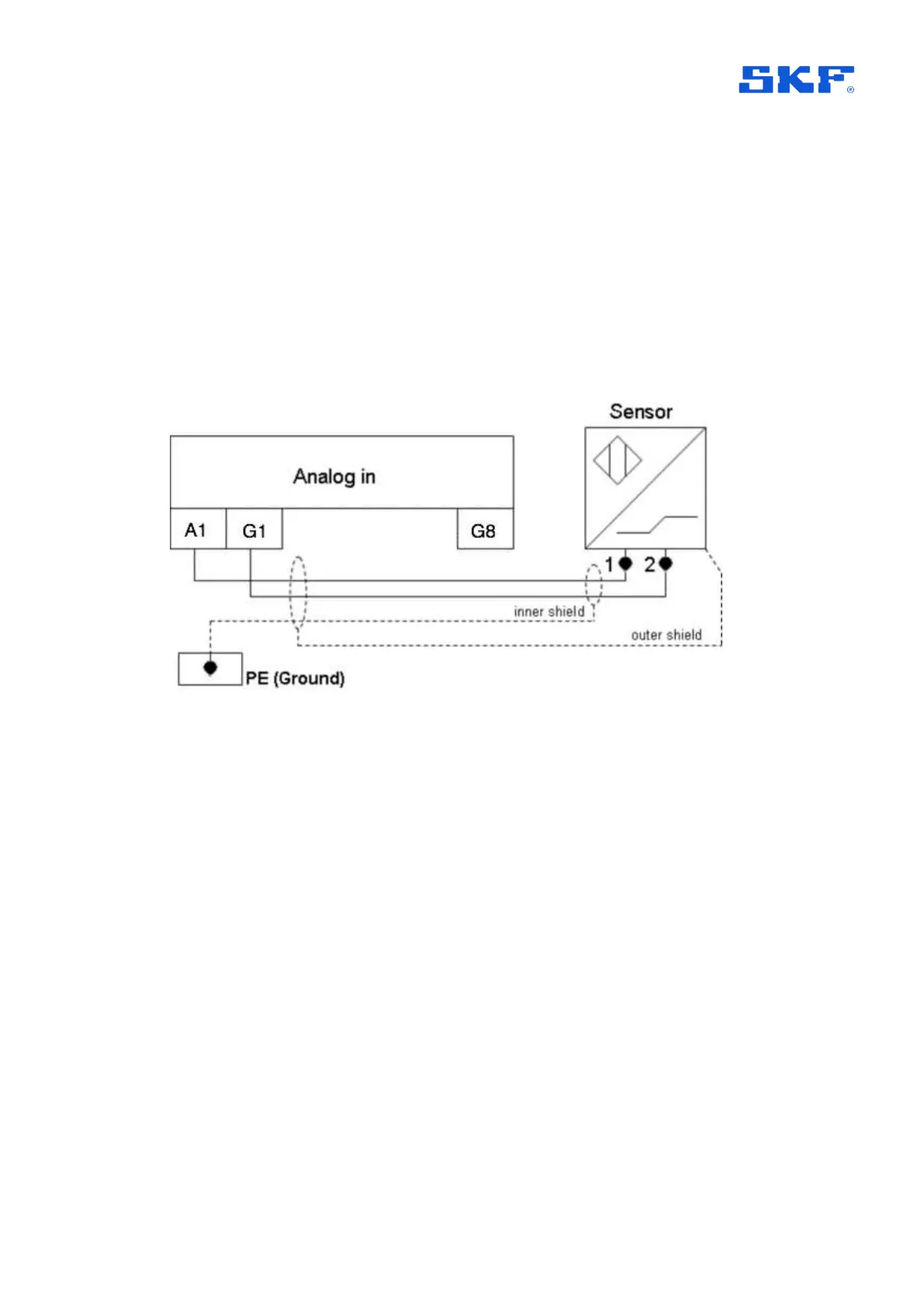
For example, Figure 10, if using analogue channel A1, connect sensor output 1
(signal) to input A1 and sensor output 2 (common/return) to input G1.
Figure 10 Example connection of an accelerometer to analogue input 1
Above, Figure 10, illustrates a typical example where the accelerometer has an inner
screen or shield (isolated from the sensor body – to be grounded at the IMx) and an
outer braid, armour or shield (connected to the sensor body and grounded at the
machine – to be left floating at the IMx).
2.5.8 Connecting voltage sources (A1 to A16)
For voltage sources (2-wire unpowered sensors or 3-wire accelerometers that are
externally powered) follow the guidance for accelerometers, in 2.5.7, to connect the
signal and common/return lines but in this case, configure the sensor power off.
2.5.9 Connecting 4–20 mA signals (A1 to A16)
To connect (2-wire) 4-20 mA signals, configure the sensor supply off: note the IMx
does not power the loop. To convert the current value to a voltage that the IMx-
16Plus can measure, a load resistor must be used on the input to each channel that
a 4-20 mA signal is connected to.


 To Next Page