MN.00273.E - 004 65
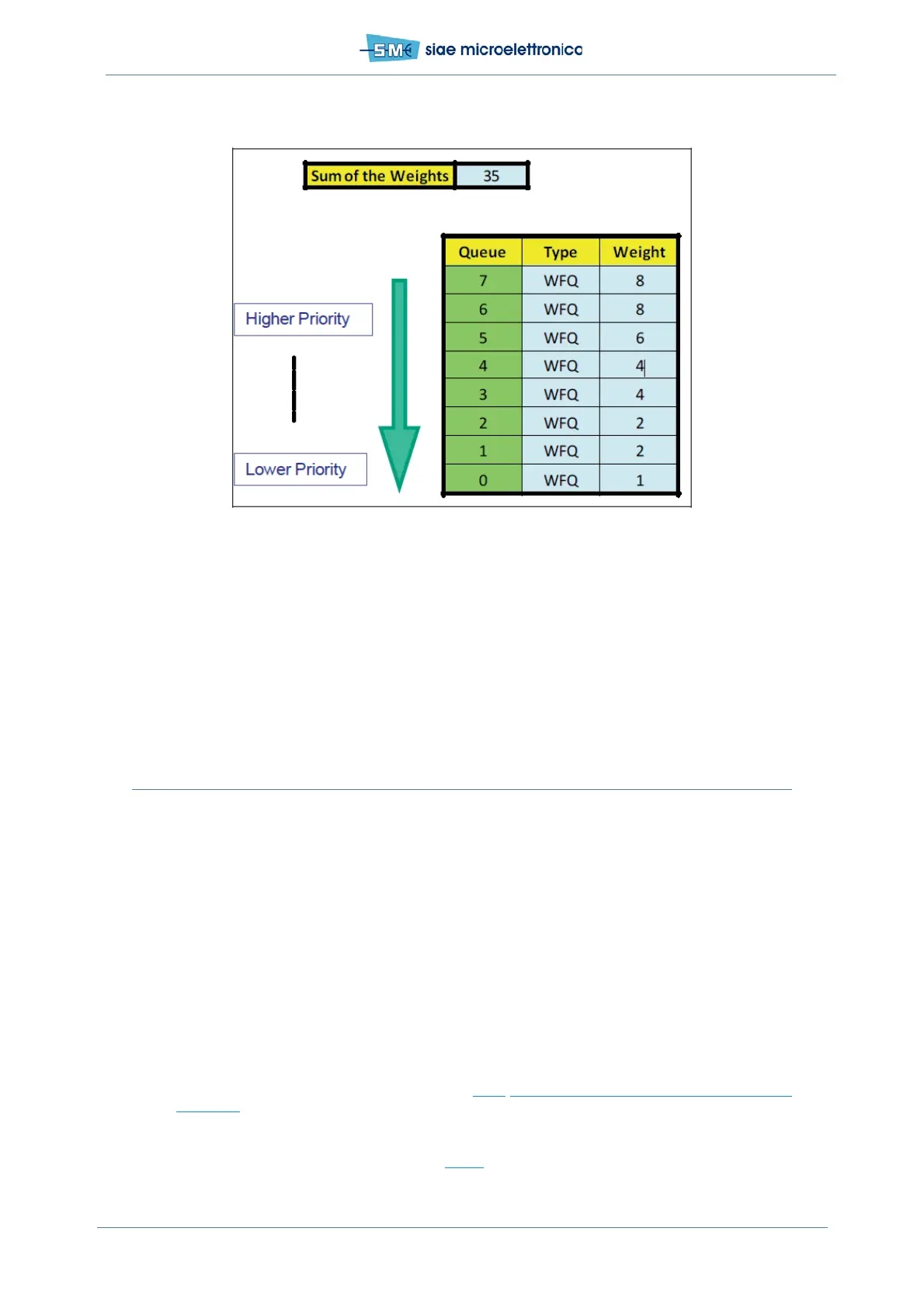
Fig.20 -
Means that the Serving Priority of the frames present in the queues will be:
• the packets present in the Queue 7 will be transmitted with a Race 8/35
• the packets present in the Queue 6 will be transmitted with a race 8/35
• ......
• the packets present in the Queue 0 will be transmitted with a rate 1/35.
7.4 CONGESTION AVOIDANCE
The Congestion Avoidance is a protocol that permits to discard some frames before congestion occurs.
When the queue is full there is a congestion situation, this means that the resources are not enough to
serve all the packets and there is not enough room in the queue for more storage. In this case some packet
must be dropped. The choice of the dropping policy has different effects on the network. In case of con-
gestion, the TCP/IP protocol reduces the transmitting windows and therefore the amount of traffic trans-
mitted. The TCP/IP protocol increases the transmitting window very slowly to allow the network to solve
the congestion issues.
This means that, when congestion occurs, some selective dropping has to be done.
There are different policies of dropping that can be adopted:
• Tail: in this case the last packets that come to the full queue are dropped (default configuration)
• Queue: in this case all the queue is emptied, i.e. all the packets present in the Queue are dropped
• Red: Random Early Discard: with this policy, before the Queue is full some incoming packets are
dropped randomly regardless if the frames are marked yellow or green (for more details on yellow
or green frames please refer to the paragraph 7.3.2
Ingress filtering policy (CIR/EIR according to
MEF 10.2))
• WRed: Weighted Random early Discard: with this policy, before the Queue is full some incoming
packets are dropped randomly. First are dropped the packets coloured in yellow and then are
dropped the packet coloured in green, see Fig.21
.



 To Next Page