16
GPP ELECTROFISHER
USER'S MANUAL
© 2011 Smith-Root, Inc. Vancouver, WA - USA • Rev. 10
Contents
Introduction ........................................................................ 1
Unpacking .......................................................................... 2
Choosing a Location .......................................................... 2
Attaching Battery Leads .................................................... 2
Fuel Shut-Off Valves .......................................................... 3
Power Supply Controls ...................................................... 3
Electrosher Controls ........................................................ 3
Electrosher Connections .................................................. 4
Operating Procedure .......................................................... 4
Typical Hookups ................................................................ 5
Maintenance ....................................................................... 6
Basic Troubleshooting ....................................................... 7
GPP Specications Spreadsheet ......................................... 8
GPP Parts Identication ..................................................... 9
Fan Installation Kit/Engine Anti-Vibration Mounting ..... 10
Generator Anti-Vibration Mounting ................................ 11
Electrosher Control Panel .............................................. 12
Electroshing Safety ...................................................... 14
Preventing Electrical Shock ............................................. 16
Planning For Safety .......................................................... 17
Do's & Don'ts .................................................................. 18
Introduction to Electroshing .......................................... 19
Types of Current .............................................................. 21
Electrode Design .............................................................. 22
Field Techniques .............................................................. 26
Electroshing Reference & Training Materials ............... 27
APPENDIX: ADVANCED TROUBLESHOOTING .. 28
Check Generator AC Voltages ................................. 29
Test for Continuity and High Voltage Output .......... 30
Check Connections, Brushes & Exciter ................... 31
Check Rotor Windings ............................................. 32
Check Stator Windings ............................................ 33
Test GPP Control Box .............................................. 34
Test GPP Control Box- Cont. .................................. 35
Flashing the Rotor .................................................... 36
Building a Test Load ................................................ 37
2.5-5.0 GPP Wiring Diag ......................................... 38
7.5 GPP Wiring Diag ............................................... 39
9.0 GPP Wiring Diag ............................................... 40
Items manufactured by companies other than Smith-Root carry the original manufactures warranty. Please contact
product manufacturer for return instructions.
All Smith-Root, Inc. manufactured products are covered by a one year warranty.
2011
BOAT SAFETY
1. Ground the generator to the boat hull.
2. Be sure that all the metal parts on the boat are bonded to
each other electrically.
3. Run all cables through electrical conduit, or use a
heavy-duty rubber-covered cord recommended for wet
locations.
4. Make all electrical connections in water-tight junction
boxes.
5. Each dip netter should have his own foot switch to
control the output. The switch should be wired in series
with the emergency off switch of the boat operator.
6. When wading with a boat, even in shallow water, chest
waders should be worn. An operator may trip, end up in
a kneeling or sitting position in the water and receive a
shock.
7. All crew members must be alert. Operators who control
the power switch must be constantly aware of the netters
in the electrical eld.
DO’S & DON’TS
Do’s:
1. Always be sure that all personnel are clear of the
electrodes before turning on the power.
2. Know how to administer rst aid treatment for electrical
shock.
3. Wear otation devices.
4. Have electrical circuits checked only by qualified
technicians.
5. Disconnect the power supply when the electrosher is
not in use.
Don’ts:
1. Don’t electrosh alone!
2. Don’t continue to electrosh if your boots or gloves get
wet inside.
3. Don’t operate an electrosher if you have had any prior
heart ailments.
4. Don’t operate generators without covers or screens.
5. Don’t operate generators without a spark arrester.
BACKPACK SAFETY
1. Before each operation, check that the frame emergency
release is in working order and check that the tilt switch
shuts off power if the unit is tipped more than 45°
2. Wear hip boots or chest-high waders, with non-skid
soles.
3. Wear polarized sunglasses to help you detect sub-surface
hazards and obstacles. Beware of turbid water that can
hide unseen sub-surface obstacles and sudden drop-offs.
4. Shut off your electrosher before entering or leaving a
stream.
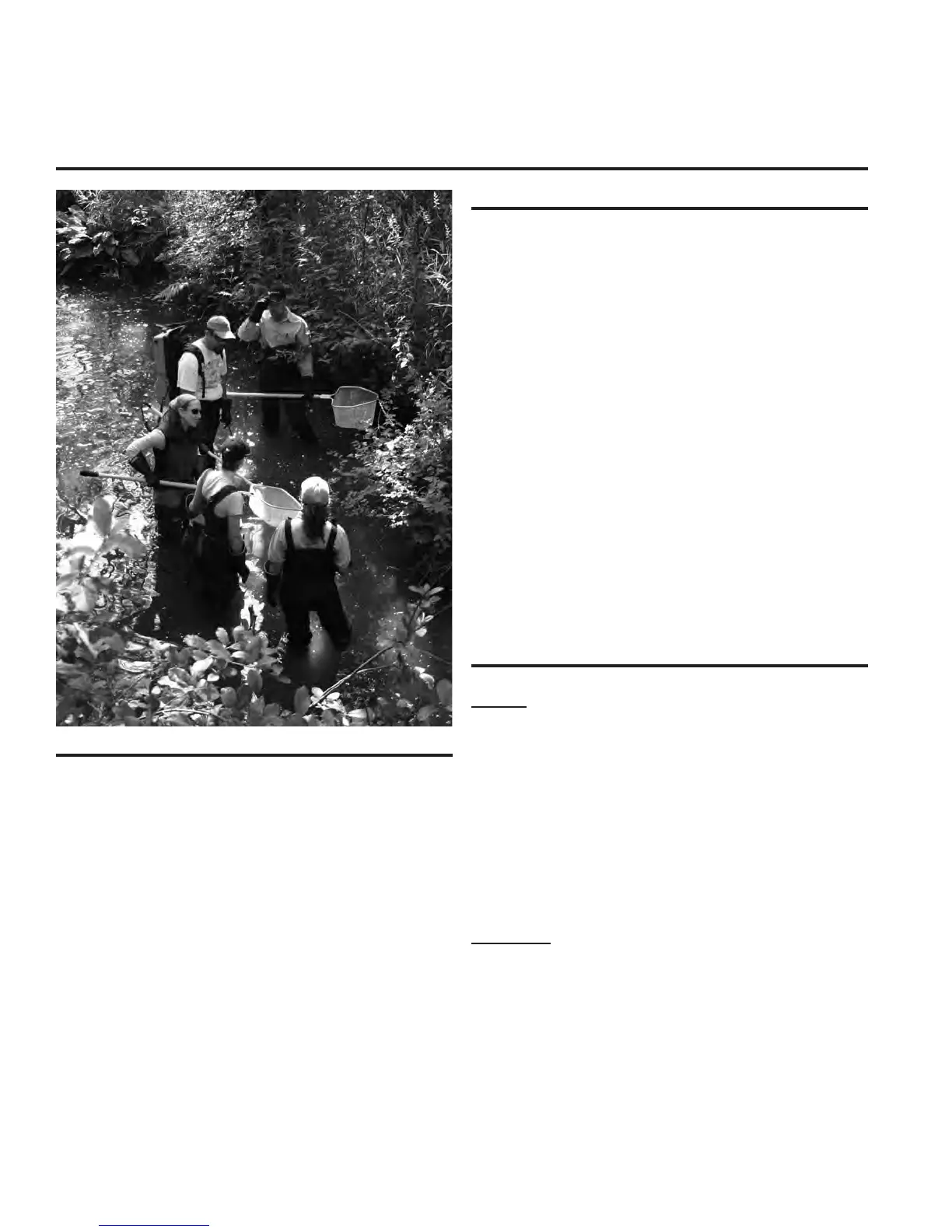
5. Do not operate an anode pole when carrying a backpack
unit weighing more than 20 pounds when in hazardous
conditions.
6. If you get water in boots, waders, or gloves, stop work
immediately and get dry clothing
7. Operate slowly and carefully. Footing in most streams
is poor, and most falls often occur when operators are
hurrying.
PLANNING FOR SAFETY


 To Next Page