17
USER’S MANUAL
www.smith-root.com
INTRODUCTION TO ELECTROFISHING
For many years it has been known that fish react to electric current passed through water.
Electricity was first used for fishing in 1863 when a British patent was granted. Major efforts
to apply electricity as a tool in fisheries management did not occur until after 1950. Since then
detailed studies have been made on the physiological effects of electricity on aquatic organisms.
RESPONSE OF FISH TO
ELECTRICITY
To collect fish by electrical means we must create an
electried zone of sufcient amplitude to stun sh. In the
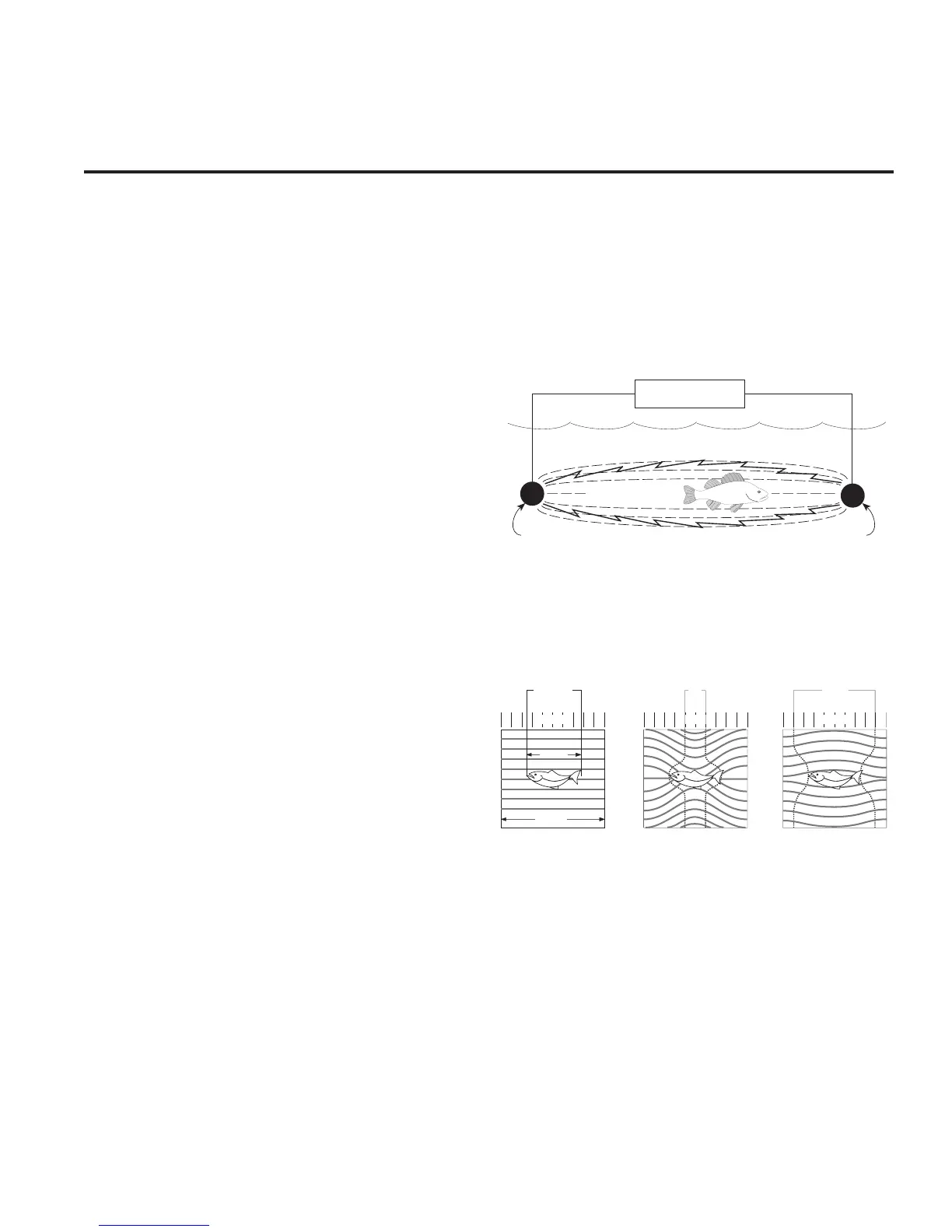
basic electroshing circuit, shown in Figure 1, a current
is passed between submerged electrodes. A sh between
these electrodes forms part of a closed circuit and some
current ows through its body.
The effectiveness of the electrosher is affected by nine
factors: voltage, electrode shape, water conductivity,
water temperature, conductivity of the stream bed, sh’s
distance, size, species, and time in the eld.
If these environmental factors are too far out of line, poor
electroshing will result. To some extent, the effects of
changes in water conductivity may be compensated for by
changing the output voltage.
WATER CONDUCTIVITY
The conductivity of the water and that of the sh’s esh
are the factors that affect electroshing most.
The conductivity of water depends on the quantity of
dissolved salts and minerals in the water. The conductivity
of potable waters in the United States ranges from 20 to
2,000 microSiemens/cm. Sufficient current at realistic
power levels will flow through water in this range to
electrosh successfully.
Figure 2 illustrates the field patterns caused by the
presence of a sh in water. In (a) no distortion is caused by
the presence of the sh. In low conductivity water, (b), the
distortion of the electric eld is such that the voltage near
the sh is less than it was before the sh was present. The
reverse is true in (c) where the water conductivity is more
than that of the sh. In this case the distortion is caused
by the current concentrating in the water surrounding the
sh. In both (b) and (c) not as much power is transferred
into the sh’s body as in (a).
012345678910
Volts
2V
012345678910
Volts
8V
b. Fish more conductive c. Water more conductive
100mm
012345678910
Volts
5.3V
a. Equal conductivities
53mm
Electrode
Water
Electrical Field
Voltage Source
Electrode
Figure 1. The basic electrofishing circuit.
Figure 2. Electric field patterns caused by fish.
INTRODUCTION TO ELECTROFISHING


 To Next Page