19
USER’S MANUAL
www.smith-root.com
TYPES OF CURRENT
ALTERNATING CURRENT
Alternating Current (AC) is an electrical current in which
the direction of current ow reverses a number of times per
second.
In an AC eld, the sh takes a position transverse to the
electrical field lines and attempts to face the anode and
cathode successively, in rhythm with the AC cycle. When
the eld strength increases, tetany occurs, and the sh is
stunned. Strong contractions of the body muscles make the
sh feel rigid.
At high voltages, the larger sh may be killed, the muscular
contractions being so severe that vertebrae are fractured
and the brain damaged. Hence AC electroshing is only
successful with small sh in low conductivity water .
DIRECT CURRENT
Direct Current (DC) is the term given to electrical current
that ows only in one direction. The current ows from
the negative electrode (cathode) to the positive electrode
(anode).
The reaction of sh to direct current is quite different from
their reaction to alternating current. The rst reaction of the
sh is to turn toward the anode and start to swim toward
it until it reaches an electrical eld strong enough to stun
it. Being stunned is called galvanonarcosis. The severe
muscle contractions caused by AC do not occur, and the
sh recover much faster. Mortality rate is much lower with
direct current.
PULSED DIRECT CURRENT
Even greater anode attraction is possible with pulsed direct
current. Pulsed direct current is made by interrupting
steady DC with an electronically controlled switch. The
switch gives several on-off pulses per second. The number
of pulses per second (pulse frequency) and the on time
(pulse width) have different effects on different species of
sh.
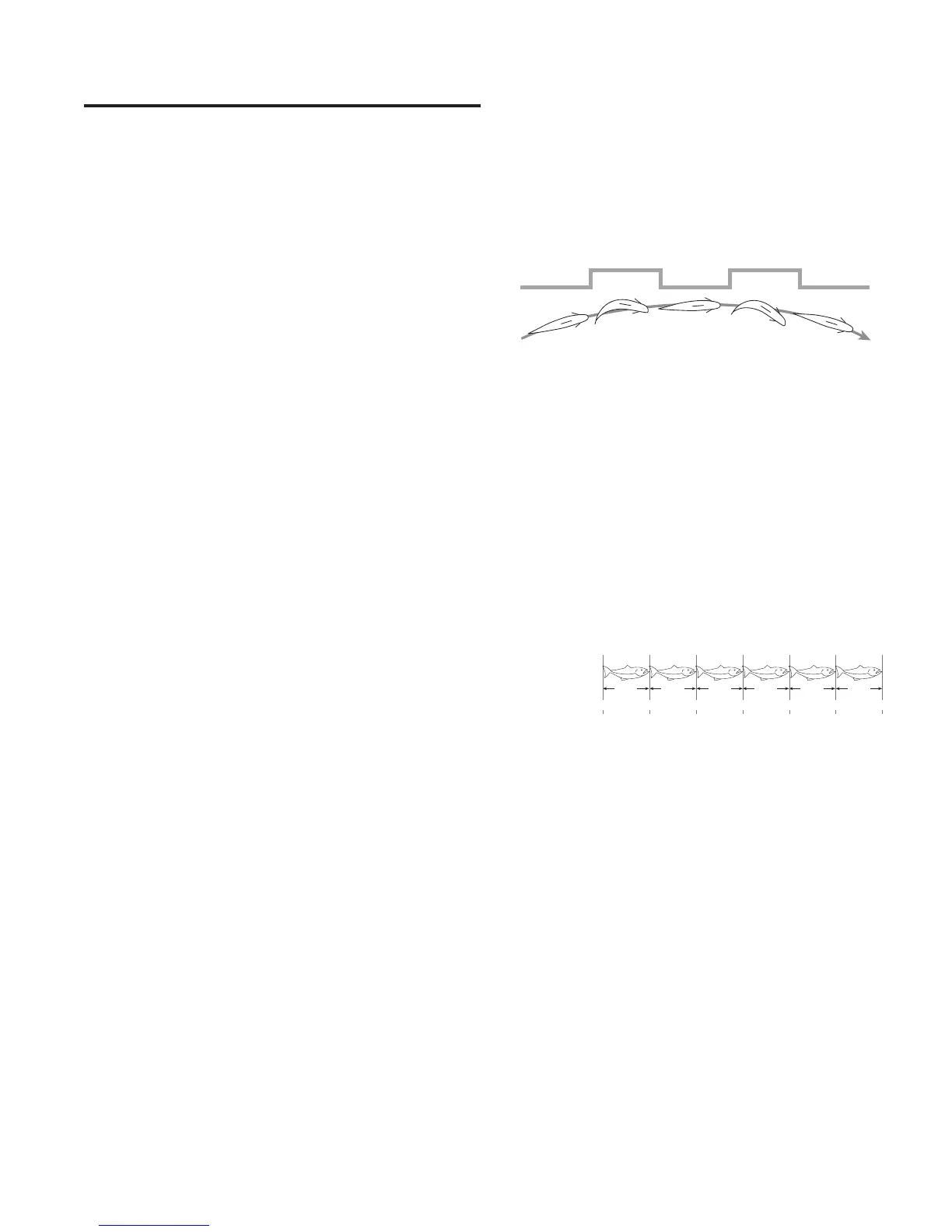
In a pulsed DC eld a sh’s body exes with each pulse,
and returns to normal between pulses. This flexing and
straightening accentuates the involuntary swimming
towards the anode, called galvanotaxis.
Smith-Root Programmable Output Waveforms give you
complete control over your electrofisher output. This
patented method of synthesizing waveforms makes it
possible to produce virtually any waveform, so you can
select the one that is safest for the sh. POW allows you
to create narrow pulses to achieve the same results as wide
pulses. Narrower pulses put less power into the water.
This has three benets: you have less chance of damage
to the sh, your battery or fuel lasts longer, and you can
work in very conductive water that overloads conventional
electroshers.
RESPONSE OF FISH TO DC FIELDS
An electric eld in water can be considered to have three
separate areas. The outer peripheral area is a weak eld
that the sh is indifferent to. The next area, closer to the
electrodes, has a stronger electrical eld, but not enough to
stun the sh. In this area, the involuntary swimming action
will occur and the sh will swim towards the anode. The
innermost area has the strongest electrical eld, and the
sh within it are immobilized.
ZONE OF POTENTIAL FISH INJURY
Fish close to the anode receive a very high head-
to-tail voltage. Most sh injuries occur within half
a meter from the anode. is is called the Zone of
potential sh injury. We can minimize the injury by
reducing the time the electricity is turned on .
DUTY-CYCLE
Duty-cycle is the percent of on-time. It is a product
of the pulse width and the pulse frequency. e
duty-cycle can be lowered in three ways: by reduc-
ing the pulse width, by reducing the pulse frequency,
or by using gated bursts, where the power is o for a
period between each burst of pulses. Fish close to an
anode with a low duty-cycle are far less likely to be
injured than with a high duty-cycle.
straight flexed straight flexed straight
+
0
off on off on off
Galvanotaxis: In pulsed DC a fish's body flexes with each pulse.
As the fish nears the anode it receives a very high
head-to-tail voltage.
0.00.20.40.60.81.01.2
50 28018 306.25 9.5
Field Intensity, V/cm
Distance from anode, m
Voltage across fish
120 400
704022
12.5
6.25
INTRODUCTION TO ELECTROFISHING


 To Next Page