Mx37y_Technical_Description_ENG_v2.00.doc
7
─ Single- and three-phase electronic meters with built-in DLC
modem, GSM/GPRS modem or RS485 comm. interface
(time stamp, status, register-value) approx. 33,000
records (60 minutes, ~ 1400 days) and in the second
-one approx. 190 (1 day, ~ 190 days) records can be
recorded. The saving period (a recording period) can
be set. Available values are 15, 30 and 60 minutes or
a daily value.
Data in a load-profile recorder are accompanied with
a time stamp and with the meter status in the last
saving period as well as with a check sum. The time
stamp indicates the end of a registration period.
Memory capacity of the load-profile recorder for 15-
minute registration period is around 190 days
(extended load-profile capacity).
1.4. Supplied energy or power limitation
The limitation or disconnection functionality can be
activated in the meter itself or by remote action.
The meter disconnects the network (via a switching
device) if a maximum energy limit was exceeded
during a predefined period of time. The energy level
and the allowed exceeding period are set in the
meter.
The meter disconnects the network if a maximum
power limit was exceeded during a predefined period
of time. The power level and the allowed exceeding
period are set in the meter.
The customer can (after correcting the exceeding
level) reconnect network manually (by pressing the
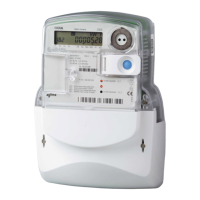
blue button on the meter for 2-5 sec.).
1.5. Code red
“Code Red” is the situation of possible power
shortage e.g. due to limitation cooling capacity of the
power generation during hot summers. For such
situations, in accordance with certain extent, the
function can be activated. A “code red” situation is
usually preceded by a “code orange”. A “code red”
situation typically lasts for a period of few days.
COSEM Objects
Code Red Group ID,
Code Red Start Date,
Code Red Duration,
Code Red Power Limit,
Code Red Active,
Code Red Remaining Duration,
Code Red Meter Group ID.
During “code red” situations the necessary total
power amount is limited by setting the maximum
consumption threshold of a large number of individual
customers (group) to a lower level. This level may be
different for individual meters according to the
consumer’s contract. Handling “code red” involves a
broadcast to all meters and only pre-programmed
meters (members of that particular group) shall
respond to this action.
Depending on the customer contract the reduction
can
vary from 0% to 100%. This Information is a part
of the configuration ID. The maximum contractual
reduction levels are presented in the Configuration
Identifier as Code Red ID.
A broadcast shall indicate the group ID, the date and
time of which the reduction becomes effective, and
the duration of the reduction.
1.6. Prepaid functionality
Prepaid functionality means that a meter only allows
consumption up to a remotely pre-set amount of
energy or credit paid in advance. At the moment
when no more credit is available, or an amount is
exceeded, the meter disconnects the customer from
the electric network.
A specified prepaid register counts at a rate equal to
the amount of consumed energy. The customer can
revalue the prepayment meter remotely (tokenless).
The prepaid register is tariff based. If the total amount
of prepaid cost for energy is consumed, the meter will
limit the level (as a warning) for a certain amount of
energy before totally disconnecting. If the prepaid
amount limit is reached, the customer will be
informed by an acoustic signal.
E-meter can operate in Credit or Prepayment Mode
depending on the Energy Mode. In Prepayment Mode
Available Credit can be revalued with Transaction.
Prepayment accounting
The implementation of prepayment accounting
functions can be separated into credit and charge
functions. The credit functions include:
• token credit function,
• emergency credit function.
Two types of charge functions are implemented:
• consumption-based tariff charges,
• time-based auxiliary charges.
Token credit:
Token Credit function deals with managing credit
registers according to credit token transfer. When
credit transfer is accepted, the values of “Available
Credit Register” and “Total Purchase Register” are
increased for the amount credit transferred.
Emergency credit:
Emergency credit function is used in situations when
“Available Credit Register Value” approaches or goes
under zero. For this purpose, three parameter objects
are implemented:
- “Emergency Credit Initial Limit” is used once after
meter installation for the purpose of enabling the
customer to make the first buy (or transferring the first
credit from the management centre). It defines the
credit value which is available when emergency credit
is first selected by the customer.



 To Next Page