43Connection
Echochange - Manual / Connection
43
and Modbus over TCP. If you intend to transmit raw data without a PLC protocol, select the Send /
Receive protocol.
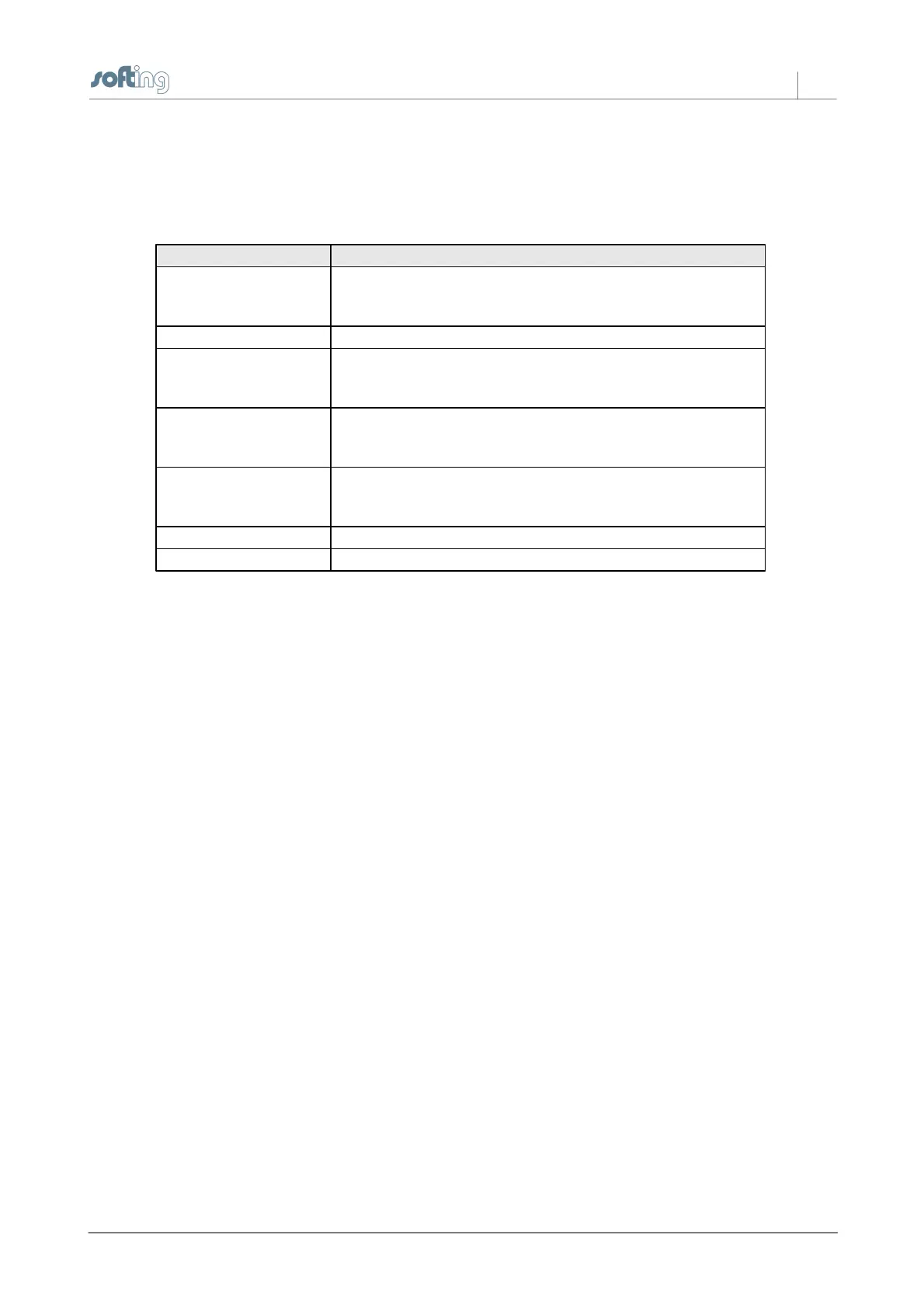
Application Protocol
Here, you can select the application protocol.
Send/Receive
(only Expert mode)
Used for the communication with other PLCs or devices that do
not support any of the protocols listed below. Only payload data
(raw data) will be transmitted, but no protocol information.
Communication with Siemens S5 CPs or echo devices.
S7 protocol used to connect to Siemens S7-400, S7-300 or S7-
200 PLCs
or echo devices.
Communication with PLCs or devices supporting the Modbus
TCP protocol, such as Wago, Beckhoff, Groupe Schneider,
Modicon ...
Rockwell
CompactLogiX /
ControlLogiX
Communication with Allen-Bradley ControlLogiX, CompactLogiX,
SoftLogiX
Communication with Allen-Bradley PLC-5 and SLC
Communication with Mitsubishi Melsec-Q
8.1.2 echochange Connection Network
The editing window for echochange connections has a left and a right panel. Due to the 4 possible
assignments of TCP/IP and H1, there are 4 different variants of this window. On the left and right,
enter the TCP/IP or H1 parameters.
Editing a Connection – General Settings for All Connections
Name of the Connection
This field displays the connection name which can be changed here.
Connection is Active
Shows whether the connection is active or not. If not, you cannot register items and there will be no
connection to the PLC. This feature allows you to disable a connection temporarily without deleting it
so that you can re-enable it later without having to enter all parameters again.
Forward clock over TCP/IP
The purpose of this function is to forward clock master frames from an H1 network to a second H1
network. This requires that the two networks are linked by 2 echochange devices via TCP/IP.
If this setting is used, you should enable it on both sides.
When the first echochange device receives a clock master frame, its internal clock will be
synchronized.
The device then sends a clock frame to the second echochange device using the TCP/IP protocol,
UDP port 994.
The second echochange device receives the frame, synchronizes its internal clock and sends the
corresponding clock master frame on the H1 side in order to synchronize the connected PLCs.
Number of the Adapter
Here, you can select network adapter 1 or 2. The selected adapter will be used for this connection.
Slave
Enable the Slave button for the side of the echochange connection that was parameterized as active.
In the slave mode, a connection to the communication partner will only be established if a connection
is already up on the master side (passive side). With the Slave option disabled, the side that was


 To Next Page