52
Connection
52
Echochange - Manual / Connection
TSAPs have a minimum length of 2 bytes and a maximum length of 8 bytes
TSAPs can be entered as hex or ASCII characters.
The TSAPs for S7 connections have a special meaning. See TSAP for S7 Connections.
Rules for entering TSAPs for S5 connections
TSAPs have a minimum length of 2 bytes and a maximum length of 8 bytes for TCP/IP, and 16
bytes for H1.
TSAPs can be entered as hex or ASCII characters.
The TSAPs for S5 connections do not have a special meaning. They are selected arbitrarily.
8.2.3.5 TSAP for S7 Connections
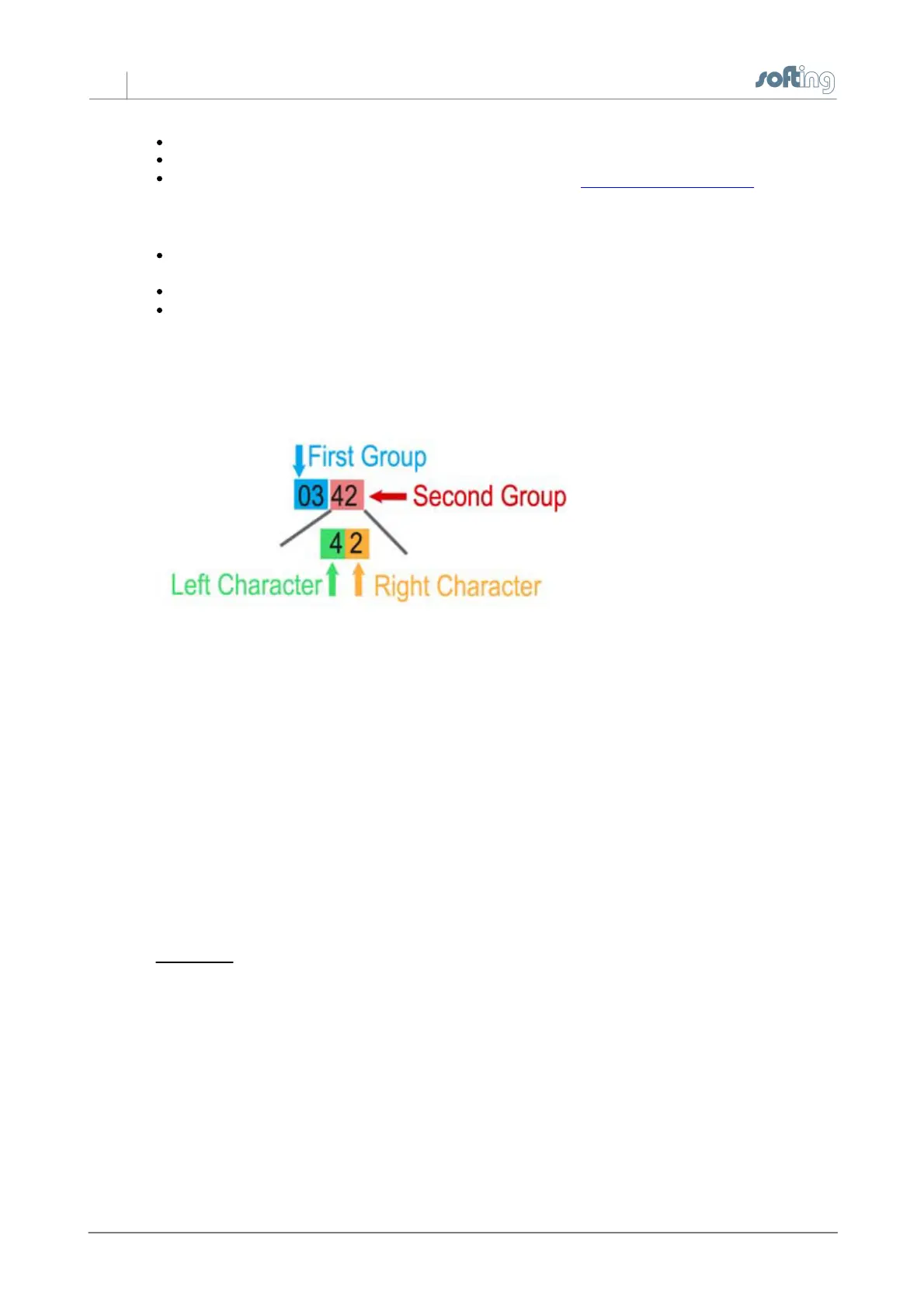
For non-parameterizable connections (= default connections), so-called standard TSAPs are used.
For these, the following rules apply:
First group
contains device IDs for which resources are provided in the S7:
01: PG or PC
02: OS (operating or monitoring device)
03: Others, such as OPC server, Simatic S7 PLC...
Second group
contains the addresses of these components
Left character (bits 7....4):
Rack number multiplied by 2
Right character (bits 3...0):
CPU slot (< 16). S7-300 always uses slot 2
The standard TSAPs MUST be used on the PLC side (Dest TSAP field of the echo
device).
The local TSAP of the echo device (Own TSAP field) may be selected freely, but should
have the same format. We recommend to use 01 01 in the Own TSAP field.
Examples:
03 02 Communication with the S7 CPU in rack 0, slot 2
03 43 Communication with the S7 CPU in rack 2, slot 3
03 2E Communication with the S7 CPU in rack 1, slot 14
NOTE:
To enter the binary standard TSAPs, use the HEX field (left field).
S7-200
The S7-200 is usually addressed with the TSAP 10 00 (binary). The own TSAP is set to 10 00 by
default.
S7-300, S7-400


 To Next Page