08
MIG 250GS Operating manual
Unlike MIG, which uses a solid consumable filler wire, the
consumable used in FCAW is of tubular construction, an outer metal
sheath being filled with fluxing agents plus metal powder. The flux
fill is also used to provide alloying, arc stability, slag cover, de-
oxidation, and, with some wires, gas shielding.
In terms of gas shielding, there are two different ways in which this
may be achieved with the FCAW process.
• Additional gas-shielding supplied from an external source, such
as a gas cylinder
• Production of a shielding gas by decomposition of fluxing agents
within the wire, self-shielding
Gas shielded wires are available with either a basic or rutile flux fill,
while self-shielded wires have a broadly basic-type flux fill. The flux
fill dictates the way the wire performs, the properties obtainable,
and suitable applications.
Gas-shielded Operation
Many cored wire consumables require an auxiliary gas shield in the
same way that solid wire MIG consumables do. These types of wire
are generally referred to as ‘gas-shielded’.
Using an auxiliary gas shield enables the wire designer to
concentrate on the performance characteristics, process tolerance,
positional capabilities, and mechanical properties of the products.
In a flux cored wire the metal sheath is generally thinner than that
of a self-shielded wire. The area of this metal sheath surrounding
the flux cored wire is much smaller than that of a solid MIG wire.
This means that the electrical resistance within the flux cored wire
is higher than with solid MIG wires and it is this higher electrical
resistance that gives this type of wire some of its novel operating
properties.
One often quoted property of fluxed cored wires are their higher
deposition rates than solid MIG wires. What is often not explained
is how they deliver these higher values and whether these can be
utilised. For example, if a solid MIG wire is used at 250 amps, then
exchanged for a flux cored wire of the same diameter, and welding
power source controls are left unchanged, then the current reading
would be much less than 250 amps, perhaps as low as 220 amps.
This is because of Ohms Law that states that as the electrical
resistance increases if the voltage remains stable then the current
must fall.
To bring the welding current back to 250 amps it is necessary to
increase the wire feed speed, effectively increasing the amount of
wire being pushed into the weld pool to make the weld. It is this
affect that produces the ‘higher deposition rates’ that the flux cored
wire manufacturers claim for this type of product. Unfortunately in
many instances the welder has difficulty in utilising this higher wire
feed speed and must either increase the welding speed or increase
the size of the weld. Often in manual applications neither of these
changes can be implemented and the welder simply reduces the
wire feed speed back to where it was and the advantages are
lost. However, if the process is automated in some way then the
process can show improvements in productivity.
It is also common to use longer contact tip to workpiece distances
with flux cored arc welding than with solid wire MIG welding and
this also has the effect of increasing the resistive heating on the
wire further accentuating the drop in welding current. Research has
also shown that increasing this distance can lead to an increase in
the ingress of nitrogen and hydrogen into the weld pool, which can
affect the quality of the weld.
Flux cored arc welding has a lower efficiency than solid wire MIG
welding because part of the wire fill contains slag forming agents.
Although the efficiency differs by wire type and manufacturer it is
typically between 75–85%.
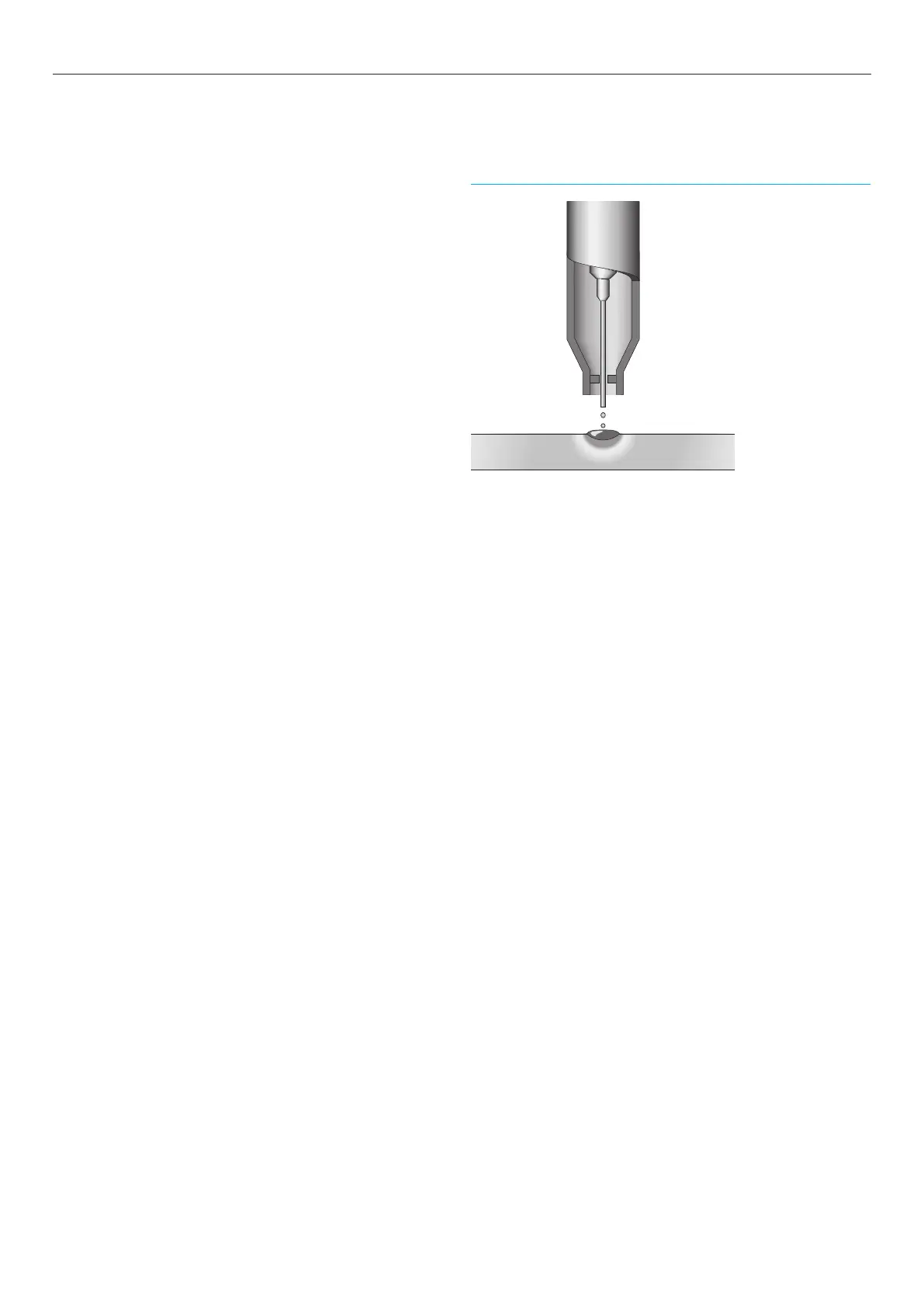
Extended self shielded flux cored wire nozzle


 To Next Page