EasyManua.ls Logo

Sony SDP-E800 - Additional Information: Specifications and Glossary; Specifications; Glossary: Center Mode; Glossary: Digital Cinema Sound

Sony SDP-E800
44 pages
Print Icon
To Next Page IconTo Next Page
To Previous Page IconTo Previous Page
Loading...
Additional
Information
Specifications
Glossary
Digital
inputs
Optical:
3
Coaxial:
1
AC-3
RF:
1
Digital
outputs
Optical:
1
Analog
outputs
FRONT
(L
R),
REAR
(L
R),
CENTER,
WOOFER:
Output
level:
IV
Output
impedance:
1
kilohms
BASS
BOOST
+5
dB
at
60
Hz
Video
inputs
3
(ANALOG
VIDEO
IN,
DIGITAL
1
VIDEO
IN,
DIGITAL
2
VIDEO
IN)
Video
output
1
(MONITOR
OUT)
Center
mode
A
setting
used
by
the
Dolby
Pro
Logic
Surround
mode
to
determine
the
kind
of
signal
processing
required
to
produce
the
surround
effect
with
the
speakers
you
have
connected.
The
center
mode
is
determined
automatically
according
to
the
setting
of
the
speaker
size
parameters
in
the
SP.
SETUP
menu.
This
processor's
Dolby
Digital
(AC-3)
circuitry
provides
a
more
versatile
range
of
speaker
settings
than
the
standard
Dolby
Pro
Logic
center
mode
setting.
For
your
reference,
the
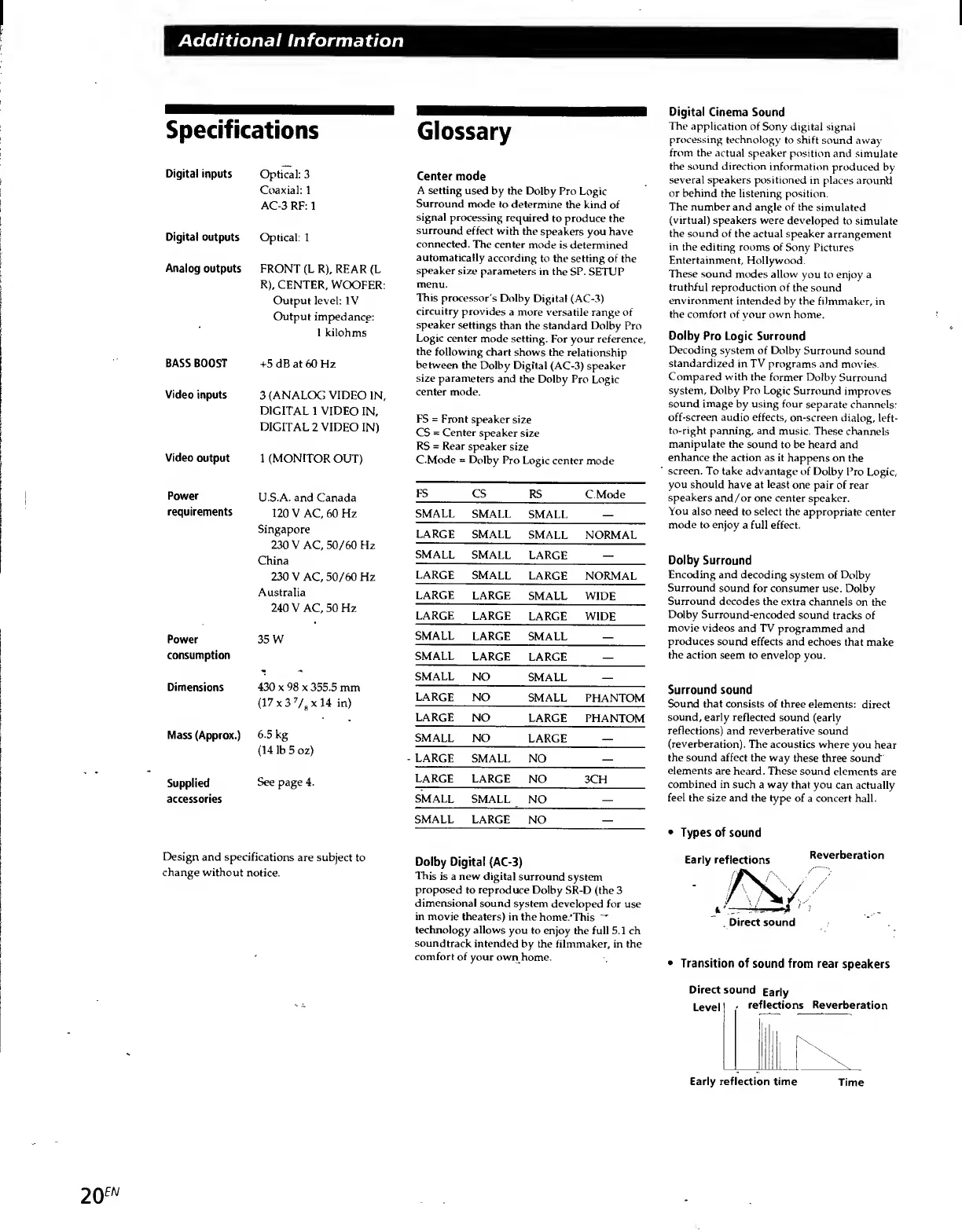
following
chart
shows
the
relationship
between
the
Dolby
Digital
(AC-3)
speaker
size
parameters
and
the
Dolby
Pro
Logic
center
mode.
FS
=
Front
speaker
size
CS
=
Center
speaker
size
RS
=
Rear
speaker
size
C.Mode
=
Dolby
Pro
Logic
center
mode
Power
U.S.A.
and
Canada
requirements
120
V
AC,
60
Hz
Singapore
230
VAC,
50/60
Hz
China
230
V
AC,
50/60
Hz
Australia
240
V
AC,
50
Hz
Power
35
W
consumption
Dimensions
430
x
98
x
355.5
mm
(17x3
7
/,x
14
in)
Mass
(Approx.)
6.5
kg
(14
lb
5
oz)
Supplied
accessories
See
page
4.
FS
CS
RS
C.Mode
SMALL
SMALL
SMALL
LARGE
SMALL
SMALL
NORMAL
SMALL
SMALL
LARGE
LARGE
SMALL
LARGE
NORMAL
LARGE
LARGE
SMALL
WIDE
LARGE
LARGE
LARGE
WIDE
SMALL
LARGE
SMALL
SMALL
LARGE
LARGE
SMALL
NO
SMALL
LARGE
NO
SMALL
PHANTOM
LARGE
NO
LARGE
PHANTOM
SMALL
NO
LARGE
LARGE
SMALL
NO
LARGE
LARGE
NO
3CH
SMALL
SMALL
NO
SMALL
LARGE
NO
Design
and
specifications
are
subject
to
change
without
notice.
Dolby
Digital
(AC-3)
This
is
a
new
digital
surround
system
proposed
to
reproduce
Dolby
SR-D
(the
3
dimensional
sound
system
developed
for
use
in
movie
theaters)
in
the
home.
3
This
technology
allows
you
to
enjoy
the
full
5.1
ch
soundtrack
intended
by
the
filmmaker,
in
the
comfort
of
your
own
home.
Digital
Cinema
Sound
The
application
of
Sony
digital
signal
processing
technology
to
shift
sound
away
from
the
actual
speaker
position
and
simulate
the
sound
direction
information
produced
by
several
speakers
positioned
in
places
arounti
or
behind
the
listening
position.
The
number
and
angle
of
the
simulated
(virtual)
speakers
were
developed
to
simulate
the
sound
of
the
actual
speaker
arrangement
in
the
editing
rooms
of
Sony
Pictures
Entertainment,
Hollywood.
These
sound
modes
allow
you
to
enjoy
a
truthful
reproduction
of
the
sound
environment
intended
by
the
filmmaker,
in
the
comfort
of
your
own
home.
Dolby
Pro
Logic
Surround
Decoding
system
of
Dolby
Surround
sound
standardized
in
TV
programs
and
movies.
Compared
with
the
former
Dolby
Surround
system,
Dolby
Pro
Logic
Surround
improves
sound
image
by
using
four
separate
channels:
off-screen
audio
effects,
on-screen
dialog,
left-
to-right
panning,
and
music.
These
channels
manipulate
the
sound
to
be
heard
and
enhance
the
action
as
it
happens
on
the
screen.
To
take
advantage
of
Dolby
Pro
Logic,
you
should
have
at
least
one
pair
of
rear
speakers
and/or
one
center
speaker.
You
also
need
to
select
the
appropriate
center
mode
to
enjoy
a
full
effect.
Dolby
Surround
Encoding
and
decoding
system
of
Dolby
Surround
sound
for
consumer
use.
Dolby
Surround
decodes
the
extra
channels
on
the
Dolby
Surround-encoded
sound
tracks
of
movie
videos
and
TV
programmed
and
produces
sound
effects
and
echoes
that
make
the
action
seem
to
envelop
you.
Surround
sound
Sound
that
consists
of
three
elements:
direct
sound,
early
reflected
sound
(early
reflections)
and
reverberative
sound
(reverberation).
The
acoustics
where
you
hear
the
sound
affect
the
way
these
three
sound'
elements
are
heard.
These
sound
elements
are
combined
in
such
a
way
that
you
can
actually
feel
the
size
and
the
type
of
a
concert
hall.
Types
of
sound
Early
reflections
Reverberation
Direct
sound
Transition
of
sound
from
rear
speakers
Direct
sound
Early
Level
I
reflections
Reverberation
Early
reflection
time
Time

Related product manuals