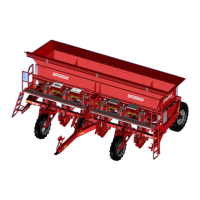
Par ts Ma nual 6740 Har vest er
Part #: 290360
Revision: 5/24/2022
3
Section-1 Safety
1.8. Connecting a Tractor to the Machine
1. When backing the tractor or towing vehicle up to the
Hitch on the machine, make sure no personnel are
between the tractor and equipment where they could
be crushed.
2. Lock the tractor or towing vehicle in position before
allowing personnel to insert the draw pin. Use the
parking brake or chocks to prevent vehicle movement.
3. Never allow persons to stand between the tractor and
the machine unless the tractor is secured against
rolling. Immobilize the tractor using the parking brake
and/or wheel chocks.
4. Attach the machine according to the instructions in the
tractor Owner/Operator and Spudnik equipment
Owner/Operator manuals.
5. Use only specified connecting components, rated to
withstand the draw weight and forces experienced
while operating the machine.
6. Never exceed the permissible nose weight of the
machine coupling.
7. Never exceed the permissible axle load and total
weight of the tractor. (See the tractor Owner/Operator
manual for the specifications.)
8. Use proper safety practices when operating the
support foot/Jack. The support foot/Jack presents a
serious risk of injury through crushing and/or shearing.
1.9. Connecting Machine PTO
1. Follow the operating instruction of the PTO shaft
manufacturer. An operator’s manual is supplied with
every PTO shaft installed on Spudnik equipment.
2. Only use the PTO shafts specified by the
manufacturer.
3. The PTO shaft housing and guard cone, as well as
PTO shaft guard, must be fitted and in safe operational
condition.
1.9. Connecting Machine PTO (Cont.)
4. For PTO shafts, make sure the tube overlaps by the
manufacturer specified amount, in both transport and
working positions.
5. Only attach and remove the PTO shaft when it is
disengaged, with the engine switched off and the
ignition key removed.
6. When using PTO shafts with overload or freewheel
couplings which are not covered by the guard on the
towing vehicle, fit the overload or freewheel coupling
on the machine side.
7. When connecting the machine PTO driveline to the
PTO spline on the tractor, always make sure the PTO
is correctly mounted and locked securely to prevent
unintended separation.
8. Attach the PTO shaft guard chain to prevent the shaft
guard from turning.
9. Before engaging the PTO shaft, ensure the selected
speed and direction of rotation of the tractor’s PTO
shaft agree with the permissible speed and direction of
rotation of the machine.
10. Before engaging the PTO shaft, make sure that no
persons are within the danger areas of the machine.
1.11. Operating Safety Practices
1. Unless specifically designed to carry the load while
moving, always empty machinery of product before
moving or transporting. This reduces weight, making
the machine easier to move, and lessening the chance
of damage to the equipment.
2. Use caution when setting up or operating the
machinery on uneven terrain, hillsides, or near ditches
to avoid the potential of overturning the equipment.
1.7. Risks of Ignoring Accident Prevention
1. Endangerment of the operator and/or other nearby
persons as a result of safety shields/devices not being
fitted or in their correct protective position.
2. Damage to important machine functions.
3. Errors when carrying out maintenance or repair work.
4. Endangerment of the operator and/or other nearby
persons through chemical exposure.
5. Endangerment of the operator and/or other nearby
persons through exposure to high speed projectiles.
6. Environmental pollution due to leaks in the hydraulic
system and gearboxes.
1.10. Connecting Machine Hydraulics
1. The hydraulic system operates under high pressure.
2. Depressurize the hydraulic system, on both the tractor
and machine, before making or breaking connections.
3. Connect the hydraulic lines to the tractor as specified
in the Owner/Operator manual. Ensure the tractor can
provide the required flow rate and pressure to operate
the implement.
4. Keep hydraulic lines clear of moving parts which could
damage the hoses.
Hydraulic oil escaping under high pressure can
penetrate the skin and cause serious injuries. If such
an injury occurs, immediately call a doctor who is
familiar with treating this type of injection injury. The
risk of infection from such injuries is high.
WARNING!


 To Next Page